David P. McMeekin, Philippe Holzhey, Sebastian O. Fürer, Steven P. Harvey, Laura T. Schelhas, James M. Ball, Suhas Mahesh, Seongrok Seo, Nicholas Hawkins, Jianfeng Lu, Michael B. Johnston, Joseph J. Berry, Udo Bach, Henry J. Snaith
{"title":"Intermediate-phase engineering via dimethylammonium cation additive for stable perovskite solar cells","authors":"David P. McMeekin, Philippe Holzhey, Sebastian O. Fürer, Steven P. Harvey, Laura T. Schelhas, James M. Ball, Suhas Mahesh, Seongrok Seo, Nicholas Hawkins, Jianfeng Lu, Michael B. Johnston, Joseph J. Berry, Udo Bach, Henry J. Snaith","doi":"10.1038/s41563-022-01399-8","DOIUrl":null,"url":null,"abstract":"Achieving the long-term stability of perovskite solar cells is arguably the most important challenge required to enable widespread commercialization. Understanding the perovskite crystallization process and its direct impact on device stability is critical to achieving this goal. The commonly employed dimethyl-formamide/dimethyl-sulfoxide solvent preparation method results in a poor crystal quality and microstructure of the polycrystalline perovskite films. In this work, we introduce a high-temperature dimethyl-sulfoxide-free processing method that utilizes dimethylammonium chloride as an additive to control the perovskite intermediate precursor phases. By controlling the crystallization sequence, we tune the grain size, texturing, orientation (corner-up versus face-up) and crystallinity of the formamidinium (FA)/caesium (FA)yCs1–yPb(IxBr1–x)3 perovskite system. A population of encapsulated devices showed improved operational stability, with a median T80 lifetime (the time over which the device power conversion efficiency decreases to 80% of its initial value) for the steady-state power conversion efficiency of 1,190 hours, and a champion device showed a T80 of 1,410 hours, under simulated sunlight at 65 °C in air, under open-circuit conditions. This work highlights the importance of material quality in achieving the long-term operational stability of perovskite optoelectronic devices. The stability of halide perovskite solar cells, determined by film morphology, is paramount to their commercialization. Here, the authors introduce a high-temperature DMSO-free method that enables better control of the grain size, texturing, orientation and crystallinity to achieve improved device operational stability.","PeriodicalId":19058,"journal":{"name":"Nature Materials","volume":"22 1","pages":"73-83"},"PeriodicalIF":38.5000,"publicationDate":"2022-12-01","publicationTypes":"Journal Article","fieldsOfStudy":null,"isOpenAccess":false,"openAccessPdf":"","citationCount":"26","resultStr":null,"platform":"Semanticscholar","paperid":null,"PeriodicalName":"Nature Materials","FirstCategoryId":"88","ListUrlMain":"https://www.nature.com/articles/s41563-022-01399-8","RegionNum":1,"RegionCategory":"材料科学","ArticlePicture":[],"TitleCN":null,"AbstractTextCN":null,"PMCID":null,"EPubDate":"","PubModel":"","JCR":"Q1","JCRName":"CHEMISTRY, PHYSICAL","Score":null,"Total":0}
引用次数: 26
Abstract
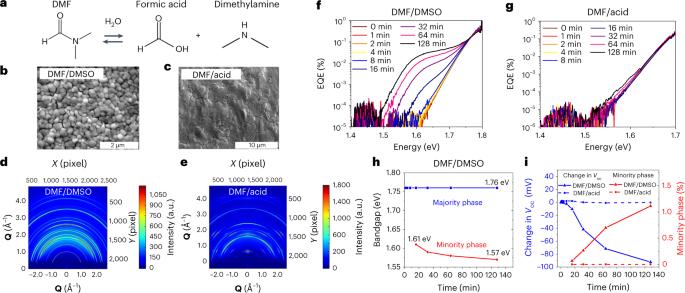
Achieving the long-term stability of perovskite solar cells is arguably the most important challenge required to enable widespread commercialization. Understanding the perovskite crystallization process and its direct impact on device stability is critical to achieving this goal. The commonly employed dimethyl-formamide/dimethyl-sulfoxide solvent preparation method results in a poor crystal quality and microstructure of the polycrystalline perovskite films. In this work, we introduce a high-temperature dimethyl-sulfoxide-free processing method that utilizes dimethylammonium chloride as an additive to control the perovskite intermediate precursor phases. By controlling the crystallization sequence, we tune the grain size, texturing, orientation (corner-up versus face-up) and crystallinity of the formamidinium (FA)/caesium (FA)yCs1–yPb(IxBr1–x)3 perovskite system. A population of encapsulated devices showed improved operational stability, with a median T80 lifetime (the time over which the device power conversion efficiency decreases to 80% of its initial value) for the steady-state power conversion efficiency of 1,190 hours, and a champion device showed a T80 of 1,410 hours, under simulated sunlight at 65 °C in air, under open-circuit conditions. This work highlights the importance of material quality in achieving the long-term operational stability of perovskite optoelectronic devices. The stability of halide perovskite solar cells, determined by film morphology, is paramount to their commercialization. Here, the authors introduce a high-temperature DMSO-free method that enables better control of the grain size, texturing, orientation and crystallinity to achieve improved device operational stability.
期刊介绍:
Nature Materials is a monthly multi-disciplinary journal aimed at bringing together cutting-edge research across the entire spectrum of materials science and engineering. It covers all applied and fundamental aspects of the synthesis/processing, structure/composition, properties, and performance of materials. The journal recognizes that materials research has an increasing impact on classical disciplines such as physics, chemistry, and biology.
Additionally, Nature Materials provides a forum for the development of a common identity among materials scientists and encourages interdisciplinary collaboration. It takes an integrated and balanced approach to all areas of materials research, fostering the exchange of ideas between scientists involved in different disciplines.
Nature Materials is an invaluable resource for scientists in academia and industry who are active in discovering and developing materials and materials-related concepts. It offers engaging and informative papers of exceptional significance and quality, with the aim of influencing the development of society in the future.



 京公网安备 11010802042870号
京ICP备2023020795号-1
京公网安备 11010802042870号
京ICP备2023020795号-1

 分享
分享
 求助内容:
求助内容: 应助结果提醒方式:
 扫码关注我们
