Mira Behnke , Paul Klemm , Philipp Dahlke , Blerina Shkodra , Baerbel Beringer-Siemers , Justyna Anna Czaplewska , Steffi Stumpf , Paul M. Jordan , Stephanie Schubert , Stephanie Hoeppener , Antje Vollrath , Oliver Werz , Ulrich S. Schubert
{"title":"Ethoxy acetalated dextran nanoparticles for drug delivery: A comparative study of formulation methods","authors":"Mira Behnke , Paul Klemm , Philipp Dahlke , Blerina Shkodra , Baerbel Beringer-Siemers , Justyna Anna Czaplewska , Steffi Stumpf , Paul M. Jordan , Stephanie Schubert , Stephanie Hoeppener , Antje Vollrath , Oliver Werz , Ulrich S. Schubert","doi":"10.1016/j.ijpx.2023.100173","DOIUrl":null,"url":null,"abstract":"<div><p>Dextran-based polymers, such as ethoxy acetalated dextran (Ace-DEX), are increasingly becoming the focus of research as they offer great potential for the development of polymer-based nanoparticles as drug delivery vehicles. Their major advantages are the facile synthesis, straightforward particle preparation and the pH-dependent degradation of the particles that can be fine-tuned by the degree of acetalation of the polymer. In this study we have shown that Ace-DEX can not only compete against the commonly used and FDA-approved polymer poly(lactic-<em>co</em>-glycolic acid) (PLGA), but even has the potential to outperform it in its encapsulation properties, <em>e.g.</em>, for the herein used anti-inflammatory leukotriene biosynthesis inhibitor BRP-187. We used three different methods (microfluidics, batch nanoprecipitation and emulsion solvent evaporation) for the preparation of BRP-187-loaded Ace-DEX nanoparticles to investigate the influence of the formulation technique on the physicochemical properties of the particles. Finally, we evaluated which production method offers the greatest potential for achieving the demands for a successful translation from research into pharmaceutical production by fulfilling the basic requirements, such as reaching a high loading capacity of the particles and excellent reproducibility while being simple and affordable.</p></div>","PeriodicalId":14280,"journal":{"name":"International Journal of Pharmaceutics: X","volume":"5 ","pages":"Article 100173"},"PeriodicalIF":6.4000,"publicationDate":"2023-12-01","publicationTypes":"Journal Article","fieldsOfStudy":null,"isOpenAccess":false,"openAccessPdf":"https://ftp.ncbi.nlm.nih.gov/pub/pmc/oa_pdf/4f/2c/main.PMC9995288.pdf","citationCount":"4","resultStr":null,"platform":"Semanticscholar","paperid":null,"PeriodicalName":"International Journal of Pharmaceutics: X","FirstCategoryId":"3","ListUrlMain":"https://www.sciencedirect.com/science/article/pii/S2590156723000178","RegionNum":2,"RegionCategory":"医学","ArticlePicture":[],"TitleCN":null,"AbstractTextCN":null,"PMCID":null,"EPubDate":"2023/2/24 0:00:00","PubModel":"Epub","JCR":"Q1","JCRName":"PHARMACOLOGY & PHARMACY","Score":null,"Total":0}
引用次数: 4
Abstract
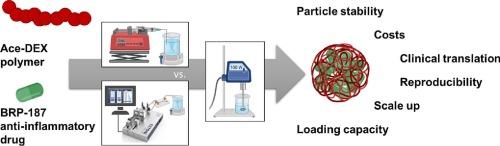
Dextran-based polymers, such as ethoxy acetalated dextran (Ace-DEX), are increasingly becoming the focus of research as they offer great potential for the development of polymer-based nanoparticles as drug delivery vehicles. Their major advantages are the facile synthesis, straightforward particle preparation and the pH-dependent degradation of the particles that can be fine-tuned by the degree of acetalation of the polymer. In this study we have shown that Ace-DEX can not only compete against the commonly used and FDA-approved polymer poly(lactic-co-glycolic acid) (PLGA), but even has the potential to outperform it in its encapsulation properties, e.g., for the herein used anti-inflammatory leukotriene biosynthesis inhibitor BRP-187. We used three different methods (microfluidics, batch nanoprecipitation and emulsion solvent evaporation) for the preparation of BRP-187-loaded Ace-DEX nanoparticles to investigate the influence of the formulation technique on the physicochemical properties of the particles. Finally, we evaluated which production method offers the greatest potential for achieving the demands for a successful translation from research into pharmaceutical production by fulfilling the basic requirements, such as reaching a high loading capacity of the particles and excellent reproducibility while being simple and affordable.
期刊介绍:
International Journal of Pharmaceutics: X offers authors with high-quality research who want to publish in a gold open access journal the opportunity to make their work immediately, permanently, and freely accessible.
International Journal of Pharmaceutics: X authors will pay an article publishing charge (APC), have a choice of license options, and retain copyright. Please check the APC here. The journal is indexed in SCOPUS, PUBMED, PMC and DOAJ.
The International Journal of Pharmaceutics is the second most cited journal in the "Pharmacy & Pharmacology" category out of 358 journals, being the true home for pharmaceutical scientists concerned with the physical, chemical and biological properties of devices and delivery systems for drugs, vaccines and biologicals, including their design, manufacture and evaluation. This includes evaluation of the properties of drugs, excipients such as surfactants and polymers and novel materials. The journal has special sections on pharmaceutical nanotechnology and personalized medicines, and publishes research papers, reviews, commentaries and letters to the editor as well as special issues.



 京公网安备 11010802042870号
京ICP备2023020795号-1
京公网安备 11010802042870号
京ICP备2023020795号-1

 分享
分享
 求助内容:
求助内容: 应助结果提醒方式:
 扫码关注我们
