{"title":"Waste-tracking tools: A business case for more sustainable and resource efficient food services","authors":"Yanne Goossens , Dominik Leverenz , Manuela Kuntscher","doi":"10.1016/j.rcradv.2022.200112","DOIUrl":null,"url":null,"abstract":"<div><p>Waste-tracking devices are powerful tools to optimise kitchen processes and reduce food waste in food services. The present study investigates how using such tools affect the sustainability of a business in terms of environmental, economic and social benefits.</p><p>By tracking leftovers from self-service breakfast buffets, the hotels in our case study were able to reduce leftovers by approx. 1,800 kg/year per kitchen, corresponding to a nutritional value of approx. 3.6 gigacalories/year. The kitchens further achieved net annual environmental impact savings of 6.8 tonnes CO<sub>2</sub> equivalents and 841 PEF mPt per kitchen. In the absence of equipment costs, each kitchen obtained net annual economic savings of 8,317 EUR, meaning they could spend up until about 8,000 EUR/year on waste-tracking equipment and still be profitable. Thus, our business case provides important insights into how food services can become more sustainable and resource efficient through food waste reduction.</p></div>","PeriodicalId":74689,"journal":{"name":"Resources, conservation & recycling advances","volume":"15 ","pages":"Article 200112"},"PeriodicalIF":6.4000,"publicationDate":"2022-11-01","publicationTypes":"Journal Article","fieldsOfStudy":null,"isOpenAccess":false,"openAccessPdf":"https://www.sciencedirect.com/science/article/pii/S2667378922000499/pdfft?md5=2f7860da5e389a62c340178622e6b72d&pid=1-s2.0-S2667378922000499-main.pdf","citationCount":"2","resultStr":null,"platform":"Semanticscholar","paperid":null,"PeriodicalName":"Resources, conservation & recycling advances","FirstCategoryId":"1085","ListUrlMain":"https://www.sciencedirect.com/science/article/pii/S2667378922000499","RegionNum":0,"RegionCategory":null,"ArticlePicture":[],"TitleCN":null,"AbstractTextCN":null,"PMCID":null,"EPubDate":"2022/8/24 0:00:00","PubModel":"Epub","JCR":"Q1","JCRName":"ENVIRONMENTAL SCIENCES","Score":null,"Total":0}
引用次数: 2
Abstract
Waste-tracking devices are powerful tools to optimise kitchen processes and reduce food waste in food services. The present study investigates how using such tools affect the sustainability of a business in terms of environmental, economic and social benefits.
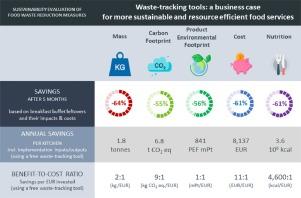
By tracking leftovers from self-service breakfast buffets, the hotels in our case study were able to reduce leftovers by approx. 1,800 kg/year per kitchen, corresponding to a nutritional value of approx. 3.6 gigacalories/year. The kitchens further achieved net annual environmental impact savings of 6.8 tonnes CO2 equivalents and 841 PEF mPt per kitchen. In the absence of equipment costs, each kitchen obtained net annual economic savings of 8,317 EUR, meaning they could spend up until about 8,000 EUR/year on waste-tracking equipment and still be profitable. Thus, our business case provides important insights into how food services can become more sustainable and resource efficient through food waste reduction.




 京公网安备 11010802042870号
京ICP备2023020795号-1
京公网安备 11010802042870号
京ICP备2023020795号-1

 分享
分享
 求助内容:
求助内容: 应助结果提醒方式:
 扫码关注我们
