Juhi Singh, Mohan Aditya Sabbineni, Ravi P. Jaiswal
{"title":"Internal active cooling of a crystalline silicon photovoltaic module: Development of a modeling framework","authors":"Juhi Singh, Mohan Aditya Sabbineni, Ravi P. Jaiswal","doi":"10.1016/j.solener.2023.111980","DOIUrl":null,"url":null,"abstract":"<div><p>Renewable energy sources are experiencing a resurgence in popularity due to growing environmental concerns. Solar technologies are the best renewable energy alternatives for meeting ever-increasing energy demand. The photovoltaic (PV) modules installed in a solar power plant get heated up quickly, resulting in significant reduction in their operating efficiency. This paper presents a mathematical model and its validation for a novel 'internal' active cooling mechanism, proposed elsewhere, for lowering the temperature of a crystalline silicon PV module. Specifically, a 3D mathematical model using COMSOL Multiphysics® software was developed to predict a silicon solar cell's temperature for conventional external and proposed internal cooling methods. The developed model was validated with the experimental data borrowed from the patent application (no. 202211050095). When compared to external air convection at a flow rate of 2 m/s, the proposed internal cooling method reduced the temperature of a Si solar cell by at least 5 °C. Finally, an economic analysis revealed that internal cooling could result in a 9.6 % net gain in the output of a solar power plant, compared to the 4.6 % net gain offered by external air cooling.</p></div>","PeriodicalId":428,"journal":{"name":"Solar Energy","volume":"264 ","pages":"Article 111980"},"PeriodicalIF":6.0000,"publicationDate":"2023-11-01","publicationTypes":"Journal Article","fieldsOfStudy":null,"isOpenAccess":false,"openAccessPdf":"","citationCount":"0","resultStr":null,"platform":"Semanticscholar","paperid":null,"PeriodicalName":"Solar Energy","FirstCategoryId":"5","ListUrlMain":"https://www.sciencedirect.com/science/article/pii/S0038092X2300614X","RegionNum":2,"RegionCategory":"工程技术","ArticlePicture":[],"TitleCN":null,"AbstractTextCN":null,"PMCID":null,"EPubDate":"","PubModel":"","JCR":"Q2","JCRName":"ENERGY & FUELS","Score":null,"Total":0}
引用次数: 0
Abstract
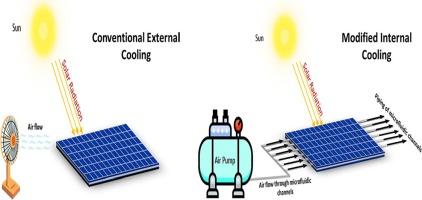
Renewable energy sources are experiencing a resurgence in popularity due to growing environmental concerns. Solar technologies are the best renewable energy alternatives for meeting ever-increasing energy demand. The photovoltaic (PV) modules installed in a solar power plant get heated up quickly, resulting in significant reduction in their operating efficiency. This paper presents a mathematical model and its validation for a novel 'internal' active cooling mechanism, proposed elsewhere, for lowering the temperature of a crystalline silicon PV module. Specifically, a 3D mathematical model using COMSOL Multiphysics® software was developed to predict a silicon solar cell's temperature for conventional external and proposed internal cooling methods. The developed model was validated with the experimental data borrowed from the patent application (no. 202211050095). When compared to external air convection at a flow rate of 2 m/s, the proposed internal cooling method reduced the temperature of a Si solar cell by at least 5 °C. Finally, an economic analysis revealed that internal cooling could result in a 9.6 % net gain in the output of a solar power plant, compared to the 4.6 % net gain offered by external air cooling.
期刊介绍:
Solar Energy welcomes manuscripts presenting information not previously published in journals on any aspect of solar energy research, development, application, measurement or policy. The term "solar energy" in this context includes the indirect uses such as wind energy and biomass




 京公网安备 11010802042870号
京ICP备2023020795号-1
京公网安备 11010802042870号
京ICP备2023020795号-1

 分享
分享
 求助内容:
求助内容: 应助结果提醒方式:
 扫码关注我们
