{"title":"Body composition, cardiorespiratory fitness, and neuromuscular adaptations induced by a home-based whole-body high intensity interval training","authors":"Corentin Scoubeau , Julie Carpentier , Stéphane Baudry , Vitalie Faoro , Malgorzata Klass","doi":"10.1016/j.jesf.2023.02.004","DOIUrl":null,"url":null,"abstract":"<div><h3>Background/objective</h3><p>Bodyweight exercises performed at home could be a complementary approach to improve health-related fitness in people having little spare time and during stay-at-home periods. This study then investigated body composition, cardiorespiratory fitness, and neuromuscular adaptations to a home-based, video-directed, whole-body high-intensity interval training (WB-HIIT).</p></div><div><h3>Methods</h3><p>Fourteen subjects participated to an 8-week WB-HIIT (6 females, 23 ± 1 years) and fourteen were included in a non-exercise control group (CTL; 6 females, 24 ± 4 years). All took part to pre- and post-intervention assessments of body composition, peak oxygen uptake (VO<sub>2</sub>peak) and first ventilatory threshold (VT1; index of aerobic capacity), dynamic (leg press 3-repetition maximum) and isometric strength (knee extensors maximal isometric contractions with assessment of voluntary activation), and muscle endurance during an isometric submaximal contraction maintained till exhaustion. WB-HIIT consisted in 30-s all-out whole-body exercises interspaced with 30 s of active recovery. Training sessions were performed at home by means of videos with demonstration of exercises. Heart rate was monitored during sessions.</p></div><div><h3>Results</h3><p>WB-HIIT increased VO<sub>2</sub>peak (5%), VT1 (20%), leg lean mass (3%), dynamic (13%) and isometric strength (6%), and muscle endurance (28%; p < 0.05), while they did not improve in CTL. VO<sub>2</sub>peak increase was correlated (r = 0.56; p < 0.05) with the time spent above 80% of maximal heart rate during training sessions. Isometric strength increase was correlated with change in voluntary activation (r = 0.74; p < 0.01).</p></div><div><h3>Conclusion</h3><p>The home-based WB-HIIT induced concomitant cardiorespiratory fitness and neuromuscular improvements. The predominant effect was observed for aerobic capacity and muscle endurance which could improve exercise tolerance and reduce fatigability.</p></div>","PeriodicalId":15793,"journal":{"name":"Journal of Exercise Science & Fitness","volume":"21 2","pages":"Pages 226-236"},"PeriodicalIF":2.4000,"publicationDate":"2023-04-01","publicationTypes":"Journal Article","fieldsOfStudy":null,"isOpenAccess":false,"openAccessPdf":"https://ftp.ncbi.nlm.nih.gov/pub/pmc/oa_pdf/76/3f/main.PMC10034507.pdf","citationCount":"0","resultStr":null,"platform":"Semanticscholar","paperid":null,"PeriodicalName":"Journal of Exercise Science & Fitness","FirstCategoryId":"3","ListUrlMain":"https://www.sciencedirect.com/science/article/pii/S1728869X23000175","RegionNum":2,"RegionCategory":"医学","ArticlePicture":[],"TitleCN":null,"AbstractTextCN":null,"PMCID":null,"EPubDate":"","PubModel":"","JCR":"Q2","JCRName":"SPORT SCIENCES","Score":null,"Total":0}
引用次数: 0
Abstract
Background/objective
Bodyweight exercises performed at home could be a complementary approach to improve health-related fitness in people having little spare time and during stay-at-home periods. This study then investigated body composition, cardiorespiratory fitness, and neuromuscular adaptations to a home-based, video-directed, whole-body high-intensity interval training (WB-HIIT).
Methods
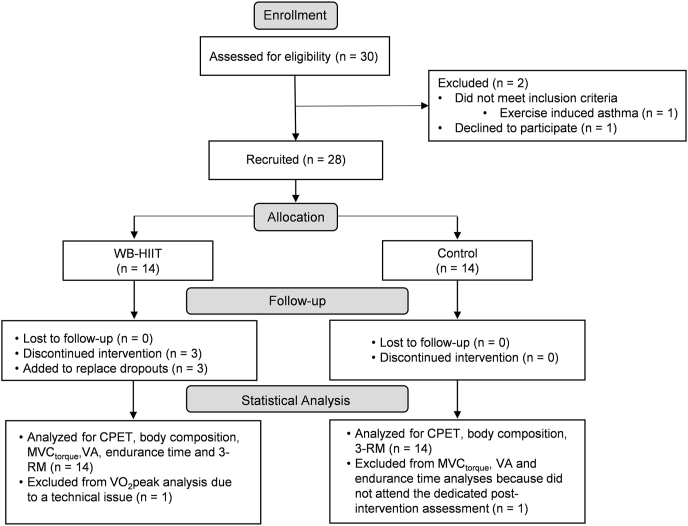
Fourteen subjects participated to an 8-week WB-HIIT (6 females, 23 ± 1 years) and fourteen were included in a non-exercise control group (CTL; 6 females, 24 ± 4 years). All took part to pre- and post-intervention assessments of body composition, peak oxygen uptake (VO2peak) and first ventilatory threshold (VT1; index of aerobic capacity), dynamic (leg press 3-repetition maximum) and isometric strength (knee extensors maximal isometric contractions with assessment of voluntary activation), and muscle endurance during an isometric submaximal contraction maintained till exhaustion. WB-HIIT consisted in 30-s all-out whole-body exercises interspaced with 30 s of active recovery. Training sessions were performed at home by means of videos with demonstration of exercises. Heart rate was monitored during sessions.
Results
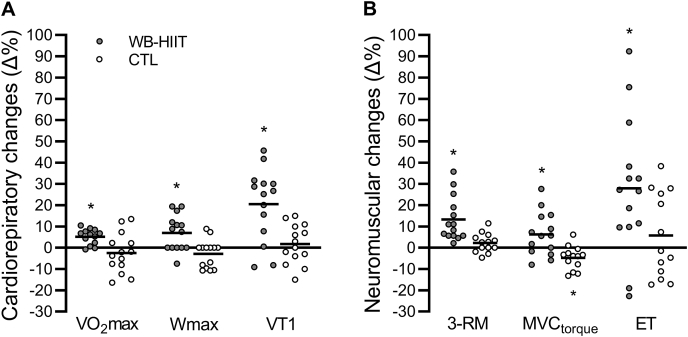
WB-HIIT increased VO2peak (5%), VT1 (20%), leg lean mass (3%), dynamic (13%) and isometric strength (6%), and muscle endurance (28%; p < 0.05), while they did not improve in CTL. VO2peak increase was correlated (r = 0.56; p < 0.05) with the time spent above 80% of maximal heart rate during training sessions. Isometric strength increase was correlated with change in voluntary activation (r = 0.74; p < 0.01).
Conclusion
The home-based WB-HIIT induced concomitant cardiorespiratory fitness and neuromuscular improvements. The predominant effect was observed for aerobic capacity and muscle endurance which could improve exercise tolerance and reduce fatigability.
期刊介绍:
The Journal of Exercise Science and Fitness is the official peer-reviewed journal of The Society of Chinese Scholars on Exercise Physiology and Fitness (SCSEPF), the Physical Fitness Association of Hong Kong, China (HKPFA), and the Hong Kong Association of Sports Medicine and Sports Science (HKASMSS). It is published twice a year, in June and December, by Elsevier.
The Journal accepts original investigations, comprehensive reviews, case studies and short communications on current topics in exercise science, physical fitness and physical education.



 京公网安备 11010802042870号
京ICP备2023020795号-1
京公网安备 11010802042870号
京ICP备2023020795号-1

 分享
分享
 求助内容:
求助内容: 应助结果提醒方式:
 扫码关注我们
