Árpád Farkas , Gábor Tomisa , Szilvia Kugler , Attila Nagy , Attila Vaskó , Erika Kis , Georgina Szénási , Gabriella Gálffy , Alpár Horváth
{"title":"The effect of exhalation before the inhalation of dry powder aerosol drugs on the breathing parameters, emitted doses and aerosol size distributions","authors":"Árpád Farkas , Gábor Tomisa , Szilvia Kugler , Attila Nagy , Attila Vaskó , Erika Kis , Georgina Szénási , Gabriella Gálffy , Alpár Horváth","doi":"10.1016/j.ijpx.2023.100167","DOIUrl":null,"url":null,"abstract":"<div><p>Airway deposition of aerosol drugs is highly dependent on the breathing manoeuvre of the patients. Though incorrect exhalation before the inhalation of the drug is one of the most common mistakes, its effect on the rest of the manoeuvre and on the airway deposition distribution of aerosol drugs is not explored in the open literature. The aim of the present work was to conduct inhalation experiments using six dry powder inhalers in order to quantify the effect of the degree of lung emptying on the inhalation time, inhaled volume and peak inhalation flow. Another goal of the research was to determine the effect of the exhalation on the aerodynamic properties of the drugs emitted by the same inhalers. According to the measurements, deep exhalation before drug inhalation increased the volume of the inhaled air and the average and maximum values of the inhalation flow rate, but the extent of the increase was patient and inhaler specific. For different inhalers, the mean value of the relative increase in peak inhalation flow due to forceful exhalation was between 15.3 and 38.4% (min: Easyhaler®, max: Breezhaler®), compared to the case of normal (tidal) exhalation before the drug inhalation. The relative increase in the inhaled volume was between 36.4 and 57.1% (min: NEXThaler®, max: Turbuhaler®). By the same token, forceful exhalation resulted in higher emitted doses and smaller emitted particles, depending on the individual breathing ability of the patient, the inhalation device and the drug metered in it. The relative increase in the emitted dose varied between 0.2 and 8.0% (min: Foster® NEXThaler®, max: Bufomix® Easyhaler®), while the relative enhancement of fine particle dose ranged between 1.9 and 30.8% (min: Foster® NEXThaler®, max: Symbicort® Turbuhaler®), depending on the inhaler. All these effects and parameter values point toward higher airway doses due to forceful exhalation before the inhalation of the drug. At the same time, the present findings highlight the necessity of proper patient education on the importance of lung emptying, but also the importance of patient-specific inhaler-drug pair choice in the future.</p></div>","PeriodicalId":14280,"journal":{"name":"International Journal of Pharmaceutics: X","volume":"5 ","pages":"Article 100167"},"PeriodicalIF":6.4000,"publicationDate":"2023-12-01","publicationTypes":"Journal Article","fieldsOfStudy":null,"isOpenAccess":false,"openAccessPdf":"https://ftp.ncbi.nlm.nih.gov/pub/pmc/oa_pdf/e8/c8/main.PMC9941374.pdf","citationCount":"2","resultStr":null,"platform":"Semanticscholar","paperid":null,"PeriodicalName":"International Journal of Pharmaceutics: X","FirstCategoryId":"3","ListUrlMain":"https://www.sciencedirect.com/science/article/pii/S2590156723000117","RegionNum":2,"RegionCategory":"医学","ArticlePicture":[],"TitleCN":null,"AbstractTextCN":null,"PMCID":null,"EPubDate":"2023/2/4 0:00:00","PubModel":"Epub","JCR":"Q1","JCRName":"PHARMACOLOGY & PHARMACY","Score":null,"Total":0}
引用次数: 2
Abstract
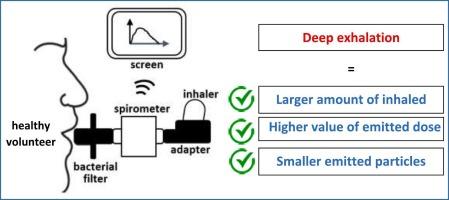
Airway deposition of aerosol drugs is highly dependent on the breathing manoeuvre of the patients. Though incorrect exhalation before the inhalation of the drug is one of the most common mistakes, its effect on the rest of the manoeuvre and on the airway deposition distribution of aerosol drugs is not explored in the open literature. The aim of the present work was to conduct inhalation experiments using six dry powder inhalers in order to quantify the effect of the degree of lung emptying on the inhalation time, inhaled volume and peak inhalation flow. Another goal of the research was to determine the effect of the exhalation on the aerodynamic properties of the drugs emitted by the same inhalers. According to the measurements, deep exhalation before drug inhalation increased the volume of the inhaled air and the average and maximum values of the inhalation flow rate, but the extent of the increase was patient and inhaler specific. For different inhalers, the mean value of the relative increase in peak inhalation flow due to forceful exhalation was between 15.3 and 38.4% (min: Easyhaler®, max: Breezhaler®), compared to the case of normal (tidal) exhalation before the drug inhalation. The relative increase in the inhaled volume was between 36.4 and 57.1% (min: NEXThaler®, max: Turbuhaler®). By the same token, forceful exhalation resulted in higher emitted doses and smaller emitted particles, depending on the individual breathing ability of the patient, the inhalation device and the drug metered in it. The relative increase in the emitted dose varied between 0.2 and 8.0% (min: Foster® NEXThaler®, max: Bufomix® Easyhaler®), while the relative enhancement of fine particle dose ranged between 1.9 and 30.8% (min: Foster® NEXThaler®, max: Symbicort® Turbuhaler®), depending on the inhaler. All these effects and parameter values point toward higher airway doses due to forceful exhalation before the inhalation of the drug. At the same time, the present findings highlight the necessity of proper patient education on the importance of lung emptying, but also the importance of patient-specific inhaler-drug pair choice in the future.
期刊介绍:
International Journal of Pharmaceutics: X offers authors with high-quality research who want to publish in a gold open access journal the opportunity to make their work immediately, permanently, and freely accessible.
International Journal of Pharmaceutics: X authors will pay an article publishing charge (APC), have a choice of license options, and retain copyright. Please check the APC here. The journal is indexed in SCOPUS, PUBMED, PMC and DOAJ.
The International Journal of Pharmaceutics is the second most cited journal in the "Pharmacy & Pharmacology" category out of 358 journals, being the true home for pharmaceutical scientists concerned with the physical, chemical and biological properties of devices and delivery systems for drugs, vaccines and biologicals, including their design, manufacture and evaluation. This includes evaluation of the properties of drugs, excipients such as surfactants and polymers and novel materials. The journal has special sections on pharmaceutical nanotechnology and personalized medicines, and publishes research papers, reviews, commentaries and letters to the editor as well as special issues.




 京公网安备 11010802042870号
京ICP备2023020795号-1
京公网安备 11010802042870号
京ICP备2023020795号-1

 分享
分享
 求助内容:
求助内容: 应助结果提醒方式:
 扫码关注我们
