{"title":"Predictors of life satisfaction in elders living at home in the Czech Republic.","authors":"Radka Bužgová, Radka Kozáková, Katka Bobčíková, Renáta Zeleníková","doi":"10.1371/journal.pone.0283772","DOIUrl":null,"url":null,"abstract":"<p><strong>Objectives: </strong>The aim of this cross-sectional study was to determine the life satisfaction of older people living in a home environment and to find out what predictors influence it.</p><p><strong>Methods: </strong>The research involved 1,121 older people 60 years and above from the Moravian-Silesian region who live in a home environment. The short form of the Life Satisfaction Index for the Thirds Age (LSITA-SF12) was used to assess life satisfaction. The Geriatric depression scale (GDS-15), the Geriatric Anxiety Inventory Scale (GAI), The Sense of Coherence Scale (SOC-13), and the Rosenberg Self-Esteem Scale (RSES) were used to evaluate related factors. In addition, age, gender, marital status, education, social support, and subjective health assessment were evaluated.</p><p><strong>Results: </strong>The overall life satisfaction score was found to be 36.34 (s = 8.66). The satisfaction of older people was classified into four grades: high satisfaction (15.2%), moderate satisfaction (60.8%), moderate dissatisfaction (23.4%), and high dissatisfaction (0.6%). The predictors of the longevity of the lives of older people were confirmed, both health factors (subjective health assessment, anxiety, and depression [Model 1: R = 0.642; R2 = 0.412; p<0.000]) and psychosocial factors (quality of life, self-esteem, sense of coherence, age, and social support [Model 2: R = 0.716; R2 = 0.513; p<0.000]).</p><p><strong>Conclusion: </strong>In implementing policy measures, these areas should be emphasized. The availability of educational and psychosocial activities (e.g. reminiscence therapy, music therapy, group cognitive behavioural therapy, cognitive rehabilitation) within the community care of the older people and university of third age is appropriate to increase the life satisfaction of the older people. An initial depression screening is also required as part of preventive medical examinations to ensure early diagnosis and treatment of depression.</p>","PeriodicalId":20189,"journal":{"name":"PLoS ONE","volume":"18 3","pages":"e0283772"},"PeriodicalIF":2.6000,"publicationDate":"2023-01-01","publicationTypes":"Journal Article","fieldsOfStudy":null,"isOpenAccess":false,"openAccessPdf":"https://www.ncbi.nlm.nih.gov/pmc/articles/PMC10062555/pdf/","citationCount":"1","resultStr":null,"platform":"Semanticscholar","paperid":null,"PeriodicalName":"PLoS ONE","FirstCategoryId":"103","ListUrlMain":"https://doi.org/10.1371/journal.pone.0283772","RegionNum":3,"RegionCategory":"综合性期刊","ArticlePicture":[],"TitleCN":null,"AbstractTextCN":null,"PMCID":null,"EPubDate":"","PubModel":"","JCR":"Q1","JCRName":"MULTIDISCIPLINARY SCIENCES","Score":null,"Total":0}
引用次数: 1
Abstract
Objectives: The aim of this cross-sectional study was to determine the life satisfaction of older people living in a home environment and to find out what predictors influence it.
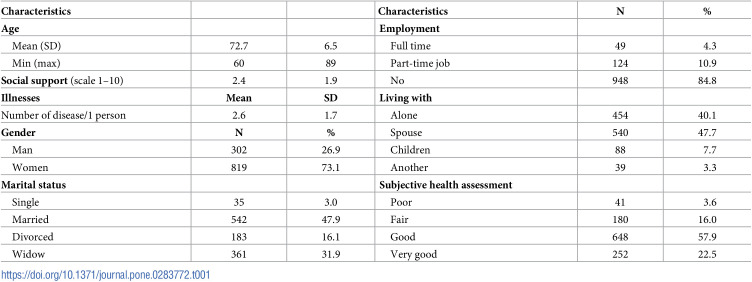
Methods: The research involved 1,121 older people 60 years and above from the Moravian-Silesian region who live in a home environment. The short form of the Life Satisfaction Index for the Thirds Age (LSITA-SF12) was used to assess life satisfaction. The Geriatric depression scale (GDS-15), the Geriatric Anxiety Inventory Scale (GAI), The Sense of Coherence Scale (SOC-13), and the Rosenberg Self-Esteem Scale (RSES) were used to evaluate related factors. In addition, age, gender, marital status, education, social support, and subjective health assessment were evaluated.
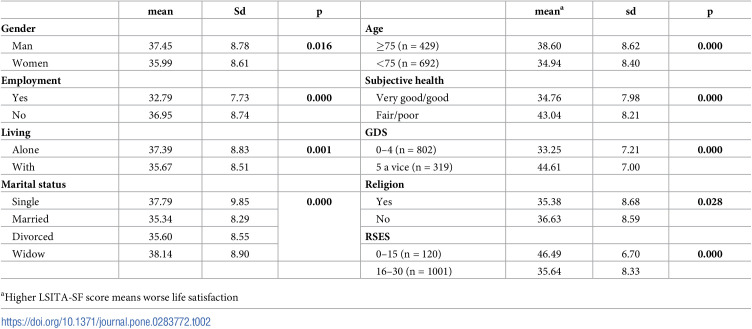
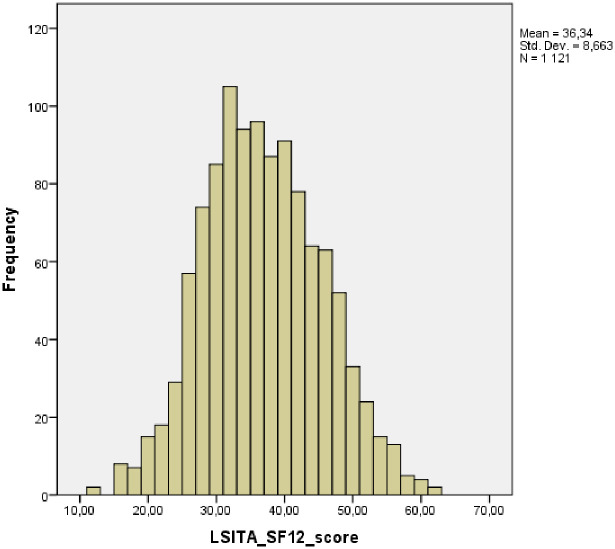
Results: The overall life satisfaction score was found to be 36.34 (s = 8.66). The satisfaction of older people was classified into four grades: high satisfaction (15.2%), moderate satisfaction (60.8%), moderate dissatisfaction (23.4%), and high dissatisfaction (0.6%). The predictors of the longevity of the lives of older people were confirmed, both health factors (subjective health assessment, anxiety, and depression [Model 1: R = 0.642; R2 = 0.412; p<0.000]) and psychosocial factors (quality of life, self-esteem, sense of coherence, age, and social support [Model 2: R = 0.716; R2 = 0.513; p<0.000]).
Conclusion: In implementing policy measures, these areas should be emphasized. The availability of educational and psychosocial activities (e.g. reminiscence therapy, music therapy, group cognitive behavioural therapy, cognitive rehabilitation) within the community care of the older people and university of third age is appropriate to increase the life satisfaction of the older people. An initial depression screening is also required as part of preventive medical examinations to ensure early diagnosis and treatment of depression.
期刊介绍:
PLOS ONE is an international, peer-reviewed, open-access, online publication. PLOS ONE welcomes reports on primary research from any scientific discipline. It provides:
* Open-access—freely accessible online, authors retain copyright
* Fast publication times
* Peer review by expert, practicing researchers
* Post-publication tools to indicate quality and impact
* Community-based dialogue on articles
* Worldwide media coverage




 京公网安备 11010802042870号
京ICP备2023020795号-1
京公网安备 11010802042870号
京ICP备2023020795号-1

 分享
分享
 求助内容:
求助内容: 应助结果提醒方式:
 扫码关注我们
