A model-based optimization strategy to achieve fast and robust freeze-drying cycles

IF 6.4 2区 医学 Q1 PHARMACOLOGY & PHARMACY International Journal of Pharmaceutics: X Pub Date : 2023-04-10 DOI:10.1016/j.ijpx.2023.100180
Brecht Vanbillemont , Anna-Lena Greiner , Vanessa Ehrl , Tim Menzen , Wolfgang Friess , Andrea Hawe
{"title":"A model-based optimization strategy to achieve fast and robust freeze-drying cycles","authors":"Brecht Vanbillemont ,&nbsp;Anna-Lena Greiner ,&nbsp;Vanessa Ehrl ,&nbsp;Tim Menzen ,&nbsp;Wolfgang Friess ,&nbsp;Andrea Hawe","doi":"10.1016/j.ijpx.2023.100180","DOIUrl":null,"url":null,"abstract":"<div><p>Freeze-drying is a time and cost-intensive process. The primary drying phase is the main target in a process optimization exercise. Biopharmaceuticals require an amorphous matrix for stabilization, which may collapse during primary drying if the critical temperature of the formulation is exceeded. The risk of product collapse should be minimized during a process optimization to accomplish a robust process, while achieving an economical process time. Mechanistic models facilitate the search for an optimal primary drying protocol. We propose a novel two-stage shelf temperature optimization approach to maximize sublimation during the primary drying phase, without risking product collapse. The approach includes experiments to obtain high-resolution variability data of process parameters such as the heat transfer coefficient, vial dimensions and dried layer resistance. These process parameters variability data are incorporated into an uncertainty analysis to estimate the risk of failure of the protocol. This optimization approach enables to identify primary drying protocols that are faster and more robust than a classical approach. The methodology was experimentally verified using two formulations which allow for either aggressive or conservative freeze-drying of biopharmaceuticals.</p></div>","PeriodicalId":14280,"journal":{"name":"International Journal of Pharmaceutics: X","volume":"5 ","pages":"Article 100180"},"PeriodicalIF":6.4000,"publicationDate":"2023-04-10","publicationTypes":"Journal Article","fieldsOfStudy":null,"isOpenAccess":false,"openAccessPdf":"https://ftp.ncbi.nlm.nih.gov/pub/pmc/oa_pdf/5a/49/main.PMC10133743.pdf","citationCount":"0","resultStr":null,"platform":"Semanticscholar","paperid":null,"PeriodicalName":"International Journal of Pharmaceutics: X","FirstCategoryId":"3","ListUrlMain":"https://www.sciencedirect.com/science/article/pii/S2590156723000245","RegionNum":2,"RegionCategory":"医学","ArticlePicture":[],"TitleCN":null,"AbstractTextCN":null,"PMCID":null,"EPubDate":"","PubModel":"","JCR":"Q1","JCRName":"PHARMACOLOGY & PHARMACY","Score":null,"Total":0}
引用次数: 0

Abstract

Freeze-drying is a time and cost-intensive process. The primary drying phase is the main target in a process optimization exercise. Biopharmaceuticals require an amorphous matrix for stabilization, which may collapse during primary drying if the critical temperature of the formulation is exceeded. The risk of product collapse should be minimized during a process optimization to accomplish a robust process, while achieving an economical process time. Mechanistic models facilitate the search for an optimal primary drying protocol. We propose a novel two-stage shelf temperature optimization approach to maximize sublimation during the primary drying phase, without risking product collapse. The approach includes experiments to obtain high-resolution variability data of process parameters such as the heat transfer coefficient, vial dimensions and dried layer resistance. These process parameters variability data are incorporated into an uncertainty analysis to estimate the risk of failure of the protocol. This optimization approach enables to identify primary drying protocols that are faster and more robust than a classical approach. The methodology was experimentally verified using two formulations which allow for either aggressive or conservative freeze-drying of biopharmaceuticals.
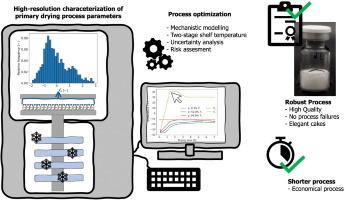
Abstract Image

查看原文
分享 分享
微信好友 朋友圈 QQ好友 复制链接
本刊更多论文
一种基于模型的优化策略,以实现快速和稳健的冷冻干燥循环
冷冻干燥是一个耗费时间和成本的过程。初级干燥阶段是工艺优化工作的主要目标。生物制药需要无定形基质来稳定,如果超过制剂的临界温度,无定形基质可能在初次干燥过程中坍塌。在工艺优化过程中,应将产品崩溃的风险降至最低,以实现稳健的工艺,同时实现经济的工艺时间。机械模型有助于寻找最佳的初级干燥方案。我们提出了一种新的两阶段货架温度优化方法,以在初级干燥阶段最大化升华,而不会有产品崩溃的风险。该方法包括实验,以获得工艺参数的高分辨率可变性数据,如传热系数、小瓶尺寸和干燥层阻力。这些过程参数可变性数据被纳入不确定性分析,以估计协议失败的风险。这种优化方法能够确定比经典方法更快、更稳健的初级干燥协议。该方法使用两种制剂进行了实验验证,这两种制剂允许生物药物的激进或保守冷冻干燥。
本文章由计算机程序翻译,如有差异,请以英文原文为准。
求助全文
约1分钟内获得全文 去求助
来源期刊
International Journal of Pharmaceutics: X
International Journal of Pharmaceutics: X Pharmacology, Toxicology and Pharmaceutics-Pharmaceutical Science
CiteScore
6.60
自引率
0.00%
发文量
32
审稿时长
24 days
期刊介绍: International Journal of Pharmaceutics: X offers authors with high-quality research who want to publish in a gold open access journal the opportunity to make their work immediately, permanently, and freely accessible. International Journal of Pharmaceutics: X authors will pay an article publishing charge (APC), have a choice of license options, and retain copyright. Please check the APC here. The journal is indexed in SCOPUS, PUBMED, PMC and DOAJ. The International Journal of Pharmaceutics is the second most cited journal in the "Pharmacy & Pharmacology" category out of 358 journals, being the true home for pharmaceutical scientists concerned with the physical, chemical and biological properties of devices and delivery systems for drugs, vaccines and biologicals, including their design, manufacture and evaluation. This includes evaluation of the properties of drugs, excipients such as surfactants and polymers and novel materials. The journal has special sections on pharmaceutical nanotechnology and personalized medicines, and publishes research papers, reviews, commentaries and letters to the editor as well as special issues.
期刊最新文献
Comparing the efficacy of nanocarriers for cutaneous and follicular delivery of poorly water-soluble molecules: A case study with ciclosporin A Gemini surfactant-stabilized cubosomes for enhanced topical delivery of 5-fluorouracil in cutaneous squamous cell carcinoma Brain-targeted delivery of siRNA via non-viral delivery systems, the therapeutic strategy for Alzheimer's disease—Unveiling challenges and prospects Enhancing islet transplantation outcomes in T1DM: The promise of mesenchymal stem cells and exosomes ROS-triggered smart hydrogel adhesives for modulating the inflammatory microenvironment and promoting tendon-bone interface regeneration
×
引用
GB/T 7714-2015
复制
MLA
复制
APA
复制
导出至
BibTeX EndNote RefMan NoteFirst NoteExpress
×
×
提示
您的信息不完整,为了账户安全,请先补充。
现在去补充
×
提示
您因"违规操作"
具体请查看互助需知
我知道了
×
提示
现在去查看 取消
×
提示
确定
0
微信
客服QQ
Book学术公众号 扫码关注我们
反馈
×
意见反馈
请填写您的意见或建议
请填写您的手机或邮箱
已复制链接
已复制链接
快去分享给好友吧!
我知道了
×
扫码分享
扫码分享
Book学术官方微信
Book学术文献互助
Book学术文献互助群
群 号:604180095
Book学术
文献互助 智能选刊 最新文献 互助须知 联系我们:info@booksci.cn
Book学术提供免费学术资源搜索服务,方便国内外学者检索中英文文献。致力于提供最便捷和优质的服务体验。
Copyright © 2023 Book学术 All rights reserved.
ghs 京公网安备 11010802042870号 京ICP备2023020795号-1





