Reem M Gahtani, Ali Alqahtani, Taha Alqahtani, Saeed Ahmed Asiri, Jamal Moideen Muthu Mohamed, S Venkatesa Prabhu, Endalew Yaze Muluneh
{"title":"5-Fluorouracil-Loaded PLGA Nanoparticles: Formulation, Physicochemical Characterisation, and <i>In Vitro</i>Anti-Cancer Activity.","authors":"Reem M Gahtani, Ali Alqahtani, Taha Alqahtani, Saeed Ahmed Asiri, Jamal Moideen Muthu Mohamed, S Venkatesa Prabhu, Endalew Yaze Muluneh","doi":"10.1155/2023/2334675","DOIUrl":null,"url":null,"abstract":"<p><p>The major goal of this investigation was to prepare a drug delivery of polymeric nanoparticles (NPs) from 5-fluorouracil (FU) that could be delivered intravenously and improve the therapeutic index of the FU. In order to achieve this, interfacial deposition method was used to prepare FU entrapped poly-(lactic-co-glycolic acid) nanoparticles (FU-PLGA-NPs). The influence of various experimental settings on the effectiveness of FU integration into the NPs was assessed. Our findings show that the technique used to prepare the organic phase and the ratio of the organic phase to the aqueous phase had the greatest impact on the effectiveness of FU integration into NPs. The results show that the preparation process produced spherical, homogenous, negatively charged particles with a nanometric size of 200 nm that are acceptable for intravenous delivery. A quick initial release over 24 h and then slow and steady release of FU from the formed NPs, exhibiting a biphasic pattern. Through the human small cell lung cancer cell line (NCI-H69), the <i>in vitro</i> anti-cancer potential of the FU-PLGA-NPs was evaluated. It was then associated to the <i>in vitro</i> anti-cancer potential of the marketed formulation Fluracil®. Investigations were also conducted into Cremophor-EL (Cre-EL) potential activity on live cells. The viability of NCI-H69 cells was drastically reduced when they were exposed to 50 <i>µ</i>g·mL<sup>-1</sup> Fluracil®. Our findings show that the integration of FU in NPs significantly increases the drug cytotoxic effect in comparison to Fluracil®, with this potential effect being particularly important for extended incubation durations.</p>","PeriodicalId":8914,"journal":{"name":"Bioinorganic Chemistry and Applications","volume":"2023 ","pages":"2334675"},"PeriodicalIF":4.1000,"publicationDate":"2023-04-17","publicationTypes":"Journal Article","fieldsOfStudy":null,"isOpenAccess":false,"openAccessPdf":"https://www.ncbi.nlm.nih.gov/pmc/articles/PMC10125733/pdf/","citationCount":"0","resultStr":null,"platform":"Semanticscholar","paperid":null,"PeriodicalName":"Bioinorganic Chemistry and Applications","FirstCategoryId":"92","ListUrlMain":"https://doi.org/10.1155/2023/2334675","RegionNum":3,"RegionCategory":"化学","ArticlePicture":[],"TitleCN":null,"AbstractTextCN":null,"PMCID":null,"EPubDate":"2023/1/1 0:00:00","PubModel":"eCollection","JCR":"Q1","JCRName":"BIOCHEMISTRY & MOLECULAR BIOLOGY","Score":null,"Total":0}
引用次数: 0
Abstract
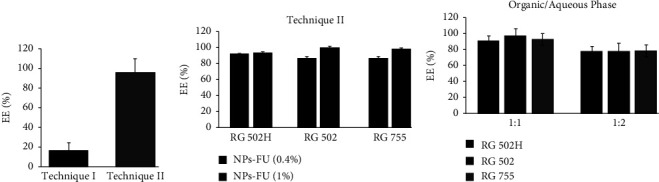
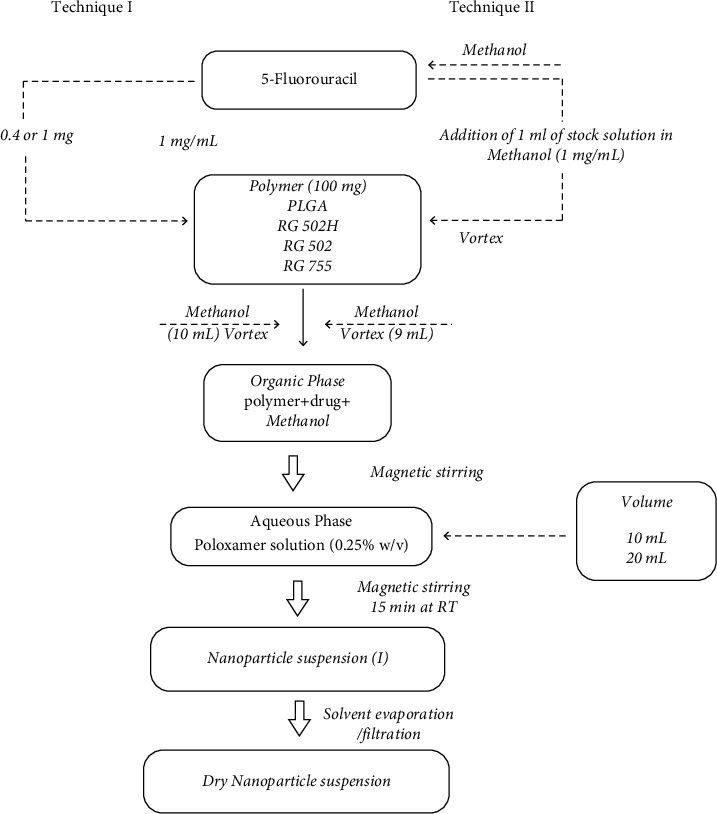
The major goal of this investigation was to prepare a drug delivery of polymeric nanoparticles (NPs) from 5-fluorouracil (FU) that could be delivered intravenously and improve the therapeutic index of the FU. In order to achieve this, interfacial deposition method was used to prepare FU entrapped poly-(lactic-co-glycolic acid) nanoparticles (FU-PLGA-NPs). The influence of various experimental settings on the effectiveness of FU integration into the NPs was assessed. Our findings show that the technique used to prepare the organic phase and the ratio of the organic phase to the aqueous phase had the greatest impact on the effectiveness of FU integration into NPs. The results show that the preparation process produced spherical, homogenous, negatively charged particles with a nanometric size of 200 nm that are acceptable for intravenous delivery. A quick initial release over 24 h and then slow and steady release of FU from the formed NPs, exhibiting a biphasic pattern. Through the human small cell lung cancer cell line (NCI-H69), the in vitro anti-cancer potential of the FU-PLGA-NPs was evaluated. It was then associated to the in vitro anti-cancer potential of the marketed formulation Fluracil®. Investigations were also conducted into Cremophor-EL (Cre-EL) potential activity on live cells. The viability of NCI-H69 cells was drastically reduced when they were exposed to 50 µg·mL-1 Fluracil®. Our findings show that the integration of FU in NPs significantly increases the drug cytotoxic effect in comparison to Fluracil®, with this potential effect being particularly important for extended incubation durations.
期刊介绍:
Bioinorganic Chemistry and Applications is primarily devoted to original research papers, but also publishes review articles, editorials, and letter to the editor in the general field of bioinorganic chemistry and its applications. Its scope includes all aspects of bioinorganic chemistry, including bioorganometallic chemistry and applied bioinorganic chemistry. The journal welcomes papers relating to metalloenzymes and model compounds, metal-based drugs, biomaterials, biocatalysis and bioelectronics, metals in biology and medicine, metals toxicology and metals in the environment, metal interactions with biomolecules and spectroscopic applications.




 京公网安备 11010802042870号
京ICP备2023020795号-1
京公网安备 11010802042870号
京ICP备2023020795号-1

 分享
分享
 求助内容:
求助内容: 应助结果提醒方式:
 扫码关注我们
