Mathias Hutzler, John P Morrissey, Andreas Laus, Franz Meussdoerffer, Martin Zarnkow
{"title":"A new hypothesis for the origin of the lager yeast Saccharomyces pastorianus.","authors":"Mathias Hutzler, John P Morrissey, Andreas Laus, Franz Meussdoerffer, Martin Zarnkow","doi":"10.1093/femsyr/foad023","DOIUrl":null,"url":null,"abstract":"<p><p>Saccharomyces pastorianus, which is responsible for the production of bottom-fermented lager beer, is a hybrid species that arose from the mating of the top-fermenting ale yeast Saccharomyces cerevisiae and the cold-tolerant Saccharomyces eubayanus around the start of the 17th century. Based on detailed analysis of Central European brewing records, we propose that the critical event for the hybridization was the introduction of top-fermenting S. cerevisiae into an environment where S. eubayanus was present, rather than the other way around. Bottom fermentation in parts of Bavaria preceded the proposed hybridization date by a couple of hundred years and we suggest that this was carried out by mixtures of yeasts, which may have included S. eubayanus. A plausible case can be made that the S. cerevisiae parent came either from the Schwarzach wheat brewery or the city of Einbeck, and the formation of S. pastorianus happened in the Munich Hofbräuhaus between 1602 and 1615 when both wheat beer and lager were brewed contemporaneously. We also describe how the distribution of strains from the Munich Spaten brewery, and the development by Hansen and Linder of methods for producing pure starter cultures, facilitated the global spread of the Bavarian S. pastorianus lineages.</p>","PeriodicalId":12290,"journal":{"name":"FEMS yeast research","volume":"23 ","pages":""},"PeriodicalIF":2.7000,"publicationDate":"2023-01-04","publicationTypes":"Journal Article","fieldsOfStudy":null,"isOpenAccess":false,"openAccessPdf":"https://ftp.ncbi.nlm.nih.gov/pub/pmc/oa_pdf/0a/ee/foad023.PMC10133815.pdf","citationCount":"2","resultStr":null,"platform":"Semanticscholar","paperid":null,"PeriodicalName":"FEMS yeast research","FirstCategoryId":"99","ListUrlMain":"https://doi.org/10.1093/femsyr/foad023","RegionNum":4,"RegionCategory":"生物学","ArticlePicture":[],"TitleCN":null,"AbstractTextCN":null,"PMCID":null,"EPubDate":"","PubModel":"","JCR":"Q3","JCRName":"BIOTECHNOLOGY & APPLIED MICROBIOLOGY","Score":null,"Total":0}
引用次数: 2
Abstract
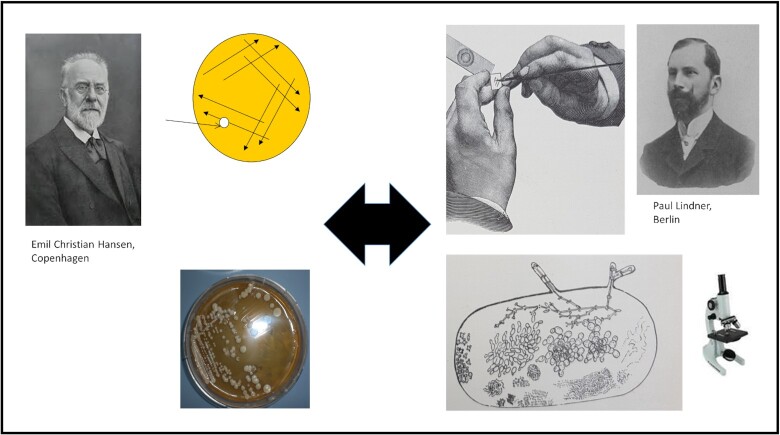
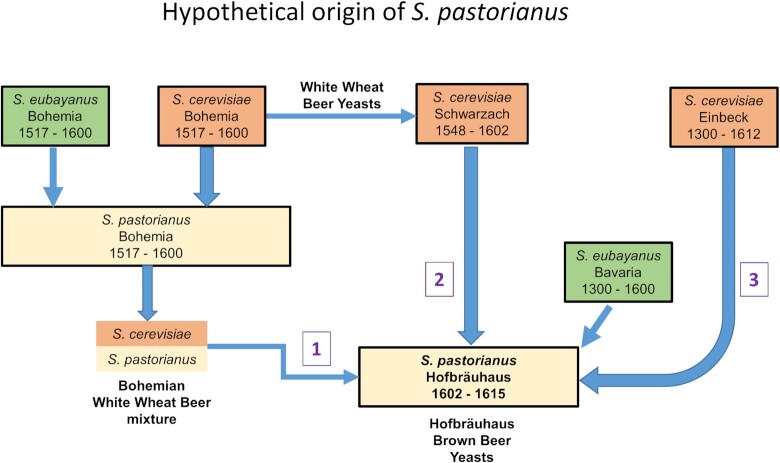
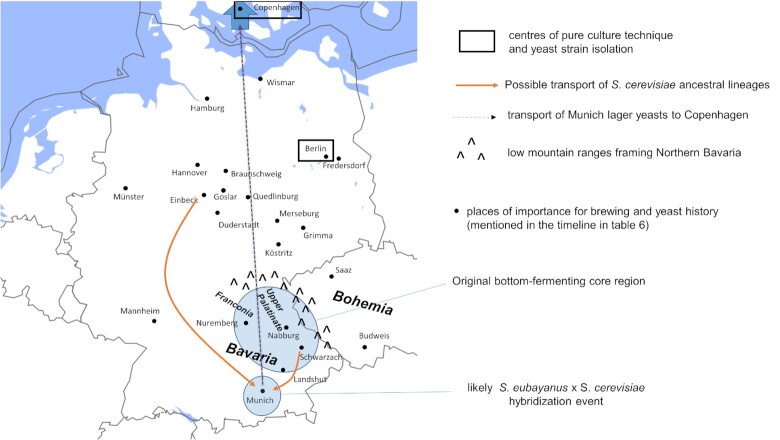
Saccharomyces pastorianus, which is responsible for the production of bottom-fermented lager beer, is a hybrid species that arose from the mating of the top-fermenting ale yeast Saccharomyces cerevisiae and the cold-tolerant Saccharomyces eubayanus around the start of the 17th century. Based on detailed analysis of Central European brewing records, we propose that the critical event for the hybridization was the introduction of top-fermenting S. cerevisiae into an environment where S. eubayanus was present, rather than the other way around. Bottom fermentation in parts of Bavaria preceded the proposed hybridization date by a couple of hundred years and we suggest that this was carried out by mixtures of yeasts, which may have included S. eubayanus. A plausible case can be made that the S. cerevisiae parent came either from the Schwarzach wheat brewery or the city of Einbeck, and the formation of S. pastorianus happened in the Munich Hofbräuhaus between 1602 and 1615 when both wheat beer and lager were brewed contemporaneously. We also describe how the distribution of strains from the Munich Spaten brewery, and the development by Hansen and Linder of methods for producing pure starter cultures, facilitated the global spread of the Bavarian S. pastorianus lineages.
期刊介绍:
FEMS Yeast Research offers efficient publication of high-quality original Research Articles, Mini-reviews, Letters to the Editor, Perspectives and Commentaries that express current opinions. The journal will select for publication only those manuscripts deemed to be of major relevance to the field and generally will not consider articles that are largely descriptive without insights on underlying mechanism or biology. Submissions on any yeast species are welcome provided they report results within the scope outlined below and are of significance to the yeast field.



 京公网安备 11010802042870号
京ICP备2023020795号-1
京公网安备 11010802042870号
京ICP备2023020795号-1

 分享
分享
 求助内容:
求助内容: 应助结果提醒方式:
 扫码关注我们
