Christopher E. Proppe, Taylor M. Aldeghi, Paola M. Rivera, David Gonzalez-Rojas, Aaron M. Wizenberg, Ethan C. Hill
{"title":"75-repetition versus sets to failure of blood flow restriction exercise on indices of muscle damage in women","authors":"Christopher E. Proppe, Taylor M. Aldeghi, Paola M. Rivera, David Gonzalez-Rojas, Aaron M. Wizenberg, Ethan C. Hill","doi":"10.1080/17461391.2023.2201813","DOIUrl":null,"url":null,"abstract":"<div>\n \n <p>There is conflicting evidence regarding the prevalence and magnitude of exercise-induced muscle damage (EIMD) following low-load resistance exercise with blood flow restriction (LL + BFR) that may be related to exercise protocols. The purpose of this investigation was to examine the effects of 75-repetition (BFR-75) (1 × 30, 3 × 15) and 4 sets to failure (BFR-4x) protocols on indices of EIMD among untrained women. Thirteen women completed this investigation. One leg was randomly assigned to BFR-75 and the other to BFR-4x. Each leg performed isokinetic, unilateral, concentric-eccentric, leg extension muscle actions at 30% of maximal strength. Indices of EIMD (muscle soreness, range of motion [ROM], limb circumference, pain pressure threshold [PPT], and maximal voluntary isometric contraction [MVIC]) were recorded before exercise, 0-, 24-, 48-, 72-, and 96-hours post-exercise. There were no changes for ROM, circumference, or PPT. Muscle soreness increased similarly in both conditions 0-, 24-, and 48-hours post-exercise and MVIC increased 24-, 48-, 72-, and 96-hours post-exercise. These findings suggested BFR-75 and BFR-4x were not associated with EIMD and elicited similar physiological responses. The increases in muscle soreness may be due to metabolic stress associated with LL + BFR protocols apart from EIMD.</p>\n </div>","PeriodicalId":93999,"journal":{"name":"European journal of sport science","volume":"23 10","pages":"1993-2001"},"PeriodicalIF":3.0000,"publicationDate":"2023-05-09","publicationTypes":"Journal Article","fieldsOfStudy":null,"isOpenAccess":false,"openAccessPdf":"https://onlinelibrary.wiley.com/doi/epdf/10.1080/17461391.2023.2201813","citationCount":"0","resultStr":null,"platform":"Semanticscholar","paperid":null,"PeriodicalName":"European journal of sport science","FirstCategoryId":"1085","ListUrlMain":"https://onlinelibrary.wiley.com/doi/10.1080/17461391.2023.2201813","RegionNum":0,"RegionCategory":null,"ArticlePicture":[],"TitleCN":null,"AbstractTextCN":null,"PMCID":null,"EPubDate":"","PubModel":"","JCR":"","JCRName":"","Score":null,"Total":0}
引用次数: 0
Abstract
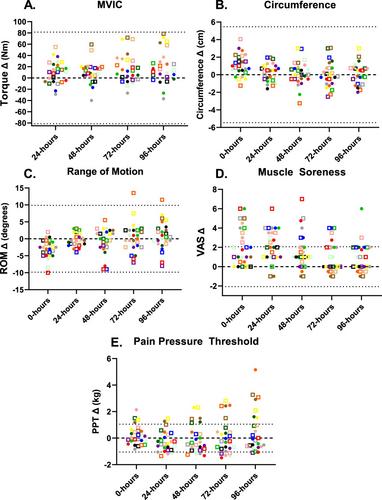
There is conflicting evidence regarding the prevalence and magnitude of exercise-induced muscle damage (EIMD) following low-load resistance exercise with blood flow restriction (LL + BFR) that may be related to exercise protocols. The purpose of this investigation was to examine the effects of 75-repetition (BFR-75) (1 × 30, 3 × 15) and 4 sets to failure (BFR-4x) protocols on indices of EIMD among untrained women. Thirteen women completed this investigation. One leg was randomly assigned to BFR-75 and the other to BFR-4x. Each leg performed isokinetic, unilateral, concentric-eccentric, leg extension muscle actions at 30% of maximal strength. Indices of EIMD (muscle soreness, range of motion [ROM], limb circumference, pain pressure threshold [PPT], and maximal voluntary isometric contraction [MVIC]) were recorded before exercise, 0-, 24-, 48-, 72-, and 96-hours post-exercise. There were no changes for ROM, circumference, or PPT. Muscle soreness increased similarly in both conditions 0-, 24-, and 48-hours post-exercise and MVIC increased 24-, 48-, 72-, and 96-hours post-exercise. These findings suggested BFR-75 and BFR-4x were not associated with EIMD and elicited similar physiological responses. The increases in muscle soreness may be due to metabolic stress associated with LL + BFR protocols apart from EIMD.



 京公网安备 11010802042870号
京ICP备2023020795号-1
京公网安备 11010802042870号
京ICP备2023020795号-1

 分享
分享

 求助内容:
求助内容: 应助结果提醒方式:
 扫码关注我们
