{"title":"The role of linguistic and cognitive skills in reading Chinese as a second language: A path analysis modeling approach.","authors":"Lei Yang, Ying Xiong, Qi Chen","doi":"10.3389/fpsyg.2023.1131913","DOIUrl":null,"url":null,"abstract":"<p><p>This study examined the role of basic linguistic skills (vocabulary, syntax, orthography, and morphological awareness), basic cognitive skills (working memory), and higher-order cognitive skills (inference making and reading monitoring) in reading Chinese as a second language (L2). A total of 252 international students from Pakistan, Indonesia, Malaysia, and Laos were recruited, and a range of measures including a Chinese reading comprehension test (HSK level 3), four linguistic knowledge tests on Chinese lexical, syntactic, and orthographic knowledge as well as morphological awareness, a reading span test, an inference making task, and an inconsistency detection test. The results of hierarchical multiple regressions showed that the measured linguistic skills and cognitive skills explained 80% of the variances in L2 Chinese reading, among which morphological awareness made the largest contribution. The path analysis revealed that linguistic skills and working memory contributed indirectly to reading comprehension <i>via</i> inference making and comprehension monitoring, while the two higher-order cognitive skills made direct contributions. Overall, this study demonstrates that inference making and comprehension monitoring contributed directly to reading comprehension, while linguistic skills and working memory functioned indirectly <i>via</i> the higher-order cognitive skills It also highlights the importance of morphological awareness in a hierarchical model of L2 Chinese reading.</p>","PeriodicalId":12525,"journal":{"name":"Frontiers in Psychology","volume":"14 ","pages":"1131913"},"PeriodicalIF":2.9000,"publicationDate":"2023-01-01","publicationTypes":"Journal Article","fieldsOfStudy":null,"isOpenAccess":false,"openAccessPdf":"https://www.ncbi.nlm.nih.gov/pmc/articles/PMC10112516/pdf/","citationCount":"0","resultStr":null,"platform":"Semanticscholar","paperid":null,"PeriodicalName":"Frontiers in Psychology","FirstCategoryId":"102","ListUrlMain":"https://doi.org/10.3389/fpsyg.2023.1131913","RegionNum":3,"RegionCategory":"心理学","ArticlePicture":[],"TitleCN":null,"AbstractTextCN":null,"PMCID":null,"EPubDate":"","PubModel":"","JCR":"Q2","JCRName":"PSYCHOLOGY, MULTIDISCIPLINARY","Score":null,"Total":0}
引用次数: 0
Abstract
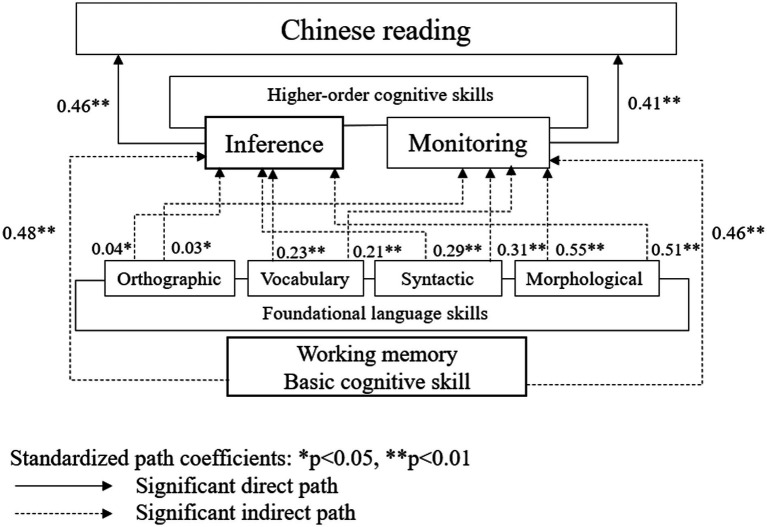
This study examined the role of basic linguistic skills (vocabulary, syntax, orthography, and morphological awareness), basic cognitive skills (working memory), and higher-order cognitive skills (inference making and reading monitoring) in reading Chinese as a second language (L2). A total of 252 international students from Pakistan, Indonesia, Malaysia, and Laos were recruited, and a range of measures including a Chinese reading comprehension test (HSK level 3), four linguistic knowledge tests on Chinese lexical, syntactic, and orthographic knowledge as well as morphological awareness, a reading span test, an inference making task, and an inconsistency detection test. The results of hierarchical multiple regressions showed that the measured linguistic skills and cognitive skills explained 80% of the variances in L2 Chinese reading, among which morphological awareness made the largest contribution. The path analysis revealed that linguistic skills and working memory contributed indirectly to reading comprehension via inference making and comprehension monitoring, while the two higher-order cognitive skills made direct contributions. Overall, this study demonstrates that inference making and comprehension monitoring contributed directly to reading comprehension, while linguistic skills and working memory functioned indirectly via the higher-order cognitive skills It also highlights the importance of morphological awareness in a hierarchical model of L2 Chinese reading.
期刊介绍:
Frontiers in Psychology is the largest journal in its field, publishing rigorously peer-reviewed research across the psychological sciences, from clinical research to cognitive science, from perception to consciousness, from imaging studies to human factors, and from animal cognition to social psychology. Field Chief Editor Axel Cleeremans at the Free University of Brussels is supported by an outstanding Editorial Board of international researchers. This multidisciplinary open-access journal is at the forefront of disseminating and communicating scientific knowledge and impactful discoveries to researchers, academics, clinicians and the public worldwide. The journal publishes the best research across the entire field of psychology. Today, psychological science is becoming increasingly important at all levels of society, from the treatment of clinical disorders to our basic understanding of how the mind works. It is highly interdisciplinary, borrowing questions from philosophy, methods from neuroscience and insights from clinical practice - all in the goal of furthering our grasp of human nature and society, as well as our ability to develop new intervention methods.




 京公网安备 11010802042870号
京ICP备2023020795号-1
京公网安备 11010802042870号
京ICP备2023020795号-1

 分享
分享
 求助内容:
求助内容: 应助结果提醒方式:
 扫码关注我们
