Hengyi Lin, Tao Han, Jiteng Wang, Zheng Ma, Xiaoping Yu
{"title":"Screening and Identification of a Strain with Protease and Phytase Activities and Its Application in Soybean Meal Fermentation","authors":"Hengyi Lin, Tao Han, Jiteng Wang, Zheng Ma, Xiaoping Yu","doi":"10.1007/s12010-023-04568-w","DOIUrl":null,"url":null,"abstract":"<div><p>The aims of the study were to degrade the anti-nutritional factors (ANFs) such as phytic acid, glycinin, and β-conglycinin and improve the values of soybean meal (SBM). Firstly, in this study, a strain PY-4B which exhibited the best enzymatic activities of protease (403.3 ± 17.8 U/mL) and phytase (62.9 ± 2.9 U/mL) was isolated and screened among the isolates. Based on the analysis of physiological and biochemical characteristics and 16S rDNA sequence, the strain PY-4B was identified and named as <i>Pseudomonas</i> PY-4B. Next, <i>Pseudomonas</i> PY-4B was applied to fermentation of SBM. The results showed that the contents of glycinin and β-conglycinin were decreased by 57–63%, and the phytic acid was remarkably degraded by 62.5% due to the fermentation of SBM by <i>Pseudomonas</i> PY-4B. The degradation of glycinin and β-conglycinin resulted in increase of contents of water-soluble proteins and amino acids in fermented SBM. Moreover, <i>Pseudomonas</i> PY-4B exhibited no hemolytic activity and slight inhibitory effect on the growth of pathogen <i>Staphylococcus aureus</i> and the wide range of pH tolerance (3 to 9). In summary, our study indicates that isolated strain <i>Pseudomonas</i> PY-4B is a safe and applicable strain and has the ability to effectively degrade the ANFs (phytic acid, glycinin, and β-conglycinin) in SBM by fermentation.</p></div>","PeriodicalId":465,"journal":{"name":"Applied Biochemistry and Biotechnology","volume":"196 2","pages":"790 - 803"},"PeriodicalIF":3.3000,"publicationDate":"2023-05-19","publicationTypes":"Journal Article","fieldsOfStudy":null,"isOpenAccess":false,"openAccessPdf":"","citationCount":"0","resultStr":null,"platform":"Semanticscholar","paperid":null,"PeriodicalName":"Applied Biochemistry and Biotechnology","FirstCategoryId":"5","ListUrlMain":"https://link.springer.com/article/10.1007/s12010-023-04568-w","RegionNum":4,"RegionCategory":"生物学","ArticlePicture":[],"TitleCN":null,"AbstractTextCN":null,"PMCID":null,"EPubDate":"","PubModel":"","JCR":"Q3","JCRName":"BIOCHEMISTRY & MOLECULAR BIOLOGY","Score":null,"Total":0}
引用次数: 0
Abstract
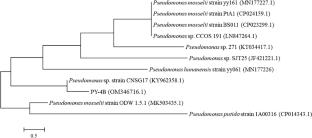
The aims of the study were to degrade the anti-nutritional factors (ANFs) such as phytic acid, glycinin, and β-conglycinin and improve the values of soybean meal (SBM). Firstly, in this study, a strain PY-4B which exhibited the best enzymatic activities of protease (403.3 ± 17.8 U/mL) and phytase (62.9 ± 2.9 U/mL) was isolated and screened among the isolates. Based on the analysis of physiological and biochemical characteristics and 16S rDNA sequence, the strain PY-4B was identified and named as Pseudomonas PY-4B. Next, Pseudomonas PY-4B was applied to fermentation of SBM. The results showed that the contents of glycinin and β-conglycinin were decreased by 57–63%, and the phytic acid was remarkably degraded by 62.5% due to the fermentation of SBM by Pseudomonas PY-4B. The degradation of glycinin and β-conglycinin resulted in increase of contents of water-soluble proteins and amino acids in fermented SBM. Moreover, Pseudomonas PY-4B exhibited no hemolytic activity and slight inhibitory effect on the growth of pathogen Staphylococcus aureus and the wide range of pH tolerance (3 to 9). In summary, our study indicates that isolated strain Pseudomonas PY-4B is a safe and applicable strain and has the ability to effectively degrade the ANFs (phytic acid, glycinin, and β-conglycinin) in SBM by fermentation.
期刊介绍:
This journal is devoted to publishing the highest quality innovative papers in the fields of biochemistry and biotechnology. The typical focus of the journal is to report applications of novel scientific and technological breakthroughs, as well as technological subjects that are still in the proof-of-concept stage. Applied Biochemistry and Biotechnology provides a forum for case studies and practical concepts of biotechnology, utilization, including controls, statistical data analysis, problem descriptions unique to a particular application, and bioprocess economic analyses. The journal publishes reviews deemed of interest to readers, as well as book reviews, meeting and symposia notices, and news items relating to biotechnology in both the industrial and academic communities.
In addition, Applied Biochemistry and Biotechnology often publishes lists of patents and publications of special interest to readers.



 京公网安备 11010802042870号
京ICP备2023020795号-1
京公网安备 11010802042870号
京ICP备2023020795号-1

 分享
分享
 求助内容:
求助内容: 应助结果提醒方式:
 扫码关注我们
