Ana Carolina Yamakawa, Amanda Haisi, Louise Bach Kmetiuk, Maysa Pellizzaro, Juliana Cristina Rebonato Mendes, Aurea Maria Oliveira Canavessi, Leila Sabrina Ullmann, Wagner Antônio Chiba de Castro, João Pessoa Araújo Júnior, Andrea Pires Dos Santos, Alexander Welker Biondo
{"title":"Molecular detection of feline hemoplasmas and retroviruses in free-roaming and shelter cats within a university campus.","authors":"Ana Carolina Yamakawa, Amanda Haisi, Louise Bach Kmetiuk, Maysa Pellizzaro, Juliana Cristina Rebonato Mendes, Aurea Maria Oliveira Canavessi, Leila Sabrina Ullmann, Wagner Antônio Chiba de Castro, João Pessoa Araújo Júnior, Andrea Pires Dos Santos, Alexander Welker Biondo","doi":"10.1177/20551169221148672","DOIUrl":null,"url":null,"abstract":"<p><strong>Objectives: </strong>The aim of the present study was to assess the frequency of hemoplasma, feline immunodeficiency virus (FIV) and feline leukemia virus (FeLV) infections in cats living in an on-campus shelter and free-roaming cats within a university campus in Brazil.</p><p><strong>Methods: </strong>Blood samples were tested using quantitative PCR for hemoplasma, FIV and FeLV. Positive hemoplasma samples were sequenced. Associations between hemoplasma detection and living situation, sex, flea and/or tick parasitism, and coinfection with FIV and FeLV, were assessed using Fisher's exact test and the respective odds ratios were calculated.</p><p><strong>Results: </strong>Overall, 6/45 (13.3%) cats tested positive: four (8.9%) were infected with '<i>Candidatus</i> Mycoplasma haemominutum' and two (4.4%) with <i>Mycoplasma haemofelis</i>. All positive samples were from free-roaming cats (6/15; 40.0%) and had statistically significantly lower packed cell volumes (<i>P</i> = 0.037). Although 5/23 (21.7%) males and 1/22 (4.6%) females were positive, no statistically significant association between sex and hemoplasma infection was found (<i>P</i> = 0.19). Viral quantitative PCR (qPCR) was performed on 43/45 samples, among which 2/43 (4.7%) were positive for FIV and none for FeLV. Only one cat (2.3%) was coinfected with hemoplasma and FIV (<i>P</i> = 0.26). In addition, 4/6 (66.7%) cats that tested positive for hemoplasmas were infested by fleas (<i>P</i> = 0.0014) and/or ticks (<i>P</i> = 0.25).</p><p><strong>Conclusions and relevance: </strong>These results show that even if the free-roaming cat population is clinically healthy and has adequate access to food, it may present flea infestation and hemoplasma infection with lower packed cell volume values.</p>","PeriodicalId":36588,"journal":{"name":"Journal of Feline Medicine and Surgery Open Reports","volume":"9 1","pages":"20551169221148672"},"PeriodicalIF":0.7000,"publicationDate":"2023-01-01","publicationTypes":"Journal Article","fieldsOfStudy":null,"isOpenAccess":false,"openAccessPdf":"https://ftp.ncbi.nlm.nih.gov/pub/pmc/oa_pdf/a9/cf/10.1177_20551169221148672.PMC10201909.pdf","citationCount":"0","resultStr":null,"platform":"Semanticscholar","paperid":null,"PeriodicalName":"Journal of Feline Medicine and Surgery Open Reports","FirstCategoryId":"1085","ListUrlMain":"https://doi.org/10.1177/20551169221148672","RegionNum":0,"RegionCategory":null,"ArticlePicture":[],"TitleCN":null,"AbstractTextCN":null,"PMCID":null,"EPubDate":"","PubModel":"","JCR":"Q3","JCRName":"VETERINARY SCIENCES","Score":null,"Total":0}
引用次数: 0
Abstract
Objectives: The aim of the present study was to assess the frequency of hemoplasma, feline immunodeficiency virus (FIV) and feline leukemia virus (FeLV) infections in cats living in an on-campus shelter and free-roaming cats within a university campus in Brazil.
Methods: Blood samples were tested using quantitative PCR for hemoplasma, FIV and FeLV. Positive hemoplasma samples were sequenced. Associations between hemoplasma detection and living situation, sex, flea and/or tick parasitism, and coinfection with FIV and FeLV, were assessed using Fisher's exact test and the respective odds ratios were calculated.
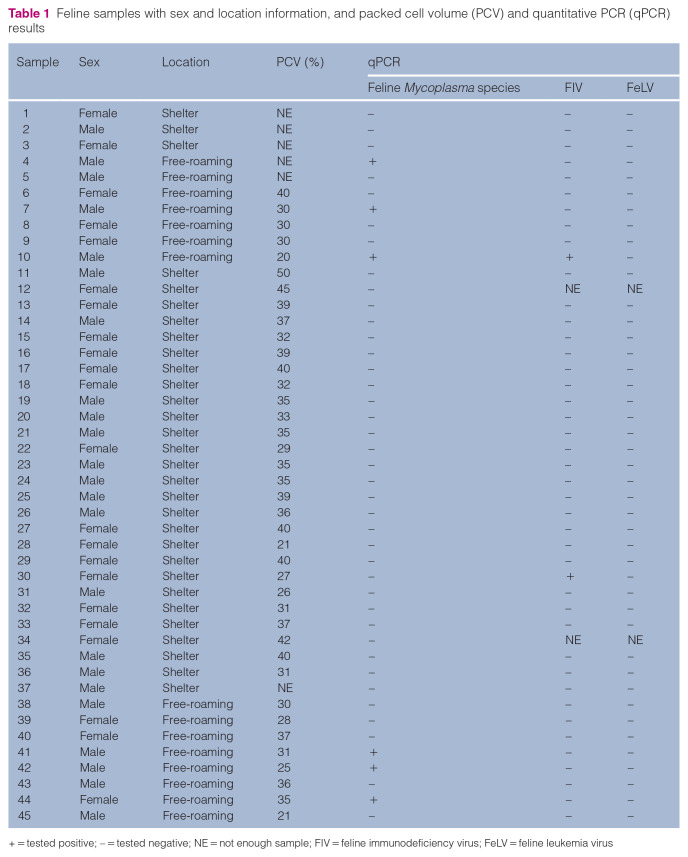
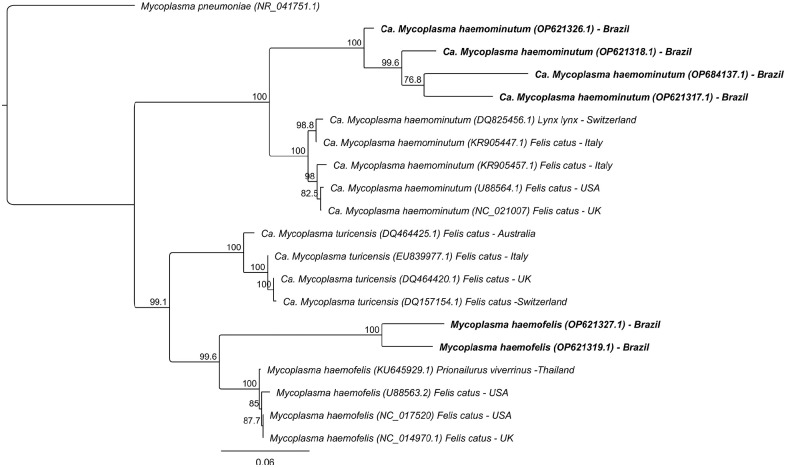
Results: Overall, 6/45 (13.3%) cats tested positive: four (8.9%) were infected with 'Candidatus Mycoplasma haemominutum' and two (4.4%) with Mycoplasma haemofelis. All positive samples were from free-roaming cats (6/15; 40.0%) and had statistically significantly lower packed cell volumes (P = 0.037). Although 5/23 (21.7%) males and 1/22 (4.6%) females were positive, no statistically significant association between sex and hemoplasma infection was found (P = 0.19). Viral quantitative PCR (qPCR) was performed on 43/45 samples, among which 2/43 (4.7%) were positive for FIV and none for FeLV. Only one cat (2.3%) was coinfected with hemoplasma and FIV (P = 0.26). In addition, 4/6 (66.7%) cats that tested positive for hemoplasmas were infested by fleas (P = 0.0014) and/or ticks (P = 0.25).
Conclusions and relevance: These results show that even if the free-roaming cat population is clinically healthy and has adequate access to food, it may present flea infestation and hemoplasma infection with lower packed cell volume values.





 京公网安备 11010802042870号
京ICP备2023020795号-1
京公网安备 11010802042870号
京ICP备2023020795号-1

 分享
分享
 求助内容:
求助内容: 应助结果提醒方式:
 扫码关注我们
