Jennifer M. Loftis , Evan Firsick , Kate Shirley , James L. Adkins , Anh Le-Cook , Emily Sano , Rebekah Hudson , Jonathan Moorman
{"title":"Inflammatory and mental health sequelae of COVID-19","authors":"Jennifer M. Loftis , Evan Firsick , Kate Shirley , James L. Adkins , Anh Le-Cook , Emily Sano , Rebekah Hudson , Jonathan Moorman","doi":"10.1016/j.cpnec.2023.100186","DOIUrl":null,"url":null,"abstract":"<div><p>The COVID-19 pandemic has caused significant negative consequences to mental health. Increased inflammatory factors and neuropsychiatric symptoms, such as cognitive impairment (“brain fog”), depression, and anxiety are associated with long COVID [post-acute sequelae of SARS-CoV-2 infection (PASC), termed neuro-PASC]. The present study sought to examine the role of inflammatory factors as predictors of neuropsychiatric symptom severity in the context of COVID-19. Adults (n = 52) who tested negative or positive for COVID-19 were asked to complete self-report questionnaires and to provide blood samples for multiplex immunoassays. Participants who tested negative for COVID-19 were assessed at baseline and at a follow-up study visit (∼4 weeks later). Individuals without COVID-19 reported significantly lower PHQ-4 scores at the follow-up visit, as compared to baseline (<em>p</em> = 0.03; 95% CI-1.67 to −0.084). Individuals who tested positive for COVID-19 and experienced neuro-PASC had PHQ-4 scores in the moderate range. The majority of people with neuro-PASC reported experiencing brain fog (70% vs. 30%). Those with more severe COVID-19 had significantly higher PHQ-4 scores, as compared to those with mild disease (<em>p</em> = 0.008; 95% CI 1.32 to 7.97). Changes in neuropsychiatric symptom severity were accompanied by alterations in immune factors, particularly monokine induced by gamma interferon (IFN-γ) (MIG, a. k.a. CXCL9). These findings add to the growing evidence supporting the usefulness of circulating MIG levels as a biomarker reflecting IFN-γ production, which is important because individuals with neuro-PASC have elevated IFN-γ responses to internal SARS-CoV-2 proteins.</p></div>","PeriodicalId":72656,"journal":{"name":"Comprehensive psychoneuroendocrinology","volume":"15 ","pages":"Article 100186"},"PeriodicalIF":2.5000,"publicationDate":"2023-08-01","publicationTypes":"Journal Article","fieldsOfStudy":null,"isOpenAccess":false,"openAccessPdf":"https://ftp.ncbi.nlm.nih.gov/pub/pmc/oa_pdf/98/ff/main.PMC10191701.pdf","citationCount":"3","resultStr":null,"platform":"Semanticscholar","paperid":null,"PeriodicalName":"Comprehensive psychoneuroendocrinology","FirstCategoryId":"1085","ListUrlMain":"https://www.sciencedirect.com/science/article/pii/S2666497623000206","RegionNum":0,"RegionCategory":null,"ArticlePicture":[],"TitleCN":null,"AbstractTextCN":null,"PMCID":null,"EPubDate":"","PubModel":"","JCR":"Q3","JCRName":"ENDOCRINOLOGY & METABOLISM","Score":null,"Total":0}
引用次数: 3
Abstract
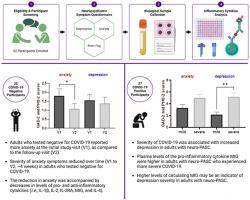
The COVID-19 pandemic has caused significant negative consequences to mental health. Increased inflammatory factors and neuropsychiatric symptoms, such as cognitive impairment (“brain fog”), depression, and anxiety are associated with long COVID [post-acute sequelae of SARS-CoV-2 infection (PASC), termed neuro-PASC]. The present study sought to examine the role of inflammatory factors as predictors of neuropsychiatric symptom severity in the context of COVID-19. Adults (n = 52) who tested negative or positive for COVID-19 were asked to complete self-report questionnaires and to provide blood samples for multiplex immunoassays. Participants who tested negative for COVID-19 were assessed at baseline and at a follow-up study visit (∼4 weeks later). Individuals without COVID-19 reported significantly lower PHQ-4 scores at the follow-up visit, as compared to baseline (p = 0.03; 95% CI-1.67 to −0.084). Individuals who tested positive for COVID-19 and experienced neuro-PASC had PHQ-4 scores in the moderate range. The majority of people with neuro-PASC reported experiencing brain fog (70% vs. 30%). Those with more severe COVID-19 had significantly higher PHQ-4 scores, as compared to those with mild disease (p = 0.008; 95% CI 1.32 to 7.97). Changes in neuropsychiatric symptom severity were accompanied by alterations in immune factors, particularly monokine induced by gamma interferon (IFN-γ) (MIG, a. k.a. CXCL9). These findings add to the growing evidence supporting the usefulness of circulating MIG levels as a biomarker reflecting IFN-γ production, which is important because individuals with neuro-PASC have elevated IFN-γ responses to internal SARS-CoV-2 proteins.




 京公网安备 11010802042870号
京ICP备2023020795号-1
京公网安备 11010802042870号
京ICP备2023020795号-1

 分享
分享
 求助内容:
求助内容: 应助结果提醒方式:
 扫码关注我们
