Livia Graumann, An Bin Cho, Eugenia Kulakova, Christian Eric Deuter, Oliver T Wolf, Stefan Roepke, Julian Hellmann-Regen, Christian Otte, Katja Wingenfeld
{"title":"Impact of social exclusion on empathy in women with borderline personality disorder.","authors":"Livia Graumann, An Bin Cho, Eugenia Kulakova, Christian Eric Deuter, Oliver T Wolf, Stefan Roepke, Julian Hellmann-Regen, Christian Otte, Katja Wingenfeld","doi":"10.1007/s00406-022-01535-0","DOIUrl":null,"url":null,"abstract":"<p><p>Unstable interpersonal relationships and fear of abandonment are core symptoms of borderline personality disorder (BPD) that often intensify during stress. Psychosocial stress, which includes components of social exclusion and increases cortisol secretion, enhances emotional empathy in healthy individuals. Women with BPD, on the contrary, react with reduced emotional empathy. The aim of the present study was to investigate the effects of perceived social exclusion without accompanying cortisol increase on empathy in women with BPD and healthy women. To induce social exclusion, we randomized 98 women with BPD and 98 healthy women to either an exclusion or an overinclusion (control) condition of Cyberball, a virtual ball game. Subsequently, participants underwent the Multifaceted Empathy Test (MET), which assesses cognitive and emotional empathy. There was no increase in cortisol release after Cyberball. Cognitive empathy did not differ between groups or conditions. Women with BPD reported lower emotional empathy for positive emotions (group by valence interaction), but not for negative emotions. Exploratory analyses suggested that this effect might be more pronounced after social exclusion. Our results confirm previous findings that cognitive empathy does not differ between women with BPD and healthy women and extend this evidence to social exclusion. Emotional empathy in women with BPD seems to be more sensitive to the effects of stress or ambiguous social situations. Specifically, emotional empathy seems to be reduced for positive emotions, and might further decline after social exclusion. Empathic reactions to emotional stimuli of different valences and to specific emotions should be further investigated.</p>","PeriodicalId":11822,"journal":{"name":"European Archives of Psychiatry and Clinical Neuroscience","volume":"273 4","pages":"865-874"},"PeriodicalIF":3.7000,"publicationDate":"2023-06-01","publicationTypes":"Journal Article","fieldsOfStudy":null,"isOpenAccess":false,"openAccessPdf":"https://www.ncbi.nlm.nih.gov/pmc/articles/PMC10238344/pdf/","citationCount":"2","resultStr":null,"platform":"Semanticscholar","paperid":null,"PeriodicalName":"European Archives of Psychiatry and Clinical Neuroscience","FirstCategoryId":"3","ListUrlMain":"https://doi.org/10.1007/s00406-022-01535-0","RegionNum":3,"RegionCategory":"医学","ArticlePicture":[],"TitleCN":null,"AbstractTextCN":null,"PMCID":null,"EPubDate":"","PubModel":"","JCR":"Q1","JCRName":"CLINICAL NEUROLOGY","Score":null,"Total":0}
引用次数: 2
Abstract
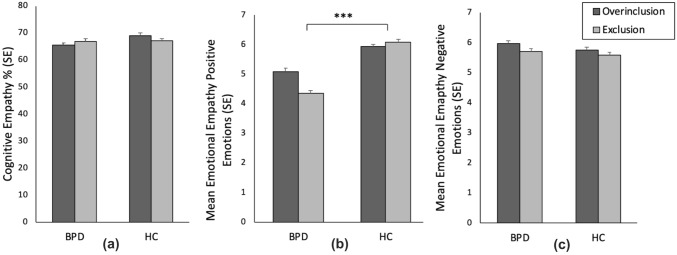
Unstable interpersonal relationships and fear of abandonment are core symptoms of borderline personality disorder (BPD) that often intensify during stress. Psychosocial stress, which includes components of social exclusion and increases cortisol secretion, enhances emotional empathy in healthy individuals. Women with BPD, on the contrary, react with reduced emotional empathy. The aim of the present study was to investigate the effects of perceived social exclusion without accompanying cortisol increase on empathy in women with BPD and healthy women. To induce social exclusion, we randomized 98 women with BPD and 98 healthy women to either an exclusion or an overinclusion (control) condition of Cyberball, a virtual ball game. Subsequently, participants underwent the Multifaceted Empathy Test (MET), which assesses cognitive and emotional empathy. There was no increase in cortisol release after Cyberball. Cognitive empathy did not differ between groups or conditions. Women with BPD reported lower emotional empathy for positive emotions (group by valence interaction), but not for negative emotions. Exploratory analyses suggested that this effect might be more pronounced after social exclusion. Our results confirm previous findings that cognitive empathy does not differ between women with BPD and healthy women and extend this evidence to social exclusion. Emotional empathy in women with BPD seems to be more sensitive to the effects of stress or ambiguous social situations. Specifically, emotional empathy seems to be reduced for positive emotions, and might further decline after social exclusion. Empathic reactions to emotional stimuli of different valences and to specific emotions should be further investigated.
期刊介绍:
The original papers published in the European Archives of Psychiatry and Clinical Neuroscience deal with all aspects of psychiatry and related clinical neuroscience.
Clinical psychiatry, psychopathology, epidemiology as well as brain imaging, neuropathological, neurophysiological, neurochemical and moleculargenetic studies of psychiatric disorders are among the topics covered.
Thus both the clinician and the neuroscientist are provided with a handy source of information on important scientific developments.



 京公网安备 11010802042870号
京ICP备2023020795号-1
京公网安备 11010802042870号
京ICP备2023020795号-1

 分享
分享
 求助内容:
求助内容: 应助结果提醒方式:
 扫码关注我们
