The ARMADILLO text message intervention to improve the sexual and reproductive health knowledge of adolescents in Peru: Results of a randomized controlled trial.
Jose E Perez-Lu, Fiorella Guerrero, César P Cárcamo, Mónica Alburqueque, Marina Chiappe, Michelle J Hindin, Ndema Habib, Lale Say, Lianne Gonsalves, Angela M Bayer
{"title":"The ARMADILLO text message intervention to improve the sexual and reproductive health knowledge of adolescents in Peru: Results of a randomized controlled trial.","authors":"Jose E Perez-Lu, Fiorella Guerrero, César P Cárcamo, Mónica Alburqueque, Marina Chiappe, Michelle J Hindin, Ndema Habib, Lale Say, Lianne Gonsalves, Angela M Bayer","doi":"10.1371/journal.pone.0262986","DOIUrl":null,"url":null,"abstract":"<p><strong>Background: </strong>The ARMADILLO Study determined whether adolescents able to access SRH information on-demand via SMS were better able to reject contraception-related myths and misconceptions as compared with adolescents receiving pushed SMS or no intervention.</p><p><strong>Trial design: </strong>This trial was an unblinded, three-arm, parallel-group, individual RCT with a 1:1:1 allocation. Trial registration: ISRCTN85156148.</p><p><strong>Methods: </strong>This study was conducted in Lima, Peru among participants ages 13-17 years. Eligible participants were randomized into one of three arms: Arm 1: access to ARMADILLO's SMS information on-demand; Arm 2 access to ARMADILLO SMS information pushed to their phone; Arm 3 control (no SMS). The intervention period lasted seven weeks. At baseline, endline, and follow-up (eight weeks following endline), participants were assessed on a variety of contraception-related myths and misconceptions. An index of myths-believed was generated. The primary outcome assessed the subject-specific change in the mean score between baseline and endline. Knowledge retention from endline to follow-up was also assessed, as was a 'content exposure' outcome, which assessed change in participants' knowledge based on relevant SMS received.</p><p><strong>Results: </strong>In total, 712 participants were randomized to the three arms: 659 completed an endline assessment and were included in the primary analysis. Arm 2 participants believed fewer myths at endline compared with control arm participants (estimated subject-specific mean difference of -3.69% [-6.17%, -1.21%], p = 0.004). There was no significant difference between participants in Arm 1 vs. the control Arm, or between participants in Arm 1 vs. Arm 2. A further decrease in myths believed between endline and follow-up (knowledge retention) was observed in all arms; however, there was no difference between arms. The content exposure analysis saw significant reductions in myths believed for Arm 1 (estimated subject-specific mean difference of -9.47% [-14.83%, -4.11%], p = .001) and Arm 2 (-5.93% [-8.57%, -3.29%], p < .001) as compared with the control arm; however Arm 1's reduced sample size (n = 28) is a severe limitation.</p><p><strong>Discussion: </strong>The ARMADILLO SMS content has a significant (but small) effect on participants' contraception-related knowledge. Standalone, adolescent SRH digital health interventions may affect only modest change. Instead, digital is probably best used a complementary channel to expand the reach of existing validated SRH information and service programs.</p>","PeriodicalId":20189,"journal":{"name":"PLoS ONE","volume":"17 2","pages":"e0262986"},"PeriodicalIF":2.6000,"publicationDate":"2022-02-10","publicationTypes":"Journal Article","fieldsOfStudy":null,"isOpenAccess":false,"openAccessPdf":"https://www.ncbi.nlm.nih.gov/pmc/articles/PMC8830715/pdf/","citationCount":"0","resultStr":null,"platform":"Semanticscholar","paperid":null,"PeriodicalName":"PLoS ONE","FirstCategoryId":"103","ListUrlMain":"https://doi.org/10.1371/journal.pone.0262986","RegionNum":3,"RegionCategory":"综合性期刊","ArticlePicture":[],"TitleCN":null,"AbstractTextCN":null,"PMCID":null,"EPubDate":"2022/1/1 0:00:00","PubModel":"eCollection","JCR":"Q1","JCRName":"MULTIDISCIPLINARY SCIENCES","Score":null,"Total":0}
引用次数: 0
Abstract
Background: The ARMADILLO Study determined whether adolescents able to access SRH information on-demand via SMS were better able to reject contraception-related myths and misconceptions as compared with adolescents receiving pushed SMS or no intervention.
Trial design: This trial was an unblinded, three-arm, parallel-group, individual RCT with a 1:1:1 allocation. Trial registration: ISRCTN85156148.
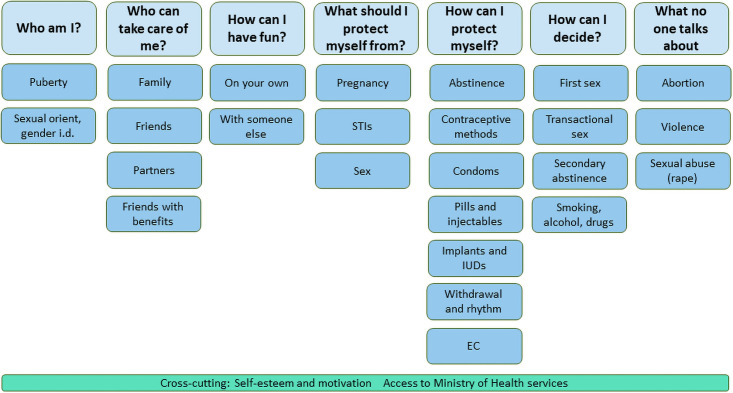
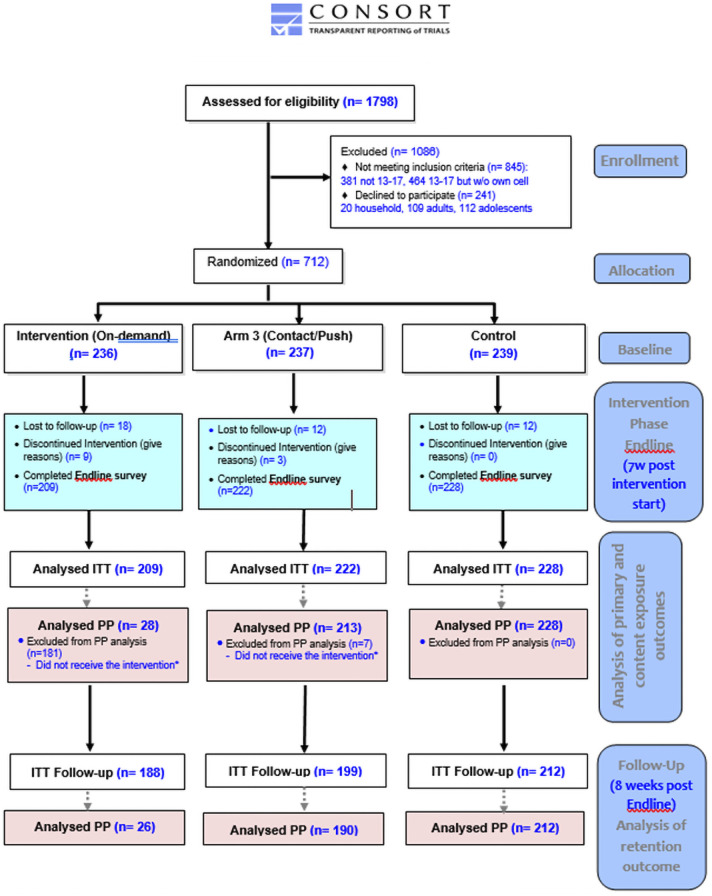
Methods: This study was conducted in Lima, Peru among participants ages 13-17 years. Eligible participants were randomized into one of three arms: Arm 1: access to ARMADILLO's SMS information on-demand; Arm 2 access to ARMADILLO SMS information pushed to their phone; Arm 3 control (no SMS). The intervention period lasted seven weeks. At baseline, endline, and follow-up (eight weeks following endline), participants were assessed on a variety of contraception-related myths and misconceptions. An index of myths-believed was generated. The primary outcome assessed the subject-specific change in the mean score between baseline and endline. Knowledge retention from endline to follow-up was also assessed, as was a 'content exposure' outcome, which assessed change in participants' knowledge based on relevant SMS received.
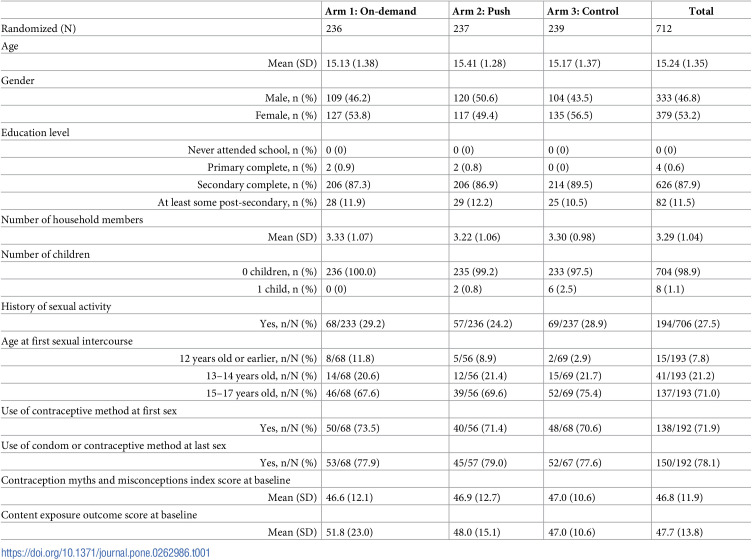
Results: In total, 712 participants were randomized to the three arms: 659 completed an endline assessment and were included in the primary analysis. Arm 2 participants believed fewer myths at endline compared with control arm participants (estimated subject-specific mean difference of -3.69% [-6.17%, -1.21%], p = 0.004). There was no significant difference between participants in Arm 1 vs. the control Arm, or between participants in Arm 1 vs. Arm 2. A further decrease in myths believed between endline and follow-up (knowledge retention) was observed in all arms; however, there was no difference between arms. The content exposure analysis saw significant reductions in myths believed for Arm 1 (estimated subject-specific mean difference of -9.47% [-14.83%, -4.11%], p = .001) and Arm 2 (-5.93% [-8.57%, -3.29%], p < .001) as compared with the control arm; however Arm 1's reduced sample size (n = 28) is a severe limitation.
Discussion: The ARMADILLO SMS content has a significant (but small) effect on participants' contraception-related knowledge. Standalone, adolescent SRH digital health interventions may affect only modest change. Instead, digital is probably best used a complementary channel to expand the reach of existing validated SRH information and service programs.
期刊介绍:
PLOS ONE is an international, peer-reviewed, open-access, online publication. PLOS ONE welcomes reports on primary research from any scientific discipline. It provides:
* Open-access—freely accessible online, authors retain copyright
* Fast publication times
* Peer review by expert, practicing researchers
* Post-publication tools to indicate quality and impact
* Community-based dialogue on articles
* Worldwide media coverage




 京公网安备 11010802042870号
京ICP备2023020795号-1
京公网安备 11010802042870号
京ICP备2023020795号-1

 分享
分享
 求助内容:
求助内容: 应助结果提醒方式:
 扫码关注我们
