{"title":"Bayesian Inference for an Unknown Number of Attributes in Restricted Latent Class Models.","authors":"Yinghan Chen, Steven Andrew Culpepper, Yuguo Chen","doi":"10.1007/s11336-022-09900-7","DOIUrl":null,"url":null,"abstract":"<p><p>The specification of the [Formula: see text] matrix in cognitive diagnosis models is important for correct classification of attribute profiles. Researchers have proposed many methods for estimation and validation of the data-driven [Formula: see text] matrices. However, inference of the number of attributes in the general restricted latent class model remains an open question. We propose a Bayesian framework for general restricted latent class models and use the spike-and-slab prior to avoid the computation issues caused by the varying dimensions of model parameters associated with the number of attributes, K. We develop an efficient Metropolis-within-Gibbs algorithm to estimate K and the corresponding [Formula: see text] matrix simultaneously. The proposed algorithm uses the stick-breaking construction to mimic an Indian buffet process and employs a novel Metropolis-Hastings transition step to encourage exploring the sample space associated with different values of K. We evaluate the performance of the proposed method through a simulation study under different model specifications and apply the method to a real data set related to a fluid intelligence matrix reasoning test.</p>","PeriodicalId":54534,"journal":{"name":"Psychometrika","volume":"88 2","pages":"613-635"},"PeriodicalIF":3.1000,"publicationDate":"2023-06-01","publicationTypes":"Journal Article","fieldsOfStudy":null,"isOpenAccess":false,"openAccessPdf":"","citationCount":"0","resultStr":null,"platform":"Semanticscholar","paperid":null,"PeriodicalName":"Psychometrika","FirstCategoryId":"102","ListUrlMain":"https://doi.org/10.1007/s11336-022-09900-7","RegionNum":2,"RegionCategory":"心理学","ArticlePicture":[],"TitleCN":null,"AbstractTextCN":null,"PMCID":null,"EPubDate":"2023/1/22 0:00:00","PubModel":"Epub","JCR":"Q1","JCRName":"MATHEMATICS, INTERDISCIPLINARY APPLICATIONS","Score":null,"Total":0}
引用次数: 0
Abstract
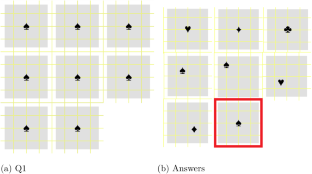
The specification of the [Formula: see text] matrix in cognitive diagnosis models is important for correct classification of attribute profiles. Researchers have proposed many methods for estimation and validation of the data-driven [Formula: see text] matrices. However, inference of the number of attributes in the general restricted latent class model remains an open question. We propose a Bayesian framework for general restricted latent class models and use the spike-and-slab prior to avoid the computation issues caused by the varying dimensions of model parameters associated with the number of attributes, K. We develop an efficient Metropolis-within-Gibbs algorithm to estimate K and the corresponding [Formula: see text] matrix simultaneously. The proposed algorithm uses the stick-breaking construction to mimic an Indian buffet process and employs a novel Metropolis-Hastings transition step to encourage exploring the sample space associated with different values of K. We evaluate the performance of the proposed method through a simulation study under different model specifications and apply the method to a real data set related to a fluid intelligence matrix reasoning test.
认知诊断模型中[公式:见正文]矩阵的规范对于正确划分属性特征非常重要。研究人员提出了许多方法来估计和验证数据驱动的[公式:见正文]矩阵。然而,在一般的受限潜类模型中,属性数量的推断仍然是一个未决问题。我们为一般受限潜类模型提出了一个贝叶斯框架,并使用尖峰和平板先验来避免因与属性数 K 相关的模型参数维度不同而引起的计算问题。我们开发了一种高效的 Metropolis-within-Gibbs 算法,以同时估计 K 和相应的[公式:见正文]矩阵。我们通过不同模型规格下的模拟研究评估了所提方法的性能,并将该方法应用于与流体智能矩阵推理测试相关的真实数据集。
期刊介绍:
The journal Psychometrika is devoted to the advancement of theory and methodology for behavioral data in psychology, education and the social and behavioral sciences generally. Its coverage is offered in two sections: Theory and Methods (T& M), and Application Reviews and Case Studies (ARCS). T&M articles present original research and reviews on the development of quantitative models, statistical methods, and mathematical techniques for evaluating data from psychology, the social and behavioral sciences and related fields. Application Reviews can be integrative, drawing together disparate methodologies for applications, or comparative and evaluative, discussing advantages and disadvantages of one or more methodologies in applications. Case Studies highlight methodology that deepens understanding of substantive phenomena through more informative data analysis, or more elegant data description.




 京公网安备 11010802042870号
京ICP备2023020795号-1
京公网安备 11010802042870号
京ICP备2023020795号-1

 分享
分享
 求助内容:
求助内容: 应助结果提醒方式:
 扫码关注我们
