{"title":"Plastic surgery online, how accessible are our units?","authors":"Cameron Clarke , Simon Filson","doi":"10.1016/j.surge.2023.05.003","DOIUrl":null,"url":null,"abstract":"<div><h3>Background</h3><p>The Covid-19 pandemic has highlighted the importance of remote patient and professional communication. This has been especially important for highly specialised and regionally-based specialties such as plastic surgery. The aim of this study was to review how UK plastic surgery units represent themselves online and their phone accessibility.</p></div><div><h3>Patients and methods</h3><p>UK plastic surgery units were identified using the BAPRAS website and their websites and telephone accessibility assessed.</p></div><div><h3>Results</h3><p>Whilst a minority of units have clearly invested heavily in ensuring comprehensive webpages, nearly a third have no dedicated webpage at all. We found significant variation in quality and user-friendliness of online resources both for patients and for other healthcare professionals, with less than a quarter of units providing comprehensive contact details, emergency referral guidance, or information about changes to services due to Covid-19, to highlight a few areas. Communication with the BAPRAS website was also poor with less than half of web-links connecting to correct and relevant webpage and only 13.5% of phone numbers connecting directly to a useful plastic surgery number. In the phone component of our study we found that 47% of calls to ‘direct’ numbers went to voicemail but wait-times were significantly less than going through hospital switchboards and connections were more accurate.</p></div><div><h3>Conclusion</h3><p>In a world where a business’ credibility is so heavily based on their online appearance and, in an increasingly online era of medicine, we hope that this study may be a resource for units to improve their web-based resources and prompt further research in enhancing patient experience online.</p></div>","PeriodicalId":49463,"journal":{"name":"Surgeon-Journal of the Royal Colleges of Surgeons of Edinburgh and Ireland","volume":"21 6","pages":"Pages e372-e377"},"PeriodicalIF":2.3000,"publicationDate":"2023-12-01","publicationTypes":"Journal Article","fieldsOfStudy":null,"isOpenAccess":false,"openAccessPdf":"https://www.ncbi.nlm.nih.gov/pmc/articles/PMC10257443/pdf/","citationCount":"0","resultStr":null,"platform":"Semanticscholar","paperid":null,"PeriodicalName":"Surgeon-Journal of the Royal Colleges of Surgeons of Edinburgh and Ireland","FirstCategoryId":"3","ListUrlMain":"https://www.sciencedirect.com/science/article/pii/S1479666X23000574","RegionNum":4,"RegionCategory":"医学","ArticlePicture":[],"TitleCN":null,"AbstractTextCN":null,"PMCID":null,"EPubDate":"","PubModel":"","JCR":"Q2","JCRName":"SURGERY","Score":null,"Total":0}
引用次数: 0
Abstract
Background
The Covid-19 pandemic has highlighted the importance of remote patient and professional communication. This has been especially important for highly specialised and regionally-based specialties such as plastic surgery. The aim of this study was to review how UK plastic surgery units represent themselves online and their phone accessibility.
Patients and methods
UK plastic surgery units were identified using the BAPRAS website and their websites and telephone accessibility assessed.
Results
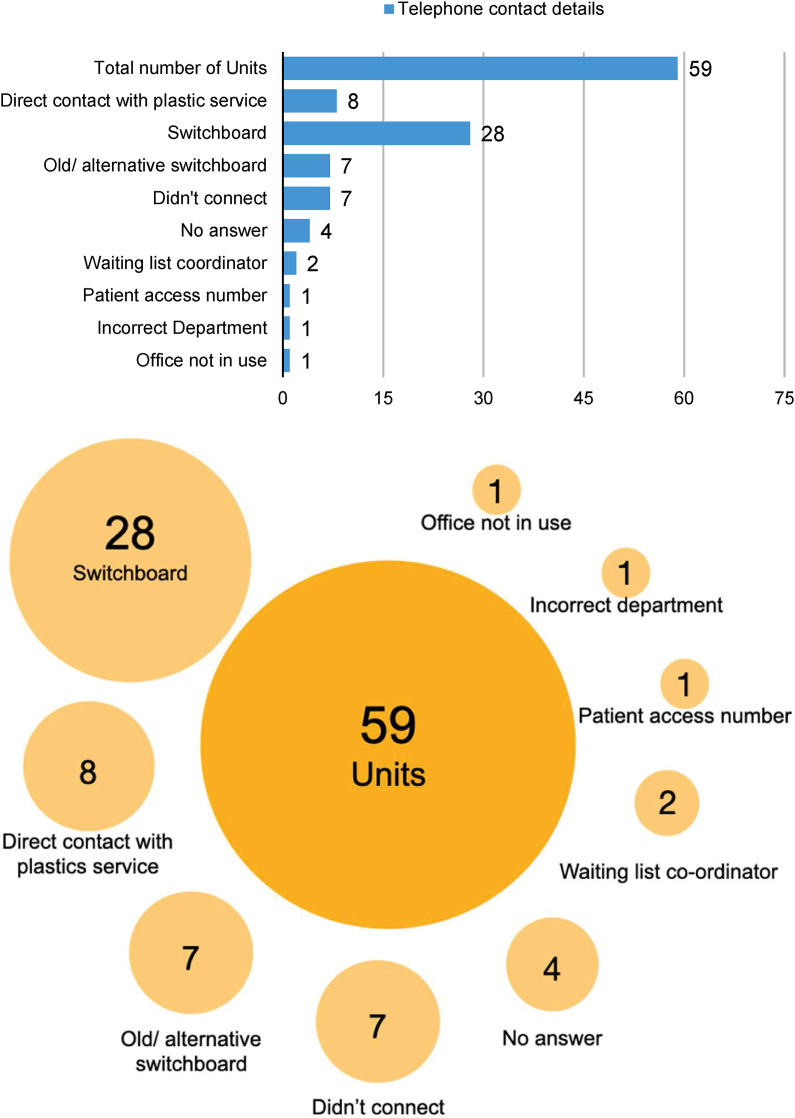
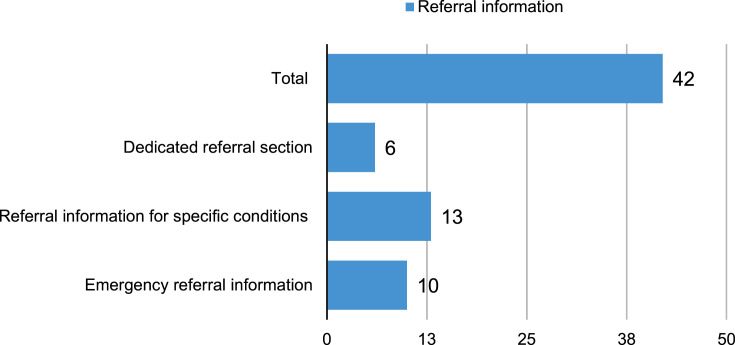
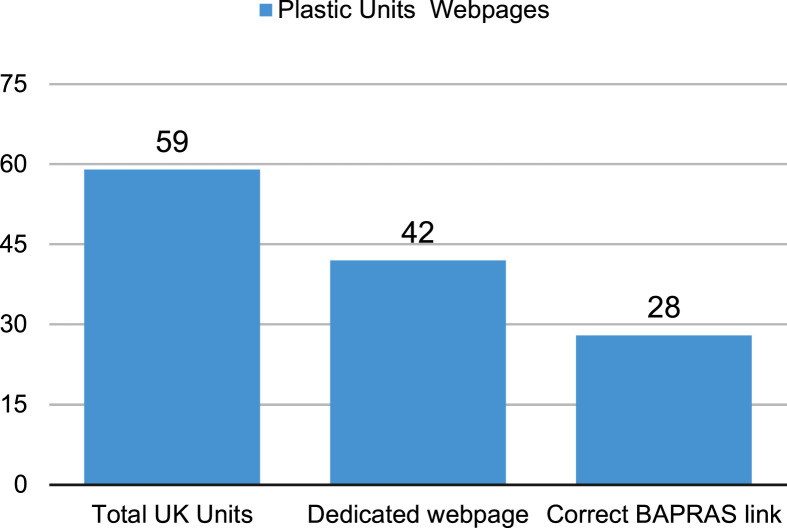
Whilst a minority of units have clearly invested heavily in ensuring comprehensive webpages, nearly a third have no dedicated webpage at all. We found significant variation in quality and user-friendliness of online resources both for patients and for other healthcare professionals, with less than a quarter of units providing comprehensive contact details, emergency referral guidance, or information about changes to services due to Covid-19, to highlight a few areas. Communication with the BAPRAS website was also poor with less than half of web-links connecting to correct and relevant webpage and only 13.5% of phone numbers connecting directly to a useful plastic surgery number. In the phone component of our study we found that 47% of calls to ‘direct’ numbers went to voicemail but wait-times were significantly less than going through hospital switchboards and connections were more accurate.
Conclusion
In a world where a business’ credibility is so heavily based on their online appearance and, in an increasingly online era of medicine, we hope that this study may be a resource for units to improve their web-based resources and prompt further research in enhancing patient experience online.
期刊介绍:
Since its establishment in 2003, The Surgeon has established itself as one of the leading multidisciplinary surgical titles, both in print and online. The Surgeon is published for the worldwide surgical and dental communities. The goal of the Journal is to achieve wider national and international recognition, through a commitment to excellence in original research. In addition, both Colleges see the Journal as an important educational service, and consequently there is a particular focus on post-graduate development. Much of our educational role will continue to be achieved through publishing expanded review articles by leaders in their field.
Articles in related areas to surgery and dentistry, such as healthcare management and education, are also welcomed. We aim to educate, entertain, give insight into new surgical techniques and technology, and provide a forum for debate and discussion.



 京公网安备 11010802042870号
京ICP备2023020795号-1
京公网安备 11010802042870号
京ICP备2023020795号-1

 分享
分享
 求助内容:
求助内容: 应助结果提醒方式:
 扫码关注我们
