Measuring Intolerance of Uncertainty After Acquired Brain Injury: Factor Structure, Reliability, and Validity of the Intolerance of Uncertainty Scale-12.
Andrea Kusec, Fionnuala C Murphy, Polly V Peers, Tom Manly
{"title":"Measuring Intolerance of Uncertainty After Acquired Brain Injury: Factor Structure, Reliability, and Validity of the Intolerance of Uncertainty Scale-12.","authors":"Andrea Kusec, Fionnuala C Murphy, Polly V Peers, Tom Manly","doi":"10.1177/10731911231182693","DOIUrl":null,"url":null,"abstract":"<p><p>Intolerance of uncertainty (IU) is a risk factor for poor mental health. Acquired brain injury (ABI; for example, stroke, traumatic brain injury) often brings considerable uncertainty and increased mood disorder vulnerability. The Intolerance of Uncertainty Scale-Short Form (IUS-12) is a brief, well-validated IU measure in non-ABI samples, comprising two subscales, namely, Prospective Anxiety and Inhibitory Anxiety. Here, for the first time, we investigated its reliability and validity (<i>N</i> = 118), and factor structure (<i>N</i> = 176), in ABI. Both subscales had high test-retest reliability (intraclass correlation coefficients [ICCs] of .75 and .86) and were significantly associated with mood disorder symptoms. The two-factor model was superior to a one-factor IU model fit. Some fit statistics were less than optimal (standardized root mean square residual [SRMR] = 0.06, root mean square error of approximation [RMSEA] = 0.09); hence, exploration of other factor structures in other ABI samples may be warranted. Nonetheless, the IUS-12 appears suitable in ABI.</p>","PeriodicalId":8577,"journal":{"name":"Assessment","volume":" ","pages":"794-811"},"PeriodicalIF":3.4000,"publicationDate":"2024-06-01","publicationTypes":"Journal Article","fieldsOfStudy":null,"isOpenAccess":false,"openAccessPdf":"https://www.ncbi.nlm.nih.gov/pmc/articles/PMC11092298/pdf/","citationCount":"0","resultStr":null,"platform":"Semanticscholar","paperid":null,"PeriodicalName":"Assessment","FirstCategoryId":"102","ListUrlMain":"https://doi.org/10.1177/10731911231182693","RegionNum":2,"RegionCategory":"心理学","ArticlePicture":[],"TitleCN":null,"AbstractTextCN":null,"PMCID":null,"EPubDate":"2023/6/26 0:00:00","PubModel":"Epub","JCR":"Q1","JCRName":"PSYCHOLOGY, CLINICAL","Score":null,"Total":0}
引用次数: 0
Abstract
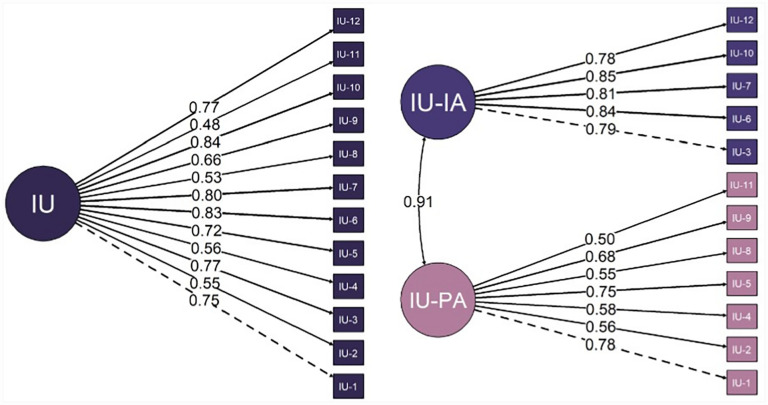
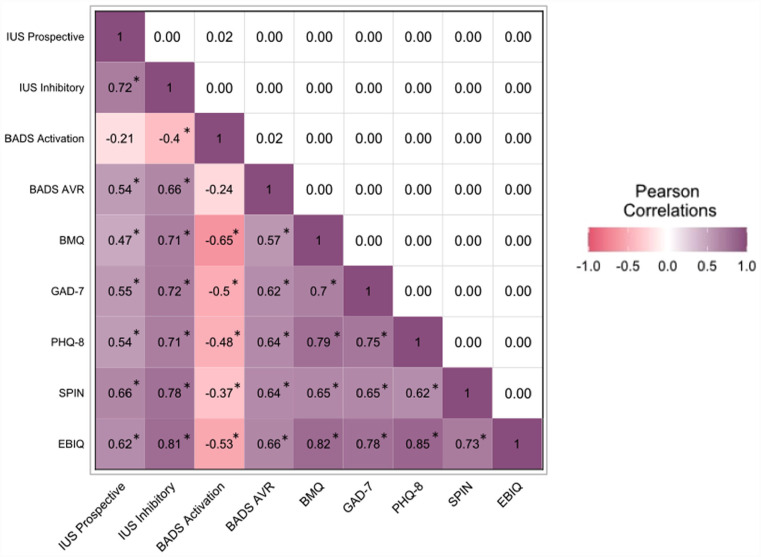
Intolerance of uncertainty (IU) is a risk factor for poor mental health. Acquired brain injury (ABI; for example, stroke, traumatic brain injury) often brings considerable uncertainty and increased mood disorder vulnerability. The Intolerance of Uncertainty Scale-Short Form (IUS-12) is a brief, well-validated IU measure in non-ABI samples, comprising two subscales, namely, Prospective Anxiety and Inhibitory Anxiety. Here, for the first time, we investigated its reliability and validity (N = 118), and factor structure (N = 176), in ABI. Both subscales had high test-retest reliability (intraclass correlation coefficients [ICCs] of .75 and .86) and were significantly associated with mood disorder symptoms. The two-factor model was superior to a one-factor IU model fit. Some fit statistics were less than optimal (standardized root mean square residual [SRMR] = 0.06, root mean square error of approximation [RMSEA] = 0.09); hence, exploration of other factor structures in other ABI samples may be warranted. Nonetheless, the IUS-12 appears suitable in ABI.
期刊介绍:
Assessment publishes articles in the domain of applied clinical assessment. The emphasis of this journal is on publication of information of relevance to the use of assessment measures, including test development, validation, and interpretation practices. The scope of the journal includes research that can inform assessment practices in mental health, forensic, medical, and other applied settings. Papers that focus on the assessment of cognitive and neuropsychological functioning, personality, and psychopathology are invited. Most papers published in Assessment report the results of original empirical research, however integrative review articles and scholarly case studies will also be considered.




 京公网安备 11010802042870号
京ICP备2023020795号-1
京公网安备 11010802042870号
京ICP备2023020795号-1

 分享
分享
 求助内容:
求助内容: 应助结果提醒方式:
 扫码关注我们
