Ryan C. Sullivan , Matthew D. Rockstrom , Eric P. Schmidt , Joseph A. Hippensteel
{"title":"Endothelial glycocalyx degradation during sepsis: Causes and consequences","authors":"Ryan C. Sullivan , Matthew D. Rockstrom , Eric P. Schmidt , Joseph A. Hippensteel","doi":"10.1016/j.mbplus.2021.100094","DOIUrl":null,"url":null,"abstract":"<div><p>The glycocalyx is a ubiquitous structure found on endothelial cells that extends into the vascular lumen. It is enriched in proteoglycans, which are proteins attached to the glycosaminoglycans heparan sulfate, chondroitin sulfate, dermatan sulfate, keratan sulfate, and hyaluronic acid. In health and disease, the endothelial glycocalyx is a central regulator of vascular permeability, inflammation, coagulation, and circulatory tonicity. During sepsis, a life-threatening syndrome seen commonly in hospitalized patients, the endothelial glycocalyx is degraded, significantly contributing to its many clinical manifestations. In this review we discuss the intrinsically linked mechanisms responsible for septic endothelial glycocalyx destruction: glycosaminoglycan degradation and proteoglycan cleavage. We then examine the consequences of local endothelial glycocalyx loss to several organ systems and the systemic consequences of shed glycocalyx constituents. Last, we explore clinically relevant non-modifiable and modifiable factors that exacerbate or protect against endothelial glycocalyx shedding during sepsis.</p></div>","PeriodicalId":52317,"journal":{"name":"Matrix Biology Plus","volume":"12 ","pages":"Article 100094"},"PeriodicalIF":0.0000,"publicationDate":"2021-12-01","publicationTypes":"Journal Article","fieldsOfStudy":null,"isOpenAccess":false,"openAccessPdf":"https://ftp.ncbi.nlm.nih.gov/pub/pmc/oa_pdf/98/bb/main.PMC8668992.pdf","citationCount":"18","resultStr":null,"platform":"Semanticscholar","paperid":null,"PeriodicalName":"Matrix Biology Plus","FirstCategoryId":"1085","ListUrlMain":"https://www.sciencedirect.com/science/article/pii/S2590028521000387","RegionNum":0,"RegionCategory":null,"ArticlePicture":[],"TitleCN":null,"AbstractTextCN":null,"PMCID":null,"EPubDate":"","PubModel":"","JCR":"Q1","JCRName":"Medicine","Score":null,"Total":0}
引用次数: 18
Abstract
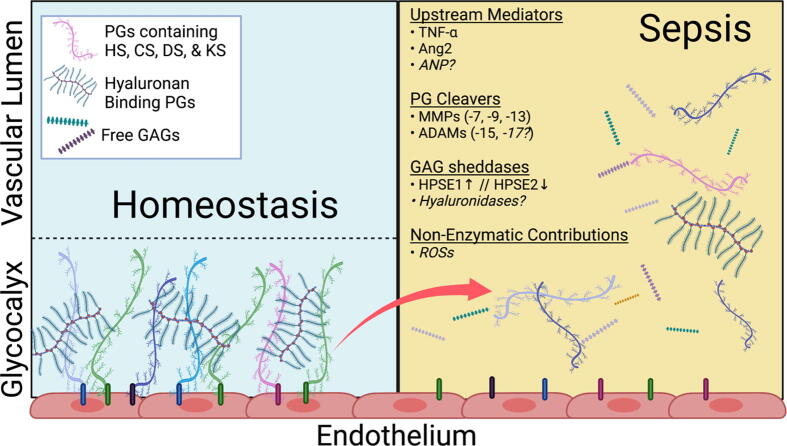
The glycocalyx is a ubiquitous structure found on endothelial cells that extends into the vascular lumen. It is enriched in proteoglycans, which are proteins attached to the glycosaminoglycans heparan sulfate, chondroitin sulfate, dermatan sulfate, keratan sulfate, and hyaluronic acid. In health and disease, the endothelial glycocalyx is a central regulator of vascular permeability, inflammation, coagulation, and circulatory tonicity. During sepsis, a life-threatening syndrome seen commonly in hospitalized patients, the endothelial glycocalyx is degraded, significantly contributing to its many clinical manifestations. In this review we discuss the intrinsically linked mechanisms responsible for septic endothelial glycocalyx destruction: glycosaminoglycan degradation and proteoglycan cleavage. We then examine the consequences of local endothelial glycocalyx loss to several organ systems and the systemic consequences of shed glycocalyx constituents. Last, we explore clinically relevant non-modifiable and modifiable factors that exacerbate or protect against endothelial glycocalyx shedding during sepsis.




 京公网安备 11010802042870号
京ICP备2023020795号-1
京公网安备 11010802042870号
京ICP备2023020795号-1

 分享
分享
 求助内容:
求助内容: 应助结果提醒方式:
 扫码关注我们
