Stephanie J. Shell, Katie Slattery, Brad Clark, James R. Broatch, Shona L. Halson, Aaron J. Coutts
{"title":"Development and validity of the subjective training quality scale","authors":"Stephanie J. Shell, Katie Slattery, Brad Clark, James R. Broatch, Shona L. Halson, Aaron J. Coutts","doi":"10.1080/17461391.2022.2111276","DOIUrl":null,"url":null,"abstract":"<div>\n \n <p>This study aimed to define, develop, and validate a subjective scale of training quality. Two related studies were used to 1) define training quality and 2) develop and validate a subjective scale. Part One: a purposive sample of 15 sub-elite (i.e. national) and elite (i.e. international) swimmers participated in one, 20–30-min semi-structured interview. Thematic analysis of interview responses established three constructs to define training quality. These were the physical, technical, and mental aspects of training. Part Two: development of the Subjective Training Quality (STQ) scale based on the three constructs identified in Part One. 252 sub-elite and elite athletes, across eight sports completed the STQ scale. Cronbach's alpha (α) assessed internal consistency, histogram plot analysis assessed face validity, and confirmatory factor analysis (CFA) compared physical, technical, and mental constructs with training quality. Root mean square error of approximation (RMSEA) and standardised root mean square residual (SRMR) evaluated CFA quality of fit. Physical, technical, and mental constructs demonstrated a high “acceptable” level of internal consistency (α = 0.85) and excellent face validity. Comparatively, the CFA quality of fit was “excellent” (RMSEA = <0.01 “good”, SRMR = 0.00 “perfect”). The STQ scale demonstrated excellent internal consistency and face validity, establishing capacity to monitor training quality. The STQ scale could be used in conjunction with traditional training monitoring tools to provide additional insight into athlete's training quality. Further investigation is required to determine how the STQ scale may interact with subjective and objective training performance measures, and how it could be incorporated into daily training monitoring.</p>\n </div>","PeriodicalId":93999,"journal":{"name":"European journal of sport science","volume":"23 7","pages":"1102-1109"},"PeriodicalIF":3.0000,"publicationDate":"2022-08-28","publicationTypes":"Journal Article","fieldsOfStudy":null,"isOpenAccess":false,"openAccessPdf":"https://onlinelibrary.wiley.com/doi/epdf/10.1080/17461391.2022.2111276","citationCount":"0","resultStr":null,"platform":"Semanticscholar","paperid":null,"PeriodicalName":"European journal of sport science","FirstCategoryId":"1085","ListUrlMain":"https://onlinelibrary.wiley.com/doi/10.1080/17461391.2022.2111276","RegionNum":0,"RegionCategory":null,"ArticlePicture":[],"TitleCN":null,"AbstractTextCN":null,"PMCID":null,"EPubDate":"","PubModel":"","JCR":"","JCRName":"","Score":null,"Total":0}
引用次数: 0
Abstract
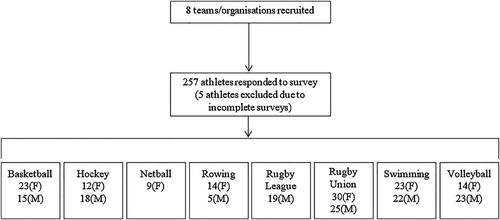
This study aimed to define, develop, and validate a subjective scale of training quality. Two related studies were used to 1) define training quality and 2) develop and validate a subjective scale. Part One: a purposive sample of 15 sub-elite (i.e. national) and elite (i.e. international) swimmers participated in one, 20–30-min semi-structured interview. Thematic analysis of interview responses established three constructs to define training quality. These were the physical, technical, and mental aspects of training. Part Two: development of the Subjective Training Quality (STQ) scale based on the three constructs identified in Part One. 252 sub-elite and elite athletes, across eight sports completed the STQ scale. Cronbach's alpha (α) assessed internal consistency, histogram plot analysis assessed face validity, and confirmatory factor analysis (CFA) compared physical, technical, and mental constructs with training quality. Root mean square error of approximation (RMSEA) and standardised root mean square residual (SRMR) evaluated CFA quality of fit. Physical, technical, and mental constructs demonstrated a high “acceptable” level of internal consistency (α = 0.85) and excellent face validity. Comparatively, the CFA quality of fit was “excellent” (RMSEA = <0.01 “good”, SRMR = 0.00 “perfect”). The STQ scale demonstrated excellent internal consistency and face validity, establishing capacity to monitor training quality. The STQ scale could be used in conjunction with traditional training monitoring tools to provide additional insight into athlete's training quality. Further investigation is required to determine how the STQ scale may interact with subjective and objective training performance measures, and how it could be incorporated into daily training monitoring.



 京公网安备 11010802042870号
京ICP备2023020795号-1
京公网安备 11010802042870号
京ICP备2023020795号-1

 分享
分享

 求助内容:
求助内容: 应助结果提醒方式:
 扫码关注我们
