{"title":"Triceps brachii hypertrophy is substantially greater after elbow extension training performed in the overhead versus neutral arm position","authors":"Sumiaki Maeo, Yuhang Wu, Meng Huang, Hikaru Sakurai, Yuki Kusagawa, Takashi Sugiyama, Hiroaki Kanehisa, Tadao Isaka","doi":"10.1080/17461391.2022.2100279","DOIUrl":null,"url":null,"abstract":"<div>\n \n <p>The biarticular triceps brachii long head (TB<sub>Long</sub>) is lengthened more in the overhead than neutral arm position. We compared triceps brachii hypertrophy after elbow extension training performed in the overhead vs. neutral arm position. Using a cable machine, 21 adults conducted elbow extensions (90−0°) with one arm in the overhead (Overhead-Arm) and the other arm in the neutral (Neutral-Arm) position at 70% one-repetition maximum (1RM), 10 reps/set, 5 sets/session, 2 sessions/week for 12 weeks. Training load was gradually increased (+5% 1RM/session) when the preceding session was completed without repetition failure. 1RM of the assigned condition and MRI-measured muscle volume of the TB<sub>Long</sub>, monoarticular lateral and medial heads (TB<sub>Lat+Med</sub>), and whole triceps brachii (Whole-TB) were assessed pre- and post-training. Training load and 1RM increased in both arms similarly (+62−71% at post, <i>P </i>= 0.285), while their absolute values/weights were always lower in Overhead-Arm (-34−39%, <i>P </i>< 0.001). Changes in muscle volume in Overhead-Arm compared to Neutral-Arm were 1.5-fold greater for the TB<sub>Long</sub> (+28.5% vs. +19.6%, Cohen's <i>d </i>= 0.61, <i>P </i>< 0.001), 1.4-fold greater for the TB<sub>Lat+Med</sub> (+14.6% vs. +10.5%, <i>d </i>= 0.39, <i>P </i>= 0.002), and 1.4-fold greater for the Whole-TB (+19.9% vs. +13.9%, <i>d </i>= 0.54, <i>P </i>< 0.001). In conclusion, triceps brachii hypertrophy was substantially greater after elbow extension training performed in the overhead versus neutral arm position, even with lower absolute loads used during the training.</p>\n </div>","PeriodicalId":93999,"journal":{"name":"European journal of sport science","volume":"23 7","pages":"1240-1250"},"PeriodicalIF":3.0000,"publicationDate":"2022-08-11","publicationTypes":"Journal Article","fieldsOfStudy":null,"isOpenAccess":false,"openAccessPdf":"https://onlinelibrary.wiley.com/doi/epdf/10.1080/17461391.2022.2100279","citationCount":"0","resultStr":null,"platform":"Semanticscholar","paperid":null,"PeriodicalName":"European journal of sport science","FirstCategoryId":"1085","ListUrlMain":"https://onlinelibrary.wiley.com/doi/10.1080/17461391.2022.2100279","RegionNum":0,"RegionCategory":null,"ArticlePicture":[],"TitleCN":null,"AbstractTextCN":null,"PMCID":null,"EPubDate":"","PubModel":"","JCR":"","JCRName":"","Score":null,"Total":0}
引用次数: 0
Abstract
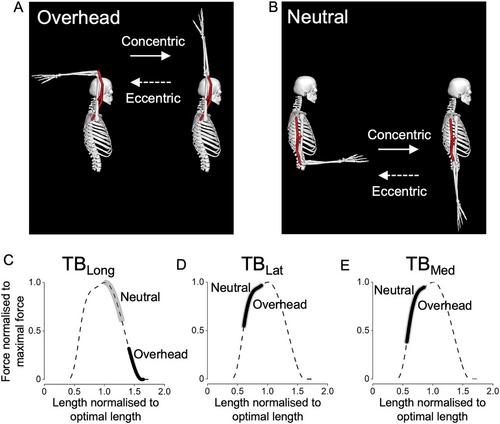
The biarticular triceps brachii long head (TBLong) is lengthened more in the overhead than neutral arm position. We compared triceps brachii hypertrophy after elbow extension training performed in the overhead vs. neutral arm position. Using a cable machine, 21 adults conducted elbow extensions (90−0°) with one arm in the overhead (Overhead-Arm) and the other arm in the neutral (Neutral-Arm) position at 70% one-repetition maximum (1RM), 10 reps/set, 5 sets/session, 2 sessions/week for 12 weeks. Training load was gradually increased (+5% 1RM/session) when the preceding session was completed without repetition failure. 1RM of the assigned condition and MRI-measured muscle volume of the TBLong, monoarticular lateral and medial heads (TBLat+Med), and whole triceps brachii (Whole-TB) were assessed pre- and post-training. Training load and 1RM increased in both arms similarly (+62−71% at post, P = 0.285), while their absolute values/weights were always lower in Overhead-Arm (-34−39%, P < 0.001). Changes in muscle volume in Overhead-Arm compared to Neutral-Arm were 1.5-fold greater for the TBLong (+28.5% vs. +19.6%, Cohen's d = 0.61, P < 0.001), 1.4-fold greater for the TBLat+Med (+14.6% vs. +10.5%, d = 0.39, P = 0.002), and 1.4-fold greater for the Whole-TB (+19.9% vs. +13.9%, d = 0.54, P < 0.001). In conclusion, triceps brachii hypertrophy was substantially greater after elbow extension training performed in the overhead versus neutral arm position, even with lower absolute loads used during the training.
双关节肱三头肌长头(TBLong)在俯卧时比中立臂位时延长得更多。我们比较了在头顶和中立臂位进行肘部伸展训练后肱三头肌肥大的情况。使用拉线机,21名成人进行肘关节伸展(90°- 0°),一只手臂在头顶(overhead - arm),另一只手臂在中立(neutral - arm)位置,以70%的最大单次重复(1RM), 10次/组,5组/组,每周2次/周,持续12周。训练负荷逐渐增加(+5% 1RM/次),当前一次训练完成后没有重复失败。在训练前和训练后评估指定条件的1RM和mri测量的TBLat、单关节外侧和内侧头(TBLat+Med)和整个肱三头肌(whole - tb)的肌肉体积。两臂的训练负荷和1RM增加相似(+62 - 71%,P = 0.285),而它们的绝对值/重量在顶臂总是较低(-34 - 39%,P < 0.001)。与中性组相比,TBLat+Med组肌肉体积变化大1.5倍(+28.5% vs +19.6%, d = 0.61, P < 0.001), TBLat+Med组肌肉体积变化大1.4倍(+14.6% vs +10.5%, d = 0.39, P = 0.002), Whole-TB组肌肉体积变化大1.4倍(+19.9% vs +13.9%, d = 0.54, P < 0.001)。综上所述,即使在训练中使用的绝对负荷较低的情况下,在以头顶姿势进行肘关节伸展训练后,肱三头肌肥大明显大于中性手臂姿势。



 京公网安备 11010802042870号
京ICP备2023020795号-1
京公网安备 11010802042870号
京ICP备2023020795号-1

 分享
分享

 求助内容:
求助内容: 应助结果提醒方式:
 扫码关注我们
