Jodie A. Palmer, Rodrigo R. Bini, Daniel W. T. Wundersitz, Michael I. C. Kingsley
{"title":"Residual neuromuscular fatigue influences subsequent on-court activity in basketball","authors":"Jodie A. Palmer, Rodrigo R. Bini, Daniel W. T. Wundersitz, Michael I. C. Kingsley","doi":"10.1080/17461391.2022.2094286","DOIUrl":null,"url":null,"abstract":"<div>\n \n <p>The aim of this study was to determine if residual neuromuscular fatigue influenced subsequent match and training activity in professional women's basketball. Prior to matches and training sessions throughout a season, players performed countermovement jumps while wearing a magnetic, angular rate and gravity (acceleration) sensor on their upper back. Flight time to contraction time ratio was used to determine neuromuscular performance and to identify neuromuscular fatigue. Average session intensity and volume, the proportion of live time spent in different intensity bands (matches), and absolute and relative time spent in different intensity bands (training) were quantified using accelerometry. Residual neuromuscular fatigue was deemed to be present when the decrement in neuromuscular performance relative to pre-season baseline was greater than the smallest worthwhile change. Players displayed residual neuromuscular fatigue before 16% of matches and 33% of training sessions. When players were fatigued prior to matches, the proportion of live time undertaking supramaximal activity was 5.7% less (<i>p</i> = 0.02) and moderate-vigorous activity was 3.7% more than when not fatigued (<i>p</i> = 0.02). When fatigued prior to training, the players displayed a 2.6% decrement in average intensity (<i>p</i> = 0.02), 2.8% decrement in absolute (<i>p</i> = 0.01) and 5.0% decrement in relative (<i>p</i> = 0.01) maximal activity, as well as 13.3% decrement in absolute (<i>p</i> < 0.01) and 6.8% decrement in relative (<i>p</i> < 0.01) supramaximal activity when compared to not being fatigued. These findings suggest that residual neuromuscular fatigue influences players’ ability to perform supramaximal activity, which highlights the importance of monitoring neuromuscular performance throughout a professional season.</p>\n </div>","PeriodicalId":93999,"journal":{"name":"European journal of sport science","volume":"23 7","pages":"1077-1084"},"PeriodicalIF":3.0000,"publicationDate":"2022-07-11","publicationTypes":"Journal Article","fieldsOfStudy":null,"isOpenAccess":false,"openAccessPdf":"https://onlinelibrary.wiley.com/doi/epdf/10.1080/17461391.2022.2094286","citationCount":"0","resultStr":null,"platform":"Semanticscholar","paperid":null,"PeriodicalName":"European journal of sport science","FirstCategoryId":"1085","ListUrlMain":"https://onlinelibrary.wiley.com/doi/10.1080/17461391.2022.2094286","RegionNum":0,"RegionCategory":null,"ArticlePicture":[],"TitleCN":null,"AbstractTextCN":null,"PMCID":null,"EPubDate":"","PubModel":"","JCR":"","JCRName":"","Score":null,"Total":0}
引用次数: 0
Abstract
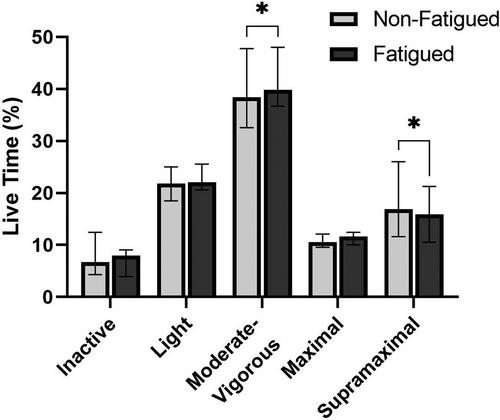
The aim of this study was to determine if residual neuromuscular fatigue influenced subsequent match and training activity in professional women's basketball. Prior to matches and training sessions throughout a season, players performed countermovement jumps while wearing a magnetic, angular rate and gravity (acceleration) sensor on their upper back. Flight time to contraction time ratio was used to determine neuromuscular performance and to identify neuromuscular fatigue. Average session intensity and volume, the proportion of live time spent in different intensity bands (matches), and absolute and relative time spent in different intensity bands (training) were quantified using accelerometry. Residual neuromuscular fatigue was deemed to be present when the decrement in neuromuscular performance relative to pre-season baseline was greater than the smallest worthwhile change. Players displayed residual neuromuscular fatigue before 16% of matches and 33% of training sessions. When players were fatigued prior to matches, the proportion of live time undertaking supramaximal activity was 5.7% less (p = 0.02) and moderate-vigorous activity was 3.7% more than when not fatigued (p = 0.02). When fatigued prior to training, the players displayed a 2.6% decrement in average intensity (p = 0.02), 2.8% decrement in absolute (p = 0.01) and 5.0% decrement in relative (p = 0.01) maximal activity, as well as 13.3% decrement in absolute (p < 0.01) and 6.8% decrement in relative (p < 0.01) supramaximal activity when compared to not being fatigued. These findings suggest that residual neuromuscular fatigue influences players’ ability to perform supramaximal activity, which highlights the importance of monitoring neuromuscular performance throughout a professional season.



 京公网安备 11010802042870号
京ICP备2023020795号-1
京公网安备 11010802042870号
京ICP备2023020795号-1

 分享
分享

 求助内容:
求助内容: 应助结果提醒方式:
 扫码关注我们
