Thomas S. van Solinge , Kristina Pagh Friis , Killian O'Brien , Romy L. Verschoor , Jeroen van Aarle , Arnold Koekman , Xandra O. Breakefield , Pieter Vader , Raymond Schiffelers , Marike Broekman
{"title":"Heparin interferes with the uptake of liposomes in glioma","authors":"Thomas S. van Solinge , Kristina Pagh Friis , Killian O'Brien , Romy L. Verschoor , Jeroen van Aarle , Arnold Koekman , Xandra O. Breakefield , Pieter Vader , Raymond Schiffelers , Marike Broekman","doi":"10.1016/j.ijpx.2023.100191","DOIUrl":null,"url":null,"abstract":"<div><p>In glioblastoma, a malignant primary brain tumor, liposomes have shown promise in pre-clinical and early phase clinical trials as delivery vehicles for therapeutics. However, external factors influencing cellular uptake of liposomes in glioma cells are poorly understood. Heparin and heparin analogues are commonly used in glioma patients to decrease the risk of thrombo-embolic events. Our results show that heparin inhibits pegylated liposome uptake by U87 glioma and GL261 cells in a dose dependent manner <em>in vitro,</em> and that heparin-mediated inhibition of uptake required presence of fetal bovine serum in the media. In a subcutaneous model of glioma<em>,</em> Cy5.5 labeled liposomes could be detected with <em>in vivo</em> imaging after direct intra-tumoral injection. <em>Ex-vivo</em> analysis with flow cytometry showed a decreased uptake of liposomes into tumor cells in mice treated systemically with heparin compared to those treated with vehicle only.</p></div>","PeriodicalId":14280,"journal":{"name":"International Journal of Pharmaceutics: X","volume":"6 ","pages":"Article 100191"},"PeriodicalIF":6.4000,"publicationDate":"2023-12-15","publicationTypes":"Journal Article","fieldsOfStudy":null,"isOpenAccess":false,"openAccessPdf":"https://www.ncbi.nlm.nih.gov/pmc/articles/PMC10319201/pdf/","citationCount":"0","resultStr":null,"platform":"Semanticscholar","paperid":null,"PeriodicalName":"International Journal of Pharmaceutics: X","FirstCategoryId":"3","ListUrlMain":"https://www.sciencedirect.com/science/article/pii/S259015672300035X","RegionNum":2,"RegionCategory":"医学","ArticlePicture":[],"TitleCN":null,"AbstractTextCN":null,"PMCID":null,"EPubDate":"2023/6/21 0:00:00","PubModel":"Epub","JCR":"Q1","JCRName":"PHARMACOLOGY & PHARMACY","Score":null,"Total":0}
引用次数: 0
Abstract
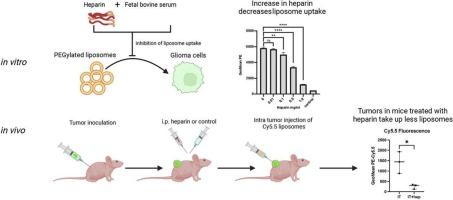
In glioblastoma, a malignant primary brain tumor, liposomes have shown promise in pre-clinical and early phase clinical trials as delivery vehicles for therapeutics. However, external factors influencing cellular uptake of liposomes in glioma cells are poorly understood. Heparin and heparin analogues are commonly used in glioma patients to decrease the risk of thrombo-embolic events. Our results show that heparin inhibits pegylated liposome uptake by U87 glioma and GL261 cells in a dose dependent manner in vitro, and that heparin-mediated inhibition of uptake required presence of fetal bovine serum in the media. In a subcutaneous model of glioma, Cy5.5 labeled liposomes could be detected with in vivo imaging after direct intra-tumoral injection. Ex-vivo analysis with flow cytometry showed a decreased uptake of liposomes into tumor cells in mice treated systemically with heparin compared to those treated with vehicle only.
期刊介绍:
International Journal of Pharmaceutics: X offers authors with high-quality research who want to publish in a gold open access journal the opportunity to make their work immediately, permanently, and freely accessible.
International Journal of Pharmaceutics: X authors will pay an article publishing charge (APC), have a choice of license options, and retain copyright. Please check the APC here. The journal is indexed in SCOPUS, PUBMED, PMC and DOAJ.
The International Journal of Pharmaceutics is the second most cited journal in the "Pharmacy & Pharmacology" category out of 358 journals, being the true home for pharmaceutical scientists concerned with the physical, chemical and biological properties of devices and delivery systems for drugs, vaccines and biologicals, including their design, manufacture and evaluation. This includes evaluation of the properties of drugs, excipients such as surfactants and polymers and novel materials. The journal has special sections on pharmaceutical nanotechnology and personalized medicines, and publishes research papers, reviews, commentaries and letters to the editor as well as special issues.



 京公网安备 11010802042870号
京ICP备2023020795号-1
京公网安备 11010802042870号
京ICP备2023020795号-1

 分享
分享
 求助内容:
求助内容: 应助结果提醒方式:
 扫码关注我们
