{"title":"Reliance upon contextual information can impede visual anticipation","authors":"Sean Müller, John Brenton, Mathew O'Grady","doi":"10.1080/17461391.2022.2157337","DOIUrl":null,"url":null,"abstract":"<div>\n \n <p>This study investigated whether skilled batsmen in a state cricket pathway could anticipate ball types when congruency of field-placings was manipulated with a bowler's action. Twenty-four male cricket batsmen were recruited who had played either first-class cricket (<i>n</i> = 6), were part of under 17 (<i>n</i> = 8) or under 19 (<i>n</i> = 10) state cricket squads. Participants completed a video-based temporal occlusion test where they were required to anticipate ball types from a swing bowler. In condition one, contextual field-placing information was presented to be congruent with the delivery type and bowler's action, whilst in condition two it was incongruent. Results did not reveal skill level differences across conditions for anticipation. In the congruent condition, all skill groups predicted above the chance level at the beginning and end of the bowler's delivery stride. In the incongruent condition, first-class players predicted above chance at the beginning of the bowler's delivery stride, and to a higher magnitude above chance compared to other skill groups at ball release. Under 17 and 19 players could not predict above chance at the start of the bowler's delivery stride with their magnitude of prediction lower than first-class players at ball release. Results indicate skilled batsmen find it challenging to integrate contextual and kinematic information to anticipate. This is likely due to greater emphasis placed upon contextual information in part supplied by data analysts. Findings have theoretical and practical implications respectively for lower body positioning for bat-ball interception and perceptual training to improve pick-up of kinematic cues.</p>\n </div>","PeriodicalId":93999,"journal":{"name":"European journal of sport science","volume":"23 7","pages":"1324-1333"},"PeriodicalIF":3.0000,"publicationDate":"2022-12-30","publicationTypes":"Journal Article","fieldsOfStudy":null,"isOpenAccess":false,"openAccessPdf":"https://onlinelibrary.wiley.com/doi/epdf/10.1080/17461391.2022.2157337","citationCount":"0","resultStr":null,"platform":"Semanticscholar","paperid":null,"PeriodicalName":"European journal of sport science","FirstCategoryId":"1085","ListUrlMain":"https://onlinelibrary.wiley.com/doi/10.1080/17461391.2022.2157337","RegionNum":0,"RegionCategory":null,"ArticlePicture":[],"TitleCN":null,"AbstractTextCN":null,"PMCID":null,"EPubDate":"","PubModel":"","JCR":"","JCRName":"","Score":null,"Total":0}
引用次数: 0
Abstract
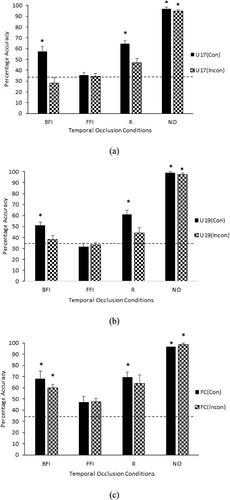
This study investigated whether skilled batsmen in a state cricket pathway could anticipate ball types when congruency of field-placings was manipulated with a bowler's action. Twenty-four male cricket batsmen were recruited who had played either first-class cricket (n = 6), were part of under 17 (n = 8) or under 19 (n = 10) state cricket squads. Participants completed a video-based temporal occlusion test where they were required to anticipate ball types from a swing bowler. In condition one, contextual field-placing information was presented to be congruent with the delivery type and bowler's action, whilst in condition two it was incongruent. Results did not reveal skill level differences across conditions for anticipation. In the congruent condition, all skill groups predicted above the chance level at the beginning and end of the bowler's delivery stride. In the incongruent condition, first-class players predicted above chance at the beginning of the bowler's delivery stride, and to a higher magnitude above chance compared to other skill groups at ball release. Under 17 and 19 players could not predict above chance at the start of the bowler's delivery stride with their magnitude of prediction lower than first-class players at ball release. Results indicate skilled batsmen find it challenging to integrate contextual and kinematic information to anticipate. This is likely due to greater emphasis placed upon contextual information in part supplied by data analysts. Findings have theoretical and practical implications respectively for lower body positioning for bat-ball interception and perceptual training to improve pick-up of kinematic cues.



 京公网安备 11010802042870号
京ICP备2023020795号-1
京公网安备 11010802042870号
京ICP备2023020795号-1

 分享
分享

 求助内容:
求助内容: 应助结果提醒方式:
 扫码关注我们
