{"title":"Functional Bioactivities of Soluble Seed Proteins from Two Leguminous Seeds.","authors":"Taiwo Scholes Adewole, Boluwatife Bolanle Dudu, Johnson Olaleye Oladele, Oyedotun Moses Oyeleke, Adenike Kuku","doi":"10.3746/pnf.2023.28.2.160","DOIUrl":null,"url":null,"abstract":"<p><p>Storage proteins from <i>Sphenostylis stenocarpa</i> and <i>Phaseolus lunatus</i> were fractionated, and their <i>in vitro</i> bioactivities were investigated. Albumin, globulin, prolamin, and glutelin constituents of the respective seeds were successively fractionated using the modified Osborne method. Phenylmethylsulfonyl fluoride (1 mM) was used as a protease inhibitor. The antioxidant, anti-inflammatory, and acetylcholinesterase-inhibitory activities of the protein fractions were evaluated using different appropriate techniques. Globulin was the predominant fraction, with a yield of 43.21±0.01% and 48.19±0.03% for <i>S. stenocarpa</i> and <i>P. lunatus</i>, respectively, whereas prolamin was not detected in both seeds. The protein fraction markedly scavenges hydroxyl radicals, nitric oxide radicals, and 2,2-diphenyl-1-picryldydrazyl radicals with concomitant high free radical-reducing power. Albumin and globulin fractions elicited the highest acetylcholinesterase-inhibitory potential of 48.75% and 49.75%, respectively, indicating their great application potential in managing neurodegenerative diseases. In this study, the albumin, globulin, and glutelin fractions of these underutilized legumes showed great analeptic bioactivities, which could be utilized as health-promoting dietary supplements/products.</p>","PeriodicalId":20424,"journal":{"name":"Preventive Nutrition and Food Science","volume":"28 2","pages":"160-169"},"PeriodicalIF":2.5000,"publicationDate":"2023-06-30","publicationTypes":"Journal Article","fieldsOfStudy":null,"isOpenAccess":false,"openAccessPdf":"https://ftp.ncbi.nlm.nih.gov/pub/pmc/oa_pdf/5d/d5/pnfs-28-2-160.PMC10321450.pdf","citationCount":"0","resultStr":null,"platform":"Semanticscholar","paperid":null,"PeriodicalName":"Preventive Nutrition and Food Science","FirstCategoryId":"1085","ListUrlMain":"https://doi.org/10.3746/pnf.2023.28.2.160","RegionNum":0,"RegionCategory":null,"ArticlePicture":[],"TitleCN":null,"AbstractTextCN":null,"PMCID":null,"EPubDate":"","PubModel":"","JCR":"Q3","JCRName":"FOOD SCIENCE & TECHNOLOGY","Score":null,"Total":0}
引用次数: 0
Abstract
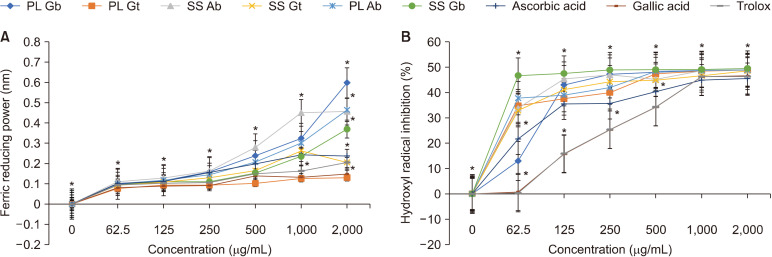
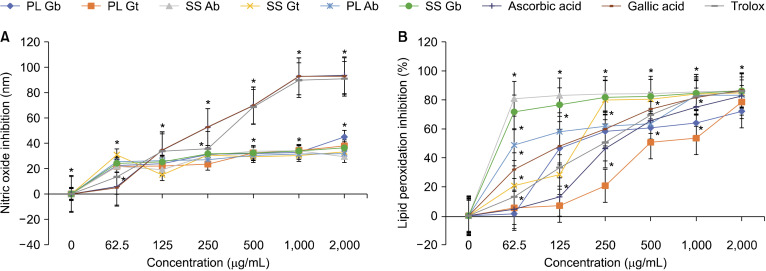
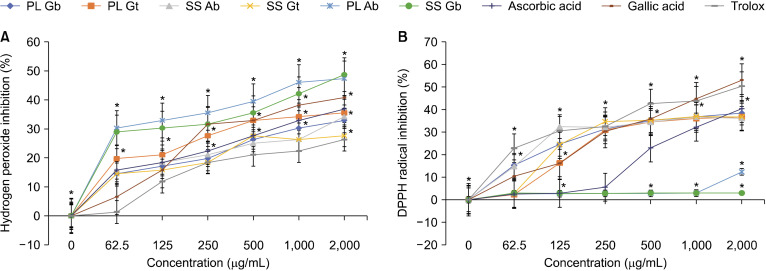
Storage proteins from Sphenostylis stenocarpa and Phaseolus lunatus were fractionated, and their in vitro bioactivities were investigated. Albumin, globulin, prolamin, and glutelin constituents of the respective seeds were successively fractionated using the modified Osborne method. Phenylmethylsulfonyl fluoride (1 mM) was used as a protease inhibitor. The antioxidant, anti-inflammatory, and acetylcholinesterase-inhibitory activities of the protein fractions were evaluated using different appropriate techniques. Globulin was the predominant fraction, with a yield of 43.21±0.01% and 48.19±0.03% for S. stenocarpa and P. lunatus, respectively, whereas prolamin was not detected in both seeds. The protein fraction markedly scavenges hydroxyl radicals, nitric oxide radicals, and 2,2-diphenyl-1-picryldydrazyl radicals with concomitant high free radical-reducing power. Albumin and globulin fractions elicited the highest acetylcholinesterase-inhibitory potential of 48.75% and 49.75%, respectively, indicating their great application potential in managing neurodegenerative diseases. In this study, the albumin, globulin, and glutelin fractions of these underutilized legumes showed great analeptic bioactivities, which could be utilized as health-promoting dietary supplements/products.




 京公网安备 11010802042870号
京ICP备2023020795号-1
京公网安备 11010802042870号
京ICP备2023020795号-1

 分享
分享
 求助内容:
求助内容: 应助结果提醒方式:
 扫码关注我们
