Luke Reilly, Sahba Seddighi, Andrew B Singleton, Mark R Cookson, Michael E Ward, Yue A Qi
{"title":"Variant biomarker discovery using mass spectrometry-based proteogenomics.","authors":"Luke Reilly, Sahba Seddighi, Andrew B Singleton, Mark R Cookson, Michael E Ward, Yue A Qi","doi":"10.3389/fragi.2023.1191993","DOIUrl":null,"url":null,"abstract":"<p><p>Genomic diversity plays critical roles in risk of disease pathogenesis and diagnosis. While genomic variants-including single nucleotide variants, frameshift variants, and mis-splicing isoforms-are commonly detected at the DNA or RNA level, their translated variant protein or polypeptide products are ultimately the functional units of the associated disease. These products are often released in biofluids and could be leveraged for clinical diagnosis and patient stratification. Recent emergence of integrated analysis of genomics with mass spectrometry-based proteomics for biomarker discovery, also known as proteogenomics, have significantly advanced the understanding disease risk variants, precise medicine, and biomarker discovery. In this review, we discuss variant proteins in the context of cancers and neurodegenerative diseases, outline current and emerging proteogenomic approaches for biomarker discovery, and provide a comprehensive proteogenomic strategy for detection of putative biomarker candidates in human biospecimens. This strategy can be implemented for proteogenomic studies in any field of enquiry. Our review timely addresses the need of biomarkers for aging related diseases.</p>","PeriodicalId":73061,"journal":{"name":"Frontiers in aging","volume":"4 ","pages":"1191993"},"PeriodicalIF":4.3000,"publicationDate":"2023-04-24","publicationTypes":"Journal Article","fieldsOfStudy":null,"isOpenAccess":false,"openAccessPdf":"https://www.ncbi.nlm.nih.gov/pmc/articles/PMC10165118/pdf/","citationCount":"0","resultStr":null,"platform":"Semanticscholar","paperid":null,"PeriodicalName":"Frontiers in aging","FirstCategoryId":"1085","ListUrlMain":"https://doi.org/10.3389/fragi.2023.1191993","RegionNum":0,"RegionCategory":null,"ArticlePicture":[],"TitleCN":null,"AbstractTextCN":null,"PMCID":null,"EPubDate":"2023/1/1 0:00:00","PubModel":"eCollection","JCR":"Q2","JCRName":"GERIATRICS & GERONTOLOGY","Score":null,"Total":0}
引用次数: 0
Abstract
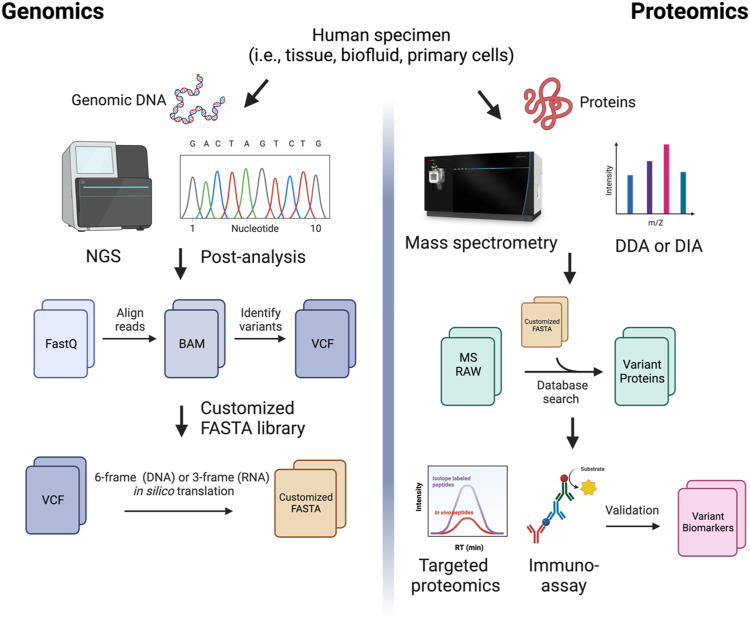
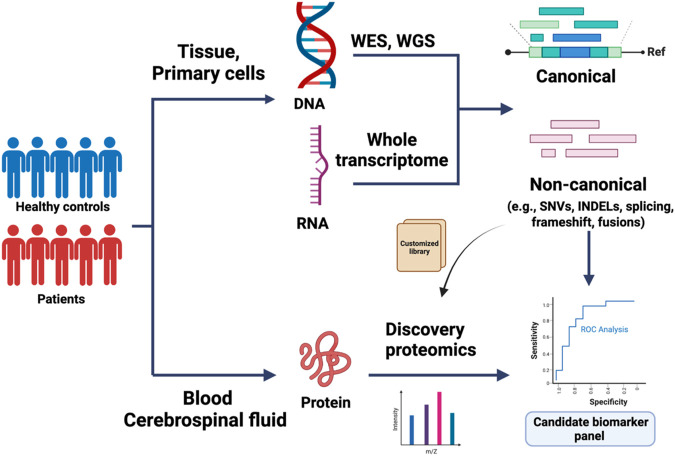
Genomic diversity plays critical roles in risk of disease pathogenesis and diagnosis. While genomic variants-including single nucleotide variants, frameshift variants, and mis-splicing isoforms-are commonly detected at the DNA or RNA level, their translated variant protein or polypeptide products are ultimately the functional units of the associated disease. These products are often released in biofluids and could be leveraged for clinical diagnosis and patient stratification. Recent emergence of integrated analysis of genomics with mass spectrometry-based proteomics for biomarker discovery, also known as proteogenomics, have significantly advanced the understanding disease risk variants, precise medicine, and biomarker discovery. In this review, we discuss variant proteins in the context of cancers and neurodegenerative diseases, outline current and emerging proteogenomic approaches for biomarker discovery, and provide a comprehensive proteogenomic strategy for detection of putative biomarker candidates in human biospecimens. This strategy can be implemented for proteogenomic studies in any field of enquiry. Our review timely addresses the need of biomarkers for aging related diseases.



 京公网安备 11010802042870号
京ICP备2023020795号-1
京公网安备 11010802042870号
京ICP备2023020795号-1

 分享
分享

 求助内容:
求助内容: 应助结果提醒方式:
 扫码关注我们
