Multicomponent recreational team handball training improves global health status in postmenopausal women at the long term – A randomised controlled trial
Rita Pereira, Peter Krustrup, Carlo Castagna, Eduardo Coelho, Eva Wulff Helge, Niklas Rye Jørgensen, Carolina Vila-Chã, Sandra Martins, João Tiago Guimarães, José Magalhães, Susana Póvoas
{"title":"Multicomponent recreational team handball training improves global health status in postmenopausal women at the long term – A randomised controlled trial","authors":"Rita Pereira, Peter Krustrup, Carlo Castagna, Eduardo Coelho, Eva Wulff Helge, Niklas Rye Jørgensen, Carolina Vila-Chã, Sandra Martins, João Tiago Guimarães, José Magalhães, Susana Póvoas","doi":"10.1080/17461391.2023.2184725","DOIUrl":null,"url":null,"abstract":"<div>\n \n <p>We studied the long-term effects of a multicomponent exercise training protocol (recreational team handball training, RTH) on global health status in inactive postmenopausal women. Participants (<i>n</i> = 45; age 65 ± 6 years, stature 157 ± 6 cm, body mass 66.2 ± 9.4 kg, fat mass 41.4 ± 5.5%, VO<sub>2peak</sub> 25.7 ± 3.6 mL/min/kg) were randomised into a control group (CG; <i>n</i> = 14) and a multicomponent exercise training group (EXG; <i>n</i> = 31, performing two to three weekly 60-min RTH sessions). Attendance was 2.0 ± 0.4 sessions/week (first 16 weeks) and 1.4 ± 0.5 (following 20 weeks) and mean heart rate (HR) loading was 77 and 79% of maximal HR (<i>p </i>= .002) for the first 16 and the following 20 weeks, respectively. Cardiovascular, bone, metabolic health, body composition and physical fitness markers were evaluated at baseline, and after 16 and 36 weeks<i>.</i> An interaction (<i>p </i>≤ .046) was shown for the 2-h oral glucose tolerance test, HDL, Yo-Yo intermittent endurance level 1 test (YYIE1) and knee strength, in favour of EXG. At 36 weeks, YYIE1 and knee strength were higher (<i>p </i>≤ .038) for EXG vs CG. Also, within-group improvements (<i>p </i>≤ .043) were observed after 36 weeks for EXG in VO<sub>2peak</sub>, lumbar spine bone mineral density, lumbar spine bone mineral content, P1NP, osteocalcin, total cholesterol, HDL, LDL, body mass, android fat mass, YYIE1, knee strength, handgrip strength and postural balance. At 36 comparatively to 16 weeks, EXG showed an increase (<i>p </i>≤ .036) in fasting blood glucose, HDL, knee strength and handgrip strength, and a decrease (<i>p </i>≤ .025) in LDL. Collectively, this multicomponent exercise training (RTH) induces beneficial changes in global health status in postmenopausal women.</p>\n </div>","PeriodicalId":93999,"journal":{"name":"European journal of sport science","volume":"23 8","pages":"1789-1799"},"PeriodicalIF":3.0000,"publicationDate":"2023-04-09","publicationTypes":"Journal Article","fieldsOfStudy":null,"isOpenAccess":false,"openAccessPdf":"https://onlinelibrary.wiley.com/doi/epdf/10.1080/17461391.2023.2184725","citationCount":"0","resultStr":null,"platform":"Semanticscholar","paperid":null,"PeriodicalName":"European journal of sport science","FirstCategoryId":"1085","ListUrlMain":"https://onlinelibrary.wiley.com/doi/10.1080/17461391.2023.2184725","RegionNum":0,"RegionCategory":null,"ArticlePicture":[],"TitleCN":null,"AbstractTextCN":null,"PMCID":null,"EPubDate":"","PubModel":"","JCR":"","JCRName":"","Score":null,"Total":0}
引用次数: 0
Abstract
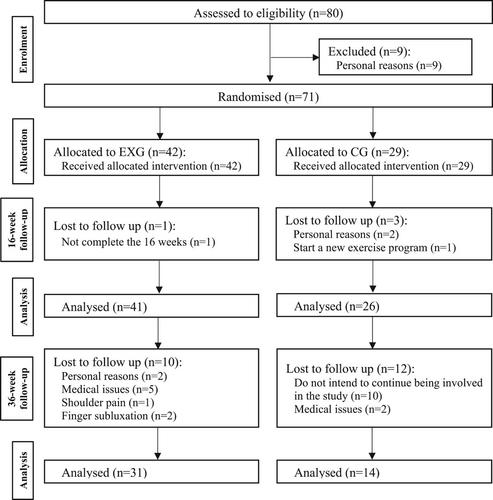
We studied the long-term effects of a multicomponent exercise training protocol (recreational team handball training, RTH) on global health status in inactive postmenopausal women. Participants (n = 45; age 65 ± 6 years, stature 157 ± 6 cm, body mass 66.2 ± 9.4 kg, fat mass 41.4 ± 5.5%, VO2peak 25.7 ± 3.6 mL/min/kg) were randomised into a control group (CG; n = 14) and a multicomponent exercise training group (EXG; n = 31, performing two to three weekly 60-min RTH sessions). Attendance was 2.0 ± 0.4 sessions/week (first 16 weeks) and 1.4 ± 0.5 (following 20 weeks) and mean heart rate (HR) loading was 77 and 79% of maximal HR (p = .002) for the first 16 and the following 20 weeks, respectively. Cardiovascular, bone, metabolic health, body composition and physical fitness markers were evaluated at baseline, and after 16 and 36 weeks. An interaction (p ≤ .046) was shown for the 2-h oral glucose tolerance test, HDL, Yo-Yo intermittent endurance level 1 test (YYIE1) and knee strength, in favour of EXG. At 36 weeks, YYIE1 and knee strength were higher (p ≤ .038) for EXG vs CG. Also, within-group improvements (p ≤ .043) were observed after 36 weeks for EXG in VO2peak, lumbar spine bone mineral density, lumbar spine bone mineral content, P1NP, osteocalcin, total cholesterol, HDL, LDL, body mass, android fat mass, YYIE1, knee strength, handgrip strength and postural balance. At 36 comparatively to 16 weeks, EXG showed an increase (p ≤ .036) in fasting blood glucose, HDL, knee strength and handgrip strength, and a decrease (p ≤ .025) in LDL. Collectively, this multicomponent exercise training (RTH) induces beneficial changes in global health status in postmenopausal women.



 京公网安备 11010802042870号
京ICP备2023020795号-1
京公网安备 11010802042870号
京ICP备2023020795号-1

 分享
分享

 求助内容:
求助内容: 应助结果提醒方式:
 扫码关注我们
