Maria Solleiro Pons, Sandra K. Hunter, Paul Ansdell
{"title":"Sex differences in fatigability and recovery following a 5 km running time trial in recreationally active adults","authors":"Maria Solleiro Pons, Sandra K. Hunter, Paul Ansdell","doi":"10.1080/17461391.2023.2233483","DOIUrl":null,"url":null,"abstract":"<div>\n \n <p>Females demonstrate greater fatigue resistance compared to males in tasks ranging from single-limb contractions to whole-body exercise, including running. Many of the studies investigating sex differences in fatigability following running, however, occur after long duration, low-intensity tasks and it is unknown whether there is a sex difference in fatigability following high-intensity running. This study compared fatigability and recovery following a 5 km running time trial in young males and females. Sixteen recreationally active participants (8 males, 8 females, age: 23 ± 4 years) completed a familiarisation and experimental trial. Knee-extensor maximal voluntary contractions (MVCs) were performed before and up to 30 min after a 5 km time trial on a treadmill. Heart rate and rating of perceived exertion (RPE) were recorded after every kilometre during the time trial. Although not significantly different, males completed the 5 km time trial 15% faster than females (<i>p = </i>0.095). Heart rate (<i>p </i>= 0.843) and RPE (<i>p </i>= 0.784) were similar between the sexes during the trial. Prior to running, males had larger MVCs (<i>p </i>= 0.014). The relative decrease in MVC force was less in females than males immediately post-exercise (−4.6 ± 2.4% vs. −15.1 ± 3.0%, <i>p </i>< 0.001) and at 10-minutes post-exercise (<i>p </i>= 0.018). At 20- and 30-minutes recovery, however, relative MVC force was not different between the sexes (<i>p </i>≥ 0.129). These data demonstrate that females experienced less fatigability of the knee extensors than males following a high-intensity 5 km running time trial. The findings highlight the need to understand responses to exercise in both sexes and have implications for recovery from training and exercise prescription.</p>\n <p><b>Highlights</b>\n \n </p><ul>\n \n <li>\n <p>Data regarding sex differences in fatigability following high-intensity running is relatively sparse.</p>\n </li>\n \n <li>\n <p>Therefore, this study quantified the decrease in knee-extensor maximum voluntary contraction force (MVC) following a 5-km self-paced running time trial.</p>\n </li>\n \n <li>\n <p>Despite similar heart rates and ratings of perceived exertion, the percentage decrease in MVC was three times greater in males compared to females.</p>\n </li>\n \n <li>\n <p>Relative MVCs remained greater in females compared to males until 20 min post-exercise.</p>\n </li>\n </ul>\n </div>","PeriodicalId":93999,"journal":{"name":"European journal of sport science","volume":"23 12","pages":"2349-2356"},"PeriodicalIF":3.0000,"publicationDate":"2023-07-30","publicationTypes":"Journal Article","fieldsOfStudy":null,"isOpenAccess":false,"openAccessPdf":"https://onlinelibrary.wiley.com/doi/epdf/10.1080/17461391.2023.2233483","citationCount":"0","resultStr":null,"platform":"Semanticscholar","paperid":null,"PeriodicalName":"European journal of sport science","FirstCategoryId":"1085","ListUrlMain":"https://onlinelibrary.wiley.com/doi/10.1080/17461391.2023.2233483","RegionNum":0,"RegionCategory":null,"ArticlePicture":[],"TitleCN":null,"AbstractTextCN":null,"PMCID":null,"EPubDate":"","PubModel":"","JCR":"","JCRName":"","Score":null,"Total":0}
引用次数: 0
Abstract
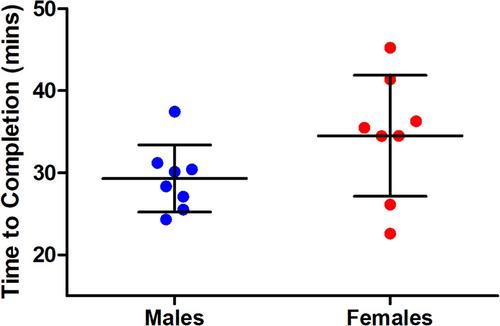
Females demonstrate greater fatigue resistance compared to males in tasks ranging from single-limb contractions to whole-body exercise, including running. Many of the studies investigating sex differences in fatigability following running, however, occur after long duration, low-intensity tasks and it is unknown whether there is a sex difference in fatigability following high-intensity running. This study compared fatigability and recovery following a 5 km running time trial in young males and females. Sixteen recreationally active participants (8 males, 8 females, age: 23 ± 4 years) completed a familiarisation and experimental trial. Knee-extensor maximal voluntary contractions (MVCs) were performed before and up to 30 min after a 5 km time trial on a treadmill. Heart rate and rating of perceived exertion (RPE) were recorded after every kilometre during the time trial. Although not significantly different, males completed the 5 km time trial 15% faster than females (p = 0.095). Heart rate (p = 0.843) and RPE (p = 0.784) were similar between the sexes during the trial. Prior to running, males had larger MVCs (p = 0.014). The relative decrease in MVC force was less in females than males immediately post-exercise (−4.6 ± 2.4% vs. −15.1 ± 3.0%, p < 0.001) and at 10-minutes post-exercise (p = 0.018). At 20- and 30-minutes recovery, however, relative MVC force was not different between the sexes (p ≥ 0.129). These data demonstrate that females experienced less fatigability of the knee extensors than males following a high-intensity 5 km running time trial. The findings highlight the need to understand responses to exercise in both sexes and have implications for recovery from training and exercise prescription.
Highlights
Data regarding sex differences in fatigability following high-intensity running is relatively sparse.
Therefore, this study quantified the decrease in knee-extensor maximum voluntary contraction force (MVC) following a 5-km self-paced running time trial.
Despite similar heart rates and ratings of perceived exertion, the percentage decrease in MVC was three times greater in males compared to females.
Relative MVCs remained greater in females compared to males until 20 min post-exercise.



 京公网安备 11010802042870号
京ICP备2023020795号-1
京公网安备 11010802042870号
京ICP备2023020795号-1

 分享
分享

 求助内容:
求助内容: 应助结果提醒方式:
 扫码关注我们
