Iria Seoane-Viaño , Xiaoyan Xu , Jun Jie Ong , Ahmed Teyeb , Simon Gaisford , André Campos-Álvarez , Anja Stulz , Carmen Marcuta , Lilia Kraschew , Wolfgang Mohr , Abdul W. Basit , Alvaro Goyanes
{"title":"3D打印药品的分散制造案例研究","authors":"Iria Seoane-Viaño , Xiaoyan Xu , Jun Jie Ong , Ahmed Teyeb , Simon Gaisford , André Campos-Álvarez , Anja Stulz , Carmen Marcuta , Lilia Kraschew , Wolfgang Mohr , Abdul W. Basit , Alvaro Goyanes","doi":"10.1016/j.ijpx.2023.100184","DOIUrl":null,"url":null,"abstract":"<div><p>Pharmaceutical 3D printing (3DP) is one of the emerging enabling technologies of personalised medicines as it affords the ability to fabricate highly versatile dosage forms. In the past 2 years, national medicines regulatory authorities have held consultations with external stakeholders to adapt regulatory frameworks to embrace point-of-care manufacturing. The proposed concept of decentralized manufacturing (DM) involves the provision of feedstock intermediates (pharma-inks) prepared by pharmaceutical companies to DM sites for manufacturing into the final medicine. In this study, we examine the feasibility of this model, with respect to both manufacturing and quality control. Efavirenz-loaded granulates (0–35%<em>w</em>/w) were produced by a manufacturing partner and shipped to a 3DP site in a different country. Direct powder extrusion (DPE) 3DP was subsequently used to prepare printlets (3D printed tablets), with mass ranging 266–371 mg. All printlets released more than 80% drug load within the first 60 min of the in vitro drug release test. An in-line near-infrared spectroscopy system was used as a process analytical technology (PAT) to quantify the printlets' drug load. Calibration models were developed using partial least squares regression, which showed excellent linearity (R<sup>2</sup> = 0.9833) and accuracy (RMSE = 1.0662). Overall, this work is the first to report the use of an in-line NIR system to perform real-time analysis of printlets prepared using pharma-inks produced by a pharmaceutical company. By demonstrating the feasibility of the proposed distribution model through this proof-of-concept study, this work paves the way for investigation of further PAT tools for quality control in 3DP point-of-care manufacturing.</p></div>","PeriodicalId":14280,"journal":{"name":"International Journal of Pharmaceutics: X","volume":"5 ","pages":"Article 100184"},"PeriodicalIF":6.4000,"publicationDate":"2023-05-30","publicationTypes":"Journal Article","fieldsOfStudy":null,"isOpenAccess":false,"openAccessPdf":"https://www.ncbi.nlm.nih.gov/pmc/articles/PMC10314212/pdf/","citationCount":"4","resultStr":"{\"title\":\"A case study on decentralized manufacturing of 3D printed medicines\",\"authors\":\"Iria Seoane-Viaño , Xiaoyan Xu , Jun Jie Ong , Ahmed Teyeb , Simon Gaisford , André Campos-Álvarez , Anja Stulz , Carmen Marcuta , Lilia Kraschew , Wolfgang Mohr , Abdul W. Basit , Alvaro Goyanes\",\"doi\":\"10.1016/j.ijpx.2023.100184\",\"DOIUrl\":null,\"url\":null,\"abstract\":\"<div><p>Pharmaceutical 3D printing (3DP) is one of the emerging enabling technologies of personalised medicines as it affords the ability to fabricate highly versatile dosage forms. In the past 2 years, national medicines regulatory authorities have held consultations with external stakeholders to adapt regulatory frameworks to embrace point-of-care manufacturing. The proposed concept of decentralized manufacturing (DM) involves the provision of feedstock intermediates (pharma-inks) prepared by pharmaceutical companies to DM sites for manufacturing into the final medicine. In this study, we examine the feasibility of this model, with respect to both manufacturing and quality control. Efavirenz-loaded granulates (0–35%<em>w</em>/w) were produced by a manufacturing partner and shipped to a 3DP site in a different country. Direct powder extrusion (DPE) 3DP was subsequently used to prepare printlets (3D printed tablets), with mass ranging 266–371 mg. All printlets released more than 80% drug load within the first 60 min of the in vitro drug release test. An in-line near-infrared spectroscopy system was used as a process analytical technology (PAT) to quantify the printlets' drug load. Calibration models were developed using partial least squares regression, which showed excellent linearity (R<sup>2</sup> = 0.9833) and accuracy (RMSE = 1.0662). Overall, this work is the first to report the use of an in-line NIR system to perform real-time analysis of printlets prepared using pharma-inks produced by a pharmaceutical company. By demonstrating the feasibility of the proposed distribution model through this proof-of-concept study, this work paves the way for investigation of further PAT tools for quality control in 3DP point-of-care manufacturing.</p></div>\",\"PeriodicalId\":14280,\"journal\":{\"name\":\"International Journal of Pharmaceutics: X\",\"volume\":\"5 \",\"pages\":\"Article 100184\"},\"PeriodicalIF\":6.4000,\"publicationDate\":\"2023-05-30\",\"publicationTypes\":\"Journal Article\",\"fieldsOfStudy\":null,\"isOpenAccess\":false,\"openAccessPdf\":\"https://www.ncbi.nlm.nih.gov/pmc/articles/PMC10314212/pdf/\",\"citationCount\":\"4\",\"resultStr\":null,\"platform\":\"Semanticscholar\",\"paperid\":null,\"PeriodicalName\":\"International Journal of Pharmaceutics: X\",\"FirstCategoryId\":\"3\",\"ListUrlMain\":\"https://www.sciencedirect.com/science/article/pii/S2590156723000282\",\"RegionNum\":2,\"RegionCategory\":\"医学\",\"ArticlePicture\":[],\"TitleCN\":null,\"AbstractTextCN\":null,\"PMCID\":null,\"EPubDate\":\"\",\"PubModel\":\"\",\"JCR\":\"Q1\",\"JCRName\":\"PHARMACOLOGY & PHARMACY\",\"Score\":null,\"Total\":0}","platform":"Semanticscholar","paperid":null,"PeriodicalName":"International Journal of Pharmaceutics: X","FirstCategoryId":"3","ListUrlMain":"https://www.sciencedirect.com/science/article/pii/S2590156723000282","RegionNum":2,"RegionCategory":"医学","ArticlePicture":[],"TitleCN":null,"AbstractTextCN":null,"PMCID":null,"EPubDate":"","PubModel":"","JCR":"Q1","JCRName":"PHARMACOLOGY & PHARMACY","Score":null,"Total":0}
A case study on decentralized manufacturing of 3D printed medicines
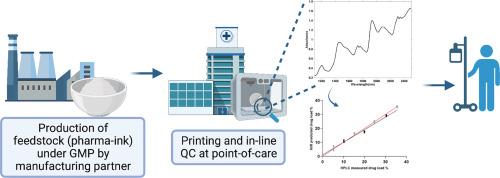
Pharmaceutical 3D printing (3DP) is one of the emerging enabling technologies of personalised medicines as it affords the ability to fabricate highly versatile dosage forms. In the past 2 years, national medicines regulatory authorities have held consultations with external stakeholders to adapt regulatory frameworks to embrace point-of-care manufacturing. The proposed concept of decentralized manufacturing (DM) involves the provision of feedstock intermediates (pharma-inks) prepared by pharmaceutical companies to DM sites for manufacturing into the final medicine. In this study, we examine the feasibility of this model, with respect to both manufacturing and quality control. Efavirenz-loaded granulates (0–35%w/w) were produced by a manufacturing partner and shipped to a 3DP site in a different country. Direct powder extrusion (DPE) 3DP was subsequently used to prepare printlets (3D printed tablets), with mass ranging 266–371 mg. All printlets released more than 80% drug load within the first 60 min of the in vitro drug release test. An in-line near-infrared spectroscopy system was used as a process analytical technology (PAT) to quantify the printlets' drug load. Calibration models were developed using partial least squares regression, which showed excellent linearity (R2 = 0.9833) and accuracy (RMSE = 1.0662). Overall, this work is the first to report the use of an in-line NIR system to perform real-time analysis of printlets prepared using pharma-inks produced by a pharmaceutical company. By demonstrating the feasibility of the proposed distribution model through this proof-of-concept study, this work paves the way for investigation of further PAT tools for quality control in 3DP point-of-care manufacturing.
期刊介绍:
International Journal of Pharmaceutics: X offers authors with high-quality research who want to publish in a gold open access journal the opportunity to make their work immediately, permanently, and freely accessible.
International Journal of Pharmaceutics: X authors will pay an article publishing charge (APC), have a choice of license options, and retain copyright. Please check the APC here. The journal is indexed in SCOPUS, PUBMED, PMC and DOAJ.
The International Journal of Pharmaceutics is the second most cited journal in the "Pharmacy & Pharmacology" category out of 358 journals, being the true home for pharmaceutical scientists concerned with the physical, chemical and biological properties of devices and delivery systems for drugs, vaccines and biologicals, including their design, manufacture and evaluation. This includes evaluation of the properties of drugs, excipients such as surfactants and polymers and novel materials. The journal has special sections on pharmaceutical nanotechnology and personalized medicines, and publishes research papers, reviews, commentaries and letters to the editor as well as special issues.



 京公网安备 11010802042870号
京ICP备2023020795号-1
京公网安备 11010802042870号
京ICP备2023020795号-1

 分享
分享
 求助内容:
求助内容: 应助结果提醒方式:
 扫码关注我们
