Bernadine Teng, Sjaan R. Gomersall, Anna L. Hatton, Asaduzzaman Khan, Sandra G. Brauer
{"title":"有跌倒风险的老年患者在现实世界中遵守规定的家庭运动的预测因素:一项前瞻性观察研究","authors":"Bernadine Teng, Sjaan R. Gomersall, Anna L. Hatton, Asaduzzaman Khan, Sandra G. Brauer","doi":"10.1002/agm2.12270","DOIUrl":null,"url":null,"abstract":"<div>\n \n \n <section>\n \n <h3> Objectives</h3>\n \n <p>Using a multi-ethnic Asian population, this study assessed adherence to prescribed home exercise programs, explored factors predicting adherence, and evaluated whether home exercise adherence was associated with physical activity.</p>\n </section>\n \n <section>\n \n <h3> Methods</h3>\n \n <p>A prospective cohort study was conducted in 68 older adults (aged ≥65 years) from two geriatric outpatient clinics in Singapore, who were receiving tailored home exercises while undergoing 6 weeks of outpatient physical therapy for falls prevention. Adherence was measured as the percentage of prescribed sessions completed. Predictor variables included sociodemographic factors, clinical characteristics, intervention-specific factors, and physical and psychosocial measures. Multivariable linear regressions were performed to develop a model that best predicted adherence to prescribed exercise. Physical activity levels, measured by accelerometry, were analyzed by cross-sectional univariate analysis at 6 weeks.</p>\n </section>\n \n <section>\n \n <h3> Results</h3>\n \n <p>The mean adherence rate was 65% (SD 34.3%). In the regression model, the number of medications [<i>B</i> = 0.360, 95% CI (0.098–0.630)], social support for exercising [<i>B</i> = 0.080, 95% CI (0.015–0.145)], and self-efficacy for exercising [<i>B</i> = −0.034, 95% CI (−0.068–0.000)] significantly explained 31% (<i>R</i><sup>2</sup> = 0.312) of the variance in exercise adherence. Older adults with better adherence took more steps/day at 6 weeks [<i>B</i> = 0.001, 95% CI (0.000–0.001)].</p>\n </section>\n \n <section>\n \n <h3> Conclusions</h3>\n \n <p>Low adherence to home exercise programs among older adults in Singapore, emphasizing the need for improvement. Counterintuitively, older adults with more medications, lower exercise self-efficacy, but with greater social support demonstrated higher adherence. Addressing unmet social support needs is crucial for enhancing adherence rates and reducing fall risks.</p>\n </section>\n </div>","PeriodicalId":32862,"journal":{"name":"Aging Medicine","volume":"6 4","pages":"361-369"},"PeriodicalIF":2.5000,"publicationDate":"2023-09-27","publicationTypes":"Journal Article","fieldsOfStudy":null,"isOpenAccess":false,"openAccessPdf":"https://onlinelibrary.wiley.com/doi/epdf/10.1002/agm2.12270","citationCount":"0","resultStr":"{\"title\":\"Predictors of real-world adherence to prescribed home exercise in older patients with a risk of falling: A prospective observational study\",\"authors\":\"Bernadine Teng, Sjaan R. Gomersall, Anna L. Hatton, Asaduzzaman Khan, Sandra G. Brauer\",\"doi\":\"10.1002/agm2.12270\",\"DOIUrl\":null,\"url\":null,\"abstract\":\"<div>\\n \\n \\n <section>\\n \\n <h3> Objectives</h3>\\n \\n <p>Using a multi-ethnic Asian population, this study assessed adherence to prescribed home exercise programs, explored factors predicting adherence, and evaluated whether home exercise adherence was associated with physical activity.</p>\\n </section>\\n \\n <section>\\n \\n <h3> Methods</h3>\\n \\n <p>A prospective cohort study was conducted in 68 older adults (aged ≥65 years) from two geriatric outpatient clinics in Singapore, who were receiving tailored home exercises while undergoing 6 weeks of outpatient physical therapy for falls prevention. Adherence was measured as the percentage of prescribed sessions completed. Predictor variables included sociodemographic factors, clinical characteristics, intervention-specific factors, and physical and psychosocial measures. Multivariable linear regressions were performed to develop a model that best predicted adherence to prescribed exercise. Physical activity levels, measured by accelerometry, were analyzed by cross-sectional univariate analysis at 6 weeks.</p>\\n </section>\\n \\n <section>\\n \\n <h3> Results</h3>\\n \\n <p>The mean adherence rate was 65% (SD 34.3%). In the regression model, the number of medications [<i>B</i> = 0.360, 95% CI (0.098–0.630)], social support for exercising [<i>B</i> = 0.080, 95% CI (0.015–0.145)], and self-efficacy for exercising [<i>B</i> = −0.034, 95% CI (−0.068–0.000)] significantly explained 31% (<i>R</i><sup>2</sup> = 0.312) of the variance in exercise adherence. Older adults with better adherence took more steps/day at 6 weeks [<i>B</i> = 0.001, 95% CI (0.000–0.001)].</p>\\n </section>\\n \\n <section>\\n \\n <h3> Conclusions</h3>\\n \\n <p>Low adherence to home exercise programs among older adults in Singapore, emphasizing the need for improvement. Counterintuitively, older adults with more medications, lower exercise self-efficacy, but with greater social support demonstrated higher adherence. Addressing unmet social support needs is crucial for enhancing adherence rates and reducing fall risks.</p>\\n </section>\\n </div>\",\"PeriodicalId\":32862,\"journal\":{\"name\":\"Aging Medicine\",\"volume\":\"6 4\",\"pages\":\"361-369\"},\"PeriodicalIF\":2.5000,\"publicationDate\":\"2023-09-27\",\"publicationTypes\":\"Journal Article\",\"fieldsOfStudy\":null,\"isOpenAccess\":false,\"openAccessPdf\":\"https://onlinelibrary.wiley.com/doi/epdf/10.1002/agm2.12270\",\"citationCount\":\"0\",\"resultStr\":null,\"platform\":\"Semanticscholar\",\"paperid\":null,\"PeriodicalName\":\"Aging Medicine\",\"FirstCategoryId\":\"1085\",\"ListUrlMain\":\"https://onlinelibrary.wiley.com/doi/10.1002/agm2.12270\",\"RegionNum\":0,\"RegionCategory\":null,\"ArticlePicture\":[],\"TitleCN\":null,\"AbstractTextCN\":null,\"PMCID\":null,\"EPubDate\":\"\",\"PubModel\":\"\",\"JCR\":\"Q3\",\"JCRName\":\"GERIATRICS & GERONTOLOGY\",\"Score\":null,\"Total\":0}","platform":"Semanticscholar","paperid":null,"PeriodicalName":"Aging Medicine","FirstCategoryId":"1085","ListUrlMain":"https://onlinelibrary.wiley.com/doi/10.1002/agm2.12270","RegionNum":0,"RegionCategory":null,"ArticlePicture":[],"TitleCN":null,"AbstractTextCN":null,"PMCID":null,"EPubDate":"","PubModel":"","JCR":"Q3","JCRName":"GERIATRICS & GERONTOLOGY","Score":null,"Total":0}
Predictors of real-world adherence to prescribed home exercise in older patients with a risk of falling: A prospective observational study
Objectives
Using a multi-ethnic Asian population, this study assessed adherence to prescribed home exercise programs, explored factors predicting adherence, and evaluated whether home exercise adherence was associated with physical activity.
Methods
A prospective cohort study was conducted in 68 older adults (aged ≥65 years) from two geriatric outpatient clinics in Singapore, who were receiving tailored home exercises while undergoing 6 weeks of outpatient physical therapy for falls prevention. Adherence was measured as the percentage of prescribed sessions completed. Predictor variables included sociodemographic factors, clinical characteristics, intervention-specific factors, and physical and psychosocial measures. Multivariable linear regressions were performed to develop a model that best predicted adherence to prescribed exercise. Physical activity levels, measured by accelerometry, were analyzed by cross-sectional univariate analysis at 6 weeks.
Results
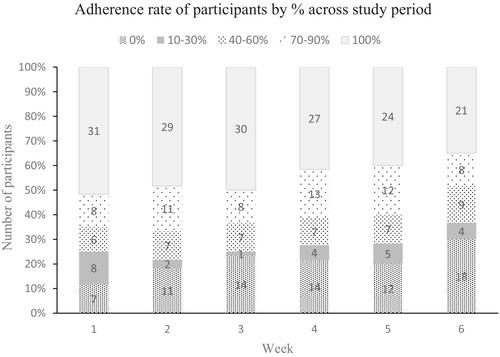
The mean adherence rate was 65% (SD 34.3%). In the regression model, the number of medications [B = 0.360, 95% CI (0.098–0.630)], social support for exercising [B = 0.080, 95% CI (0.015–0.145)], and self-efficacy for exercising [B = −0.034, 95% CI (−0.068–0.000)] significantly explained 31% (R2 = 0.312) of the variance in exercise adherence. Older adults with better adherence took more steps/day at 6 weeks [B = 0.001, 95% CI (0.000–0.001)].
Conclusions
Low adherence to home exercise programs among older adults in Singapore, emphasizing the need for improvement. Counterintuitively, older adults with more medications, lower exercise self-efficacy, but with greater social support demonstrated higher adherence. Addressing unmet social support needs is crucial for enhancing adherence rates and reducing fall risks.




 京公网安备 11010802042870号
京ICP备2023020795号-1
京公网安备 11010802042870号
京ICP备2023020795号-1

 分享
分享
 求助内容:
求助内容: 应助结果提醒方式:
 扫码关注我们
