{"title":"用于气态储氢的 A2B7 型 La0.7-xYxMg0.3Ni3.5 合金的成分调整","authors":"","doi":"10.1016/j.jre.2023.11.005","DOIUrl":null,"url":null,"abstract":"<div><div>Rare earth-based superlattice alloys have great potential for gaseous hydrogen storage, as well as successful application as nickel-metal hydride batteries anodes. In this work, Y substitution was carried out to adjust the gaseous hydrogen storage properties of A<sub>2</sub>B<sub>7</sub>-type La<sub>0.7</sub>Mg<sub>0.3</sub>Ni<sub>3.5</sub> alloys. The results indicate a multiphase structure in the alloys comprised of the main rhombohedral Gd<sub>2</sub>Co<sub>7</sub> and PuNi<sub>3</sub> phases, with a small amount of CaCu<sub>5</sub> phase. Moreover, the Y substitution results in higher abundance of the Gd<sub>2</sub>Co<sub>7</sub> phase. The alloy La<sub>0.42</sub>Y<sub>0.28</sub>Mg<sub>0.3</sub>Ni<sub>3.5</sub> exhibits a hydrogen storage capacity of 1.55 wt% at 298 K and a desorption plateau pressure of 0.244 MPa. In addition, this alloy demonstrates a stable cycle life by a capacity retention of 94.2% after 50 cycles, with the main capacity degradation occurring during the initial 20 cycles. This work accentuates the potential of the La–Y–Mg–Ni-based superlattice alloys for applications in solid-state hydrogen storage.</div></div>","PeriodicalId":16940,"journal":{"name":"Journal of Rare Earths","volume":"42 10","pages":"Pages 1912-1919"},"PeriodicalIF":7.2000,"publicationDate":"2024-10-01","publicationTypes":"Journal Article","fieldsOfStudy":null,"isOpenAccess":false,"openAccessPdf":"","citationCount":"0","resultStr":"{\"title\":\"Compositional tuning of A2B7-type La0.7–xYxMg0.3Ni3.5 alloys for gaseous hydrogen storage\",\"authors\":\"\",\"doi\":\"10.1016/j.jre.2023.11.005\",\"DOIUrl\":null,\"url\":null,\"abstract\":\"<div><div>Rare earth-based superlattice alloys have great potential for gaseous hydrogen storage, as well as successful application as nickel-metal hydride batteries anodes. In this work, Y substitution was carried out to adjust the gaseous hydrogen storage properties of A<sub>2</sub>B<sub>7</sub>-type La<sub>0.7</sub>Mg<sub>0.3</sub>Ni<sub>3.5</sub> alloys. The results indicate a multiphase structure in the alloys comprised of the main rhombohedral Gd<sub>2</sub>Co<sub>7</sub> and PuNi<sub>3</sub> phases, with a small amount of CaCu<sub>5</sub> phase. Moreover, the Y substitution results in higher abundance of the Gd<sub>2</sub>Co<sub>7</sub> phase. The alloy La<sub>0.42</sub>Y<sub>0.28</sub>Mg<sub>0.3</sub>Ni<sub>3.5</sub> exhibits a hydrogen storage capacity of 1.55 wt% at 298 K and a desorption plateau pressure of 0.244 MPa. In addition, this alloy demonstrates a stable cycle life by a capacity retention of 94.2% after 50 cycles, with the main capacity degradation occurring during the initial 20 cycles. This work accentuates the potential of the La–Y–Mg–Ni-based superlattice alloys for applications in solid-state hydrogen storage.</div></div>\",\"PeriodicalId\":16940,\"journal\":{\"name\":\"Journal of Rare Earths\",\"volume\":\"42 10\",\"pages\":\"Pages 1912-1919\"},\"PeriodicalIF\":7.2000,\"publicationDate\":\"2024-10-01\",\"publicationTypes\":\"Journal Article\",\"fieldsOfStudy\":null,\"isOpenAccess\":false,\"openAccessPdf\":\"\",\"citationCount\":\"0\",\"resultStr\":null,\"platform\":\"Semanticscholar\",\"paperid\":null,\"PeriodicalName\":\"Journal of Rare Earths\",\"FirstCategoryId\":\"92\",\"ListUrlMain\":\"https://www.sciencedirect.com/science/article/pii/S1002072123003095\",\"RegionNum\":1,\"RegionCategory\":\"化学\",\"ArticlePicture\":[],\"TitleCN\":null,\"AbstractTextCN\":null,\"PMCID\":null,\"EPubDate\":\"2023/11/10 0:00:00\",\"PubModel\":\"Epub\",\"JCR\":\"Q1\",\"JCRName\":\"CHEMISTRY, APPLIED\",\"Score\":null,\"Total\":0}","platform":"Semanticscholar","paperid":null,"PeriodicalName":"Journal of Rare Earths","FirstCategoryId":"92","ListUrlMain":"https://www.sciencedirect.com/science/article/pii/S1002072123003095","RegionNum":1,"RegionCategory":"化学","ArticlePicture":[],"TitleCN":null,"AbstractTextCN":null,"PMCID":null,"EPubDate":"2023/11/10 0:00:00","PubModel":"Epub","JCR":"Q1","JCRName":"CHEMISTRY, APPLIED","Score":null,"Total":0}
Compositional tuning of A2B7-type La0.7–xYxMg0.3Ni3.5 alloys for gaseous hydrogen storage
Rare earth-based superlattice alloys have great potential for gaseous hydrogen storage, as well as successful application as nickel-metal hydride batteries anodes. In this work, Y substitution was carried out to adjust the gaseous hydrogen storage properties of A2B7-type La0.7Mg0.3Ni3.5 alloys. The results indicate a multiphase structure in the alloys comprised of the main rhombohedral Gd2Co7 and PuNi3 phases, with a small amount of CaCu5 phase. Moreover, the Y substitution results in higher abundance of the Gd2Co7 phase. The alloy La0.42Y0.28Mg0.3Ni3.5 exhibits a hydrogen storage capacity of 1.55 wt% at 298 K and a desorption plateau pressure of 0.244 MPa. In addition, this alloy demonstrates a stable cycle life by a capacity retention of 94.2% after 50 cycles, with the main capacity degradation occurring during the initial 20 cycles. This work accentuates the potential of the La–Y–Mg–Ni-based superlattice alloys for applications in solid-state hydrogen storage.
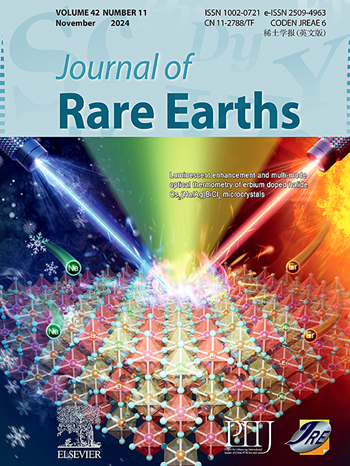
期刊介绍:
The Journal of Rare Earths reports studies on the 17 rare earth elements. It is a unique English-language learned journal that publishes works on various aspects of basic theory and applied science in the field of rare earths (RE). The journal accepts original high-quality original research papers and review articles with inventive content, and complete experimental data. It represents high academic standards and new progress in the RE field. Due to the advantage of abundant RE resources of China, the research on RE develops very actively, and papers on the latest progress in this field emerge every year. It is not only an important resource in which technicians publish and obtain their latest research results on RE, but also an important way of reflecting the updated progress in RE research field.
The Journal of Rare Earths covers all research and application of RE rare earths including spectroscopy, luminescence and phosphors, rare earth catalysis, magnetism and magnetic materials, advanced rare earth materials, RE chemistry & hydrometallurgy, RE metallography & pyrometallurgy, RE new materials, RE solid state physics & solid state chemistry, rare earth applications, RE analysis & test, RE geology & ore dressing, etc.






 京公网安备 11010802042870号
京ICP备2023020795号-1
京公网安备 11010802042870号
京ICP备2023020795号-1

 分享
分享
 求助内容:
求助内容: 应助结果提醒方式:
 扫码关注我们
