Ahmed M. Zayed, Bahaa S. Metwally, M. A. Masoud, Mahmoud F. Mubarak, Hussain Shendy, Mahmoud S. M. Abdel Wahed
{"title":"通过特定的热化学方案,将非常规农业废弃物转化为可持续的生态友好型活性炭","authors":"Ahmed M. Zayed, Bahaa S. Metwally, M. A. Masoud, Mahmoud F. Mubarak, Hussain Shendy, Mahmoud S. M. Abdel Wahed","doi":"10.1007/s13204-023-02939-7","DOIUrl":null,"url":null,"abstract":"<div><p>The preparation of eco-friendly activated carbons (ACs) has gained significant attention due to their enhanced ability to remove a wide range of pollutants from water. Agricultural waste materials are promising precursors for the preparation of ACs due to their abundant availability and low cost. For the first time, this study is dedicated to preparing activated carbon from the useless leaves of sugar beet (LSB). This was conducted by thermo-chemical activation using H<sub>3</sub>PO<sub>4</sub> as a robust activating agent. The activation process was carried out in a programmable furnace at a fixed temperature of 550 °C for 2 h. Different ratios of H<sub>3</sub>PO<sub>4</sub> (85%) and pristine LSB (0.5:1, 1:1, 2:1, and 3:1) were used to produce four synthesized ACs, which were labeled as AC<sub>(0.5:1)</sub>, AC<sub>(1:1)</sub>, AC<sub>(2:1)</sub> and AC<sub>(3:1)</sub>, respectively, for evaluating the impact of the impregnation ratios on the properties of these synthesized ACs. The as-synthesized ACs were characterized by X-ray diffraction (XRD), scanning electron microscopy (SEM), energy-dispersive X-ray spectroscopy (EDS), Fourier-transform infrared spectroscopy (FTIR), and Brunauer–Emmett–Teller surface area (S<sub>BET</sub>) analysis. Among all the prepared ACs, AC<sub>(2:1)</sub> showed the highest degree of amorphicity, which resulted in the highest S<sub>BET</sub> value of 700.71 m<sup>2</sup>/g. This high surface area suggests a magnificent porous structure and surface chemistry of the synthesized AC, making it suitable for various environmental applications. The study shows that the thermo-chemical activation of sugar beet leaves with H<sub>3</sub>PO<sub>4</sub> can produce a highly competent AC with excellent characteristics that can be used in waste management, water purification, and other related applications. Overall, this study highlights the potential of using useless LSB as a sustainable source of AC production and provides new insights into the preparation and characterization of eco-friendly ACs.</p></div>","PeriodicalId":471,"journal":{"name":"Applied Nanoscience","volume":"14 1","pages":"21 - 32"},"PeriodicalIF":3.6740,"publicationDate":"2023-09-01","publicationTypes":"Journal Article","fieldsOfStudy":null,"isOpenAccess":false,"openAccessPdf":"","citationCount":"0","resultStr":"{\"title\":\"From non-conventional agricultural waste into sustainable and eco-friendly activated carbon through specified thermo-chemical protocol\",\"authors\":\"Ahmed M. Zayed, Bahaa S. Metwally, M. A. Masoud, Mahmoud F. Mubarak, Hussain Shendy, Mahmoud S. M. Abdel Wahed\",\"doi\":\"10.1007/s13204-023-02939-7\",\"DOIUrl\":null,\"url\":null,\"abstract\":\"<div><p>The preparation of eco-friendly activated carbons (ACs) has gained significant attention due to their enhanced ability to remove a wide range of pollutants from water. Agricultural waste materials are promising precursors for the preparation of ACs due to their abundant availability and low cost. For the first time, this study is dedicated to preparing activated carbon from the useless leaves of sugar beet (LSB). This was conducted by thermo-chemical activation using H<sub>3</sub>PO<sub>4</sub> as a robust activating agent. The activation process was carried out in a programmable furnace at a fixed temperature of 550 °C for 2 h. Different ratios of H<sub>3</sub>PO<sub>4</sub> (85%) and pristine LSB (0.5:1, 1:1, 2:1, and 3:1) were used to produce four synthesized ACs, which were labeled as AC<sub>(0.5:1)</sub>, AC<sub>(1:1)</sub>, AC<sub>(2:1)</sub> and AC<sub>(3:1)</sub>, respectively, for evaluating the impact of the impregnation ratios on the properties of these synthesized ACs. The as-synthesized ACs were characterized by X-ray diffraction (XRD), scanning electron microscopy (SEM), energy-dispersive X-ray spectroscopy (EDS), Fourier-transform infrared spectroscopy (FTIR), and Brunauer–Emmett–Teller surface area (S<sub>BET</sub>) analysis. Among all the prepared ACs, AC<sub>(2:1)</sub> showed the highest degree of amorphicity, which resulted in the highest S<sub>BET</sub> value of 700.71 m<sup>2</sup>/g. This high surface area suggests a magnificent porous structure and surface chemistry of the synthesized AC, making it suitable for various environmental applications. The study shows that the thermo-chemical activation of sugar beet leaves with H<sub>3</sub>PO<sub>4</sub> can produce a highly competent AC with excellent characteristics that can be used in waste management, water purification, and other related applications. Overall, this study highlights the potential of using useless LSB as a sustainable source of AC production and provides new insights into the preparation and characterization of eco-friendly ACs.</p></div>\",\"PeriodicalId\":471,\"journal\":{\"name\":\"Applied Nanoscience\",\"volume\":\"14 1\",\"pages\":\"21 - 32\"},\"PeriodicalIF\":3.6740,\"publicationDate\":\"2023-09-01\",\"publicationTypes\":\"Journal Article\",\"fieldsOfStudy\":null,\"isOpenAccess\":false,\"openAccessPdf\":\"\",\"citationCount\":\"0\",\"resultStr\":null,\"platform\":\"Semanticscholar\",\"paperid\":null,\"PeriodicalName\":\"Applied Nanoscience\",\"FirstCategoryId\":\"5\",\"ListUrlMain\":\"https://link.springer.com/article/10.1007/s13204-023-02939-7\",\"RegionNum\":4,\"RegionCategory\":\"工程技术\",\"ArticlePicture\":[],\"TitleCN\":null,\"AbstractTextCN\":null,\"PMCID\":null,\"EPubDate\":\"\",\"PubModel\":\"\",\"JCR\":\"Q1\",\"JCRName\":\"Engineering\",\"Score\":null,\"Total\":0}","platform":"Semanticscholar","paperid":null,"PeriodicalName":"Applied Nanoscience","FirstCategoryId":"5","ListUrlMain":"https://link.springer.com/article/10.1007/s13204-023-02939-7","RegionNum":4,"RegionCategory":"工程技术","ArticlePicture":[],"TitleCN":null,"AbstractTextCN":null,"PMCID":null,"EPubDate":"","PubModel":"","JCR":"Q1","JCRName":"Engineering","Score":null,"Total":0}
引用次数: 0
摘要
生态友好型活性碳(ACs)具有更强的去除水中各种污染物的能力,因此其制备方法备受关注。农业废弃物因其丰富的资源和低廉的成本而成为制备活性炭的理想前体。本研究首次致力于从无用的甜菜叶(LSB)中制备活性炭。制备方法是使用 H3PO4 作为强活化剂进行热化学活化。活化过程在固定温度 550 °C 的可编程炉中进行,持续 2 小时。5:1、1:1、2:1 和 3:1)生成四种合成 AC,分别标记为 AC(0.5:1)、AC(1:1)、AC(2:1) 和 AC(3:1),以评估浸渍比例对这些合成 AC 性能的影响。通过 X 射线衍射 (XRD)、扫描电子显微镜 (SEM)、能量色散 X 射线光谱 (EDS)、傅立叶变换红外光谱 (FTIR) 和布鲁瑙尔-艾美特-泰勒表面积 (SBET) 分析对合成的 AC 进行了表征。在所有制备的 AC 中,AC(2:1) 的非晶化程度最高,其 SBET 值也最高,为 700.71 m2/g。这一高比表面积表明合成的 AC 具有良好的多孔结构和表面化学性质,使其适用于各种环境应用。该研究表明,用 H3PO4 对甜菜叶进行热化学活化,可以制备出具有优良特性的高功能 AC,可用于废物管理、水净化和其他相关应用。总之,这项研究强调了利用无用的 LSB 作为可持续 AC 生产源的潜力,并为生态友好型 AC 的制备和表征提供了新的见解。
From non-conventional agricultural waste into sustainable and eco-friendly activated carbon through specified thermo-chemical protocol
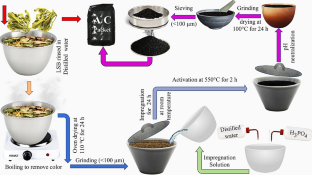
The preparation of eco-friendly activated carbons (ACs) has gained significant attention due to their enhanced ability to remove a wide range of pollutants from water. Agricultural waste materials are promising precursors for the preparation of ACs due to their abundant availability and low cost. For the first time, this study is dedicated to preparing activated carbon from the useless leaves of sugar beet (LSB). This was conducted by thermo-chemical activation using H3PO4 as a robust activating agent. The activation process was carried out in a programmable furnace at a fixed temperature of 550 °C for 2 h. Different ratios of H3PO4 (85%) and pristine LSB (0.5:1, 1:1, 2:1, and 3:1) were used to produce four synthesized ACs, which were labeled as AC(0.5:1), AC(1:1), AC(2:1) and AC(3:1), respectively, for evaluating the impact of the impregnation ratios on the properties of these synthesized ACs. The as-synthesized ACs were characterized by X-ray diffraction (XRD), scanning electron microscopy (SEM), energy-dispersive X-ray spectroscopy (EDS), Fourier-transform infrared spectroscopy (FTIR), and Brunauer–Emmett–Teller surface area (SBET) analysis. Among all the prepared ACs, AC(2:1) showed the highest degree of amorphicity, which resulted in the highest SBET value of 700.71 m2/g. This high surface area suggests a magnificent porous structure and surface chemistry of the synthesized AC, making it suitable for various environmental applications. The study shows that the thermo-chemical activation of sugar beet leaves with H3PO4 can produce a highly competent AC with excellent characteristics that can be used in waste management, water purification, and other related applications. Overall, this study highlights the potential of using useless LSB as a sustainable source of AC production and provides new insights into the preparation and characterization of eco-friendly ACs.
期刊介绍:
Applied Nanoscience is a hybrid journal that publishes original articles about state of the art nanoscience and the application of emerging nanotechnologies to areas fundamental to building technologically advanced and sustainable civilization, including areas as diverse as water science, advanced materials, energy, electronics, environmental science and medicine. The journal accepts original and review articles as well as book reviews for publication. All the manuscripts are single-blind peer-reviewed for scientific quality and acceptance.



 京公网安备 11010802042870号
京ICP备2023020795号-1
京公网安备 11010802042870号
京ICP备2023020795号-1

 分享
分享
 求助内容:
求助内容: 应助结果提醒方式:
 扫码关注我们
