{"title":"[用下颌骨运动图记录上下颌骨关系的准确性评估]。","authors":"Wen-Jun She, Jun-Liang Xie, Ting Jiao","doi":"","DOIUrl":null,"url":null,"abstract":"<p><strong>Purpose: </strong>To evaluate the accuracy of recording maxillomandibular position relationship with the mandibular kinesiography by surface electromyography analysis of the masticatory muscles and MRI of temporomandibular joint (TMJ).</p><p><strong>Methods: </strong>Eight edentulous patients were selected randomly, and the maxillomandibular position relationship was determined by mandibular kinesiography and traditional method respectively. Then the corresponding bite plates were made to wear. Surface electromyography test of left and right anterior temporal and masseter muscle and magnetic resonance scan of the temporomandibular joint were performed on closed mouth position to record peak potentials, calculate asymmetric indexes, analyze the position relationship between the joint disc and the condyle, measure TMJ joint space. SPSS 18.0 software package was used for data analysis.</p><p><strong>Results: </strong>There was no significant difference in the amplitude of the anterior temporal or masseter muscle, the asymmetry index of total, asymmetry index of masseter, asymmetry index of temporalis, the anterior, upper and posterior spaces of TMJ between the mandibular kinesiography group and the traditional group (P>0.05). The temporomandibular articular disc process relationship of the two groups were conformed to the normal physiological position relationship.</p><p><strong>Conclusions: </strong>Mandibular kinesiography could accurately record the maxillomandibular position relationship in patients with edentulous jaws.</p>","PeriodicalId":21709,"journal":{"name":"上海口腔医学","volume":"32 5","pages":"497-500"},"PeriodicalIF":0.0000,"publicationDate":"2023-10-01","publicationTypes":"Journal Article","fieldsOfStudy":null,"isOpenAccess":false,"openAccessPdf":"","citationCount":"0","resultStr":"{\"title\":\"[Accuracy evaluation of recording maxillomandibular relation with the mandibular kinesiography].\",\"authors\":\"Wen-Jun She, Jun-Liang Xie, Ting Jiao\",\"doi\":\"\",\"DOIUrl\":null,\"url\":null,\"abstract\":\"<p><strong>Purpose: </strong>To evaluate the accuracy of recording maxillomandibular position relationship with the mandibular kinesiography by surface electromyography analysis of the masticatory muscles and MRI of temporomandibular joint (TMJ).</p><p><strong>Methods: </strong>Eight edentulous patients were selected randomly, and the maxillomandibular position relationship was determined by mandibular kinesiography and traditional method respectively. Then the corresponding bite plates were made to wear. Surface electromyography test of left and right anterior temporal and masseter muscle and magnetic resonance scan of the temporomandibular joint were performed on closed mouth position to record peak potentials, calculate asymmetric indexes, analyze the position relationship between the joint disc and the condyle, measure TMJ joint space. SPSS 18.0 software package was used for data analysis.</p><p><strong>Results: </strong>There was no significant difference in the amplitude of the anterior temporal or masseter muscle, the asymmetry index of total, asymmetry index of masseter, asymmetry index of temporalis, the anterior, upper and posterior spaces of TMJ between the mandibular kinesiography group and the traditional group (P>0.05). The temporomandibular articular disc process relationship of the two groups were conformed to the normal physiological position relationship.</p><p><strong>Conclusions: </strong>Mandibular kinesiography could accurately record the maxillomandibular position relationship in patients with edentulous jaws.</p>\",\"PeriodicalId\":21709,\"journal\":{\"name\":\"上海口腔医学\",\"volume\":\"32 5\",\"pages\":\"497-500\"},\"PeriodicalIF\":0.0000,\"publicationDate\":\"2023-10-01\",\"publicationTypes\":\"Journal Article\",\"fieldsOfStudy\":null,\"isOpenAccess\":false,\"openAccessPdf\":\"\",\"citationCount\":\"0\",\"resultStr\":null,\"platform\":\"Semanticscholar\",\"paperid\":null,\"PeriodicalName\":\"上海口腔医学\",\"FirstCategoryId\":\"3\",\"ListUrlMain\":\"\",\"RegionNum\":0,\"RegionCategory\":null,\"ArticlePicture\":[],\"TitleCN\":null,\"AbstractTextCN\":null,\"PMCID\":null,\"EPubDate\":\"\",\"PubModel\":\"\",\"JCR\":\"Q4\",\"JCRName\":\"Medicine\",\"Score\":null,\"Total\":0}","platform":"Semanticscholar","paperid":null,"PeriodicalName":"上海口腔医学","FirstCategoryId":"3","ListUrlMain":"","RegionNum":0,"RegionCategory":null,"ArticlePicture":[],"TitleCN":null,"AbstractTextCN":null,"PMCID":null,"EPubDate":"","PubModel":"","JCR":"Q4","JCRName":"Medicine","Score":null,"Total":0}
[Accuracy evaluation of recording maxillomandibular relation with the mandibular kinesiography].
Purpose: To evaluate the accuracy of recording maxillomandibular position relationship with the mandibular kinesiography by surface electromyography analysis of the masticatory muscles and MRI of temporomandibular joint (TMJ).
Methods: Eight edentulous patients were selected randomly, and the maxillomandibular position relationship was determined by mandibular kinesiography and traditional method respectively. Then the corresponding bite plates were made to wear. Surface electromyography test of left and right anterior temporal and masseter muscle and magnetic resonance scan of the temporomandibular joint were performed on closed mouth position to record peak potentials, calculate asymmetric indexes, analyze the position relationship between the joint disc and the condyle, measure TMJ joint space. SPSS 18.0 software package was used for data analysis.
Results: There was no significant difference in the amplitude of the anterior temporal or masseter muscle, the asymmetry index of total, asymmetry index of masseter, asymmetry index of temporalis, the anterior, upper and posterior spaces of TMJ between the mandibular kinesiography group and the traditional group (P>0.05). The temporomandibular articular disc process relationship of the two groups were conformed to the normal physiological position relationship.
Conclusions: Mandibular kinesiography could accurately record the maxillomandibular position relationship in patients with edentulous jaws.
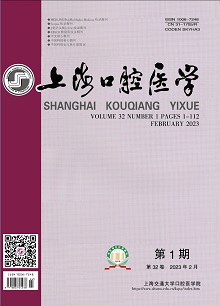
期刊介绍:
"Shanghai Journal of Stomatology (SJS)" is a comprehensive academic journal of stomatology directed by Shanghai Jiao Tong University and sponsored by the Ninth People's Hospital Affiliated to Shanghai Jiao Tong University School of Medicine. The main columns include basic research, clinical research, column articles, clinical summaries, reviews, academic lectures, etc., which are suitable for reference by clinicians, scientific researchers and teaching personnel at all levels engaged in oral medicine.
 分享
分享




 京公网安备 11010802042870号
京ICP备2023020795号-1
京公网安备 11010802042870号
京ICP备2023020795号-1

 求助内容:
求助内容: 应助结果提醒方式:
 扫码关注我们
