Denis А. Davydov, Gleb S. Budylin, Alexey V. Baev, Daniil V. Vaipan, Elena M. Seredenina, Armais A. Kamalov, Evgeny A. Shirshin
{"title":"利用光学光谱仪进行皮肤脱水监测可评估机体内的含水量:热负荷和物理负荷、利尿治疗。","authors":"Denis А. Davydov, Gleb S. Budylin, Alexey V. Baev, Daniil V. Vaipan, Elena M. Seredenina, Armais A. Kamalov, Evgeny A. Shirshin","doi":"10.1002/jbio.202300509","DOIUrl":null,"url":null,"abstract":"<p>This study investigates the relationship between body hydration levels and skin hydration using spatially resolved diffuse reflectance spectroscopy. The research involved monitoring skin dehydration and rehydration under various conditions, including thermal and physical loads on healthy volunteers, and diuretic therapy in patients with edema syndrome. Findings indicate a correlation between body mass reduction and skin hydration: a 1% loss in body mass corresponds to a 10% decrease in skin hydration. During thermal stress, water absorption at 970 nm decreased monotonically without recovery. Physical activity resulted in approximately 10% changes in skin water content within 20 min, followed by rehydration. Patients with edema syndrome exhibited the most substantial decrease in water absorption amplitude, at nearly 30%, during diuretic treatment. These results support optical spectroscopy as a non-invasive tool for assessing body hydration, with implications for developing portable hydration monitoring devices for clinical and sports applications.</p>","PeriodicalId":184,"journal":{"name":"Journal of Biophotonics","volume":"18 6","pages":""},"PeriodicalIF":2.0000,"publicationDate":"2024-01-07","publicationTypes":"Journal Article","fieldsOfStudy":null,"isOpenAccess":false,"openAccessPdf":"","citationCount":"0","resultStr":"{\"title\":\"Skin dehydration monitoring with optical spectroscopy allows assessment of water content in the organism: Thermal and physical loads, diuretic therapy\",\"authors\":\"Denis А. Davydov, Gleb S. Budylin, Alexey V. Baev, Daniil V. Vaipan, Elena M. Seredenina, Armais A. Kamalov, Evgeny A. Shirshin\",\"doi\":\"10.1002/jbio.202300509\",\"DOIUrl\":null,\"url\":null,\"abstract\":\"<p>This study investigates the relationship between body hydration levels and skin hydration using spatially resolved diffuse reflectance spectroscopy. The research involved monitoring skin dehydration and rehydration under various conditions, including thermal and physical loads on healthy volunteers, and diuretic therapy in patients with edema syndrome. Findings indicate a correlation between body mass reduction and skin hydration: a 1% loss in body mass corresponds to a 10% decrease in skin hydration. During thermal stress, water absorption at 970 nm decreased monotonically without recovery. Physical activity resulted in approximately 10% changes in skin water content within 20 min, followed by rehydration. Patients with edema syndrome exhibited the most substantial decrease in water absorption amplitude, at nearly 30%, during diuretic treatment. These results support optical spectroscopy as a non-invasive tool for assessing body hydration, with implications for developing portable hydration monitoring devices for clinical and sports applications.</p>\",\"PeriodicalId\":184,\"journal\":{\"name\":\"Journal of Biophotonics\",\"volume\":\"18 6\",\"pages\":\"\"},\"PeriodicalIF\":2.0000,\"publicationDate\":\"2024-01-07\",\"publicationTypes\":\"Journal Article\",\"fieldsOfStudy\":null,\"isOpenAccess\":false,\"openAccessPdf\":\"\",\"citationCount\":\"0\",\"resultStr\":null,\"platform\":\"Semanticscholar\",\"paperid\":null,\"PeriodicalName\":\"Journal of Biophotonics\",\"FirstCategoryId\":\"101\",\"ListUrlMain\":\"https://onlinelibrary.wiley.com/doi/10.1002/jbio.202300509\",\"RegionNum\":3,\"RegionCategory\":\"物理与天体物理\",\"ArticlePicture\":[],\"TitleCN\":null,\"AbstractTextCN\":null,\"PMCID\":null,\"EPubDate\":\"\",\"PubModel\":\"\",\"JCR\":\"Q3\",\"JCRName\":\"BIOCHEMICAL RESEARCH METHODS\",\"Score\":null,\"Total\":0}","platform":"Semanticscholar","paperid":null,"PeriodicalName":"Journal of Biophotonics","FirstCategoryId":"101","ListUrlMain":"https://onlinelibrary.wiley.com/doi/10.1002/jbio.202300509","RegionNum":3,"RegionCategory":"物理与天体物理","ArticlePicture":[],"TitleCN":null,"AbstractTextCN":null,"PMCID":null,"EPubDate":"","PubModel":"","JCR":"Q3","JCRName":"BIOCHEMICAL RESEARCH METHODS","Score":null,"Total":0}
Skin dehydration monitoring with optical spectroscopy allows assessment of water content in the organism: Thermal and physical loads, diuretic therapy
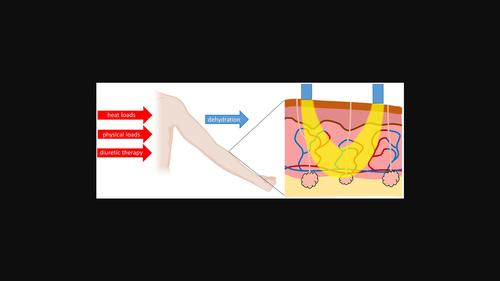
This study investigates the relationship between body hydration levels and skin hydration using spatially resolved diffuse reflectance spectroscopy. The research involved monitoring skin dehydration and rehydration under various conditions, including thermal and physical loads on healthy volunteers, and diuretic therapy in patients with edema syndrome. Findings indicate a correlation between body mass reduction and skin hydration: a 1% loss in body mass corresponds to a 10% decrease in skin hydration. During thermal stress, water absorption at 970 nm decreased monotonically without recovery. Physical activity resulted in approximately 10% changes in skin water content within 20 min, followed by rehydration. Patients with edema syndrome exhibited the most substantial decrease in water absorption amplitude, at nearly 30%, during diuretic treatment. These results support optical spectroscopy as a non-invasive tool for assessing body hydration, with implications for developing portable hydration monitoring devices for clinical and sports applications.
期刊介绍:
The first international journal dedicated to publishing reviews and original articles from this exciting field, the Journal of Biophotonics covers the broad range of research on interactions between light and biological material. The journal offers a platform where the physicist communicates with the biologist and where the clinical practitioner learns about the latest tools for the diagnosis of diseases. As such, the journal is highly interdisciplinary, publishing cutting edge research in the fields of life sciences, medicine, physics, chemistry, and engineering. The coverage extends from fundamental research to specific developments, while also including the latest applications.




 京公网安备 11010802042870号
京ICP备2023020795号-1
京公网安备 11010802042870号
京ICP备2023020795号-1

 分享
分享
 求助内容:
求助内容: 应助结果提醒方式:
 扫码关注我们
