Daisuke Higuchi, Yu Kondo, Yuta Watanabe, Takahiro Miki
{"title":"颈椎手术患者的健康相关生活质量与疼痛、运动恐惧和体育锻炼有关。","authors":"Daisuke Higuchi, Yu Kondo, Yuta Watanabe, Takahiro Miki","doi":"10.5535/arm.23142","DOIUrl":null,"url":null,"abstract":"<p><strong>Objective: </strong>To determine the association between health-related quality of life (HRQOL) and neck pain, kinesiophobia, and modalities of physical activity in individuals with postoperative degenerative cervical myelopathy and radiculopathy (DCM/R) because postoperative pain after cervical spine surgery is likely to persist, causing kinesiophobia and avoidance of physical activity.</p><p><strong>Methods: </strong>A questionnaire was distributed to 280 individuals with DCM/R. The questionnaire comprised the following four items: HRQOL (EuroQol 5-dimensions 5-level), neck pain (numerical rating scale [NRS]), kinesiophobia (11-item Tampa Scale for Kinesiophobia [TSK-11]), and physical activity (paid work, light exercise, walking, strength training, and gardening). Hierarchical multiple regression analysis was performed using the NRS, TSK-11, and physical activity as independent variables.</p><p><strong>Results: </strong>In total, 126 individuals provided analyzable responses (45.0%). After including the NRS score as an independent variable to the multiple regression equation for participants' background, the independent rate of the regression equation significantly improved by only 4.1% (R2=0.153). The addition of the TSK-11 score significantly improved this effect by 11.1% (R2=0.264). Finally, the addition of physical activity also significantly improved the explanatory rate by 9.9% (R2=0.363).</p><p><strong>Conclusion: </strong>Neck pain, kinesiophobia, and physical activity (specifically paid work and walking) were independently associated with HRQOL in individuals with postoperative DCM/R.</p>","PeriodicalId":47738,"journal":{"name":"Annals of Rehabilitation Medicine-ARM","volume":" ","pages":"57-64"},"PeriodicalIF":2.8000,"publicationDate":"2024-02-01","publicationTypes":"Journal Article","fieldsOfStudy":null,"isOpenAccess":false,"openAccessPdf":"https://www.ncbi.nlm.nih.gov/pmc/articles/PMC10915307/pdf/","citationCount":"0","resultStr":"{\"title\":\"Health-Related Quality of Life is Associated With Pain, Kinesiophobia, and Physical Activity in Individuals Who Underwent Cervical Spine Surgery.\",\"authors\":\"Daisuke Higuchi, Yu Kondo, Yuta Watanabe, Takahiro Miki\",\"doi\":\"10.5535/arm.23142\",\"DOIUrl\":null,\"url\":null,\"abstract\":\"<p><strong>Objective: </strong>To determine the association between health-related quality of life (HRQOL) and neck pain, kinesiophobia, and modalities of physical activity in individuals with postoperative degenerative cervical myelopathy and radiculopathy (DCM/R) because postoperative pain after cervical spine surgery is likely to persist, causing kinesiophobia and avoidance of physical activity.</p><p><strong>Methods: </strong>A questionnaire was distributed to 280 individuals with DCM/R. The questionnaire comprised the following four items: HRQOL (EuroQol 5-dimensions 5-level), neck pain (numerical rating scale [NRS]), kinesiophobia (11-item Tampa Scale for Kinesiophobia [TSK-11]), and physical activity (paid work, light exercise, walking, strength training, and gardening). Hierarchical multiple regression analysis was performed using the NRS, TSK-11, and physical activity as independent variables.</p><p><strong>Results: </strong>In total, 126 individuals provided analyzable responses (45.0%). After including the NRS score as an independent variable to the multiple regression equation for participants' background, the independent rate of the regression equation significantly improved by only 4.1% (R2=0.153). The addition of the TSK-11 score significantly improved this effect by 11.1% (R2=0.264). Finally, the addition of physical activity also significantly improved the explanatory rate by 9.9% (R2=0.363).</p><p><strong>Conclusion: </strong>Neck pain, kinesiophobia, and physical activity (specifically paid work and walking) were independently associated with HRQOL in individuals with postoperative DCM/R.</p>\",\"PeriodicalId\":47738,\"journal\":{\"name\":\"Annals of Rehabilitation Medicine-ARM\",\"volume\":\" \",\"pages\":\"57-64\"},\"PeriodicalIF\":2.8000,\"publicationDate\":\"2024-02-01\",\"publicationTypes\":\"Journal Article\",\"fieldsOfStudy\":null,\"isOpenAccess\":false,\"openAccessPdf\":\"https://www.ncbi.nlm.nih.gov/pmc/articles/PMC10915307/pdf/\",\"citationCount\":\"0\",\"resultStr\":null,\"platform\":\"Semanticscholar\",\"paperid\":null,\"PeriodicalName\":\"Annals of Rehabilitation Medicine-ARM\",\"FirstCategoryId\":\"1085\",\"ListUrlMain\":\"https://doi.org/10.5535/arm.23142\",\"RegionNum\":0,\"RegionCategory\":null,\"ArticlePicture\":[],\"TitleCN\":null,\"AbstractTextCN\":null,\"PMCID\":null,\"EPubDate\":\"2024/2/8 0:00:00\",\"PubModel\":\"Epub\",\"JCR\":\"Q1\",\"JCRName\":\"REHABILITATION\",\"Score\":null,\"Total\":0}","platform":"Semanticscholar","paperid":null,"PeriodicalName":"Annals of Rehabilitation Medicine-ARM","FirstCategoryId":"1085","ListUrlMain":"https://doi.org/10.5535/arm.23142","RegionNum":0,"RegionCategory":null,"ArticlePicture":[],"TitleCN":null,"AbstractTextCN":null,"PMCID":null,"EPubDate":"2024/2/8 0:00:00","PubModel":"Epub","JCR":"Q1","JCRName":"REHABILITATION","Score":null,"Total":0}
Health-Related Quality of Life is Associated With Pain, Kinesiophobia, and Physical Activity in Individuals Who Underwent Cervical Spine Surgery.
Objective: To determine the association between health-related quality of life (HRQOL) and neck pain, kinesiophobia, and modalities of physical activity in individuals with postoperative degenerative cervical myelopathy and radiculopathy (DCM/R) because postoperative pain after cervical spine surgery is likely to persist, causing kinesiophobia and avoidance of physical activity.
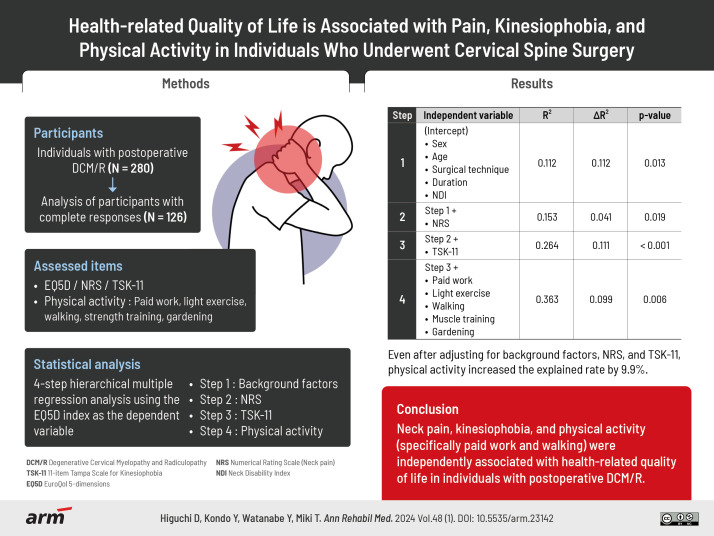
Methods: A questionnaire was distributed to 280 individuals with DCM/R. The questionnaire comprised the following four items: HRQOL (EuroQol 5-dimensions 5-level), neck pain (numerical rating scale [NRS]), kinesiophobia (11-item Tampa Scale for Kinesiophobia [TSK-11]), and physical activity (paid work, light exercise, walking, strength training, and gardening). Hierarchical multiple regression analysis was performed using the NRS, TSK-11, and physical activity as independent variables.
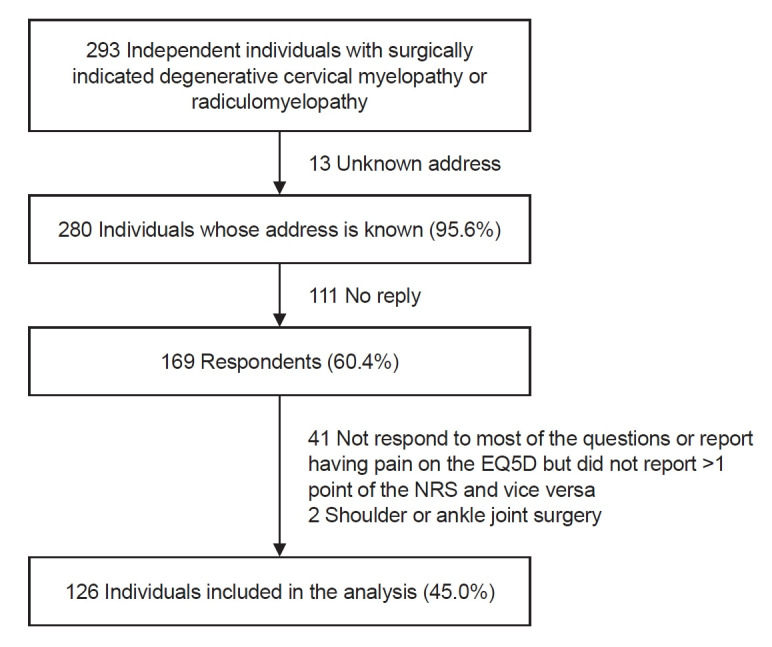
Results: In total, 126 individuals provided analyzable responses (45.0%). After including the NRS score as an independent variable to the multiple regression equation for participants' background, the independent rate of the regression equation significantly improved by only 4.1% (R2=0.153). The addition of the TSK-11 score significantly improved this effect by 11.1% (R2=0.264). Finally, the addition of physical activity also significantly improved the explanatory rate by 9.9% (R2=0.363).
Conclusion: Neck pain, kinesiophobia, and physical activity (specifically paid work and walking) were independently associated with HRQOL in individuals with postoperative DCM/R.





 京公网安备 11010802042870号
京ICP备2023020795号-1
京公网安备 11010802042870号
京ICP备2023020795号-1

 分享
分享
 求助内容:
求助内容: 应助结果提醒方式:
 扫码关注我们
