Hailong Xu, Li Huang, Wen Zhang, Jing Liang, Xuanqiao Gao, Jianfeng Li
{"title":"通过微柱评估钼铼合金的定向机械响应","authors":"Hailong Xu, Li Huang, Wen Zhang, Jing Liang, Xuanqiao Gao, Jianfeng Li","doi":"10.1002/eng2.12829","DOIUrl":null,"url":null,"abstract":"<p>Textures in molybdenum-rhenium (Mo-Re) alloys are inevitable during thermal fabrication. [110] and [100] are common orientations in Mo-Re alloys and effect mechanical responses. However, orientation dependence of mechanical responses in Mo-Re alloys is not quite clear yet. To clarity this problem, micro-pillar compression tests are conducted in grains with orientation [100] and [110] separately. Orientation-dependent compressive properties are found in Mo-14Re and Mo-42Re (wt.%), but are not found in Mo and Mo-5Re, which may be attributed to activated multi-slip planes as increased Re. Solid solution effect of Re not only relies on orientations, but also on Re contents. Softening effect occurs in both [100] and [110] Mo-5Re. while, strong strengthening effect happens in [110] Mo-14Re and Mo-42Re. Our research clarifies that Mo-Re alloys with [110] orientation/texture could be preferred to obtain good strengthening effect.</p>","PeriodicalId":72922,"journal":{"name":"Engineering reports : open access","volume":"6 10","pages":""},"PeriodicalIF":2.0000,"publicationDate":"2024-02-06","publicationTypes":"Journal Article","fieldsOfStudy":null,"isOpenAccess":false,"openAccessPdf":"https://onlinelibrary.wiley.com/doi/epdf/10.1002/eng2.12829","citationCount":"0","resultStr":"{\"title\":\"Orientation-dependent mechanical responses in molybdenum-rhenium alloys evaluated via micro-pillars\",\"authors\":\"Hailong Xu, Li Huang, Wen Zhang, Jing Liang, Xuanqiao Gao, Jianfeng Li\",\"doi\":\"10.1002/eng2.12829\",\"DOIUrl\":null,\"url\":null,\"abstract\":\"<p>Textures in molybdenum-rhenium (Mo-Re) alloys are inevitable during thermal fabrication. [110] and [100] are common orientations in Mo-Re alloys and effect mechanical responses. However, orientation dependence of mechanical responses in Mo-Re alloys is not quite clear yet. To clarity this problem, micro-pillar compression tests are conducted in grains with orientation [100] and [110] separately. Orientation-dependent compressive properties are found in Mo-14Re and Mo-42Re (wt.%), but are not found in Mo and Mo-5Re, which may be attributed to activated multi-slip planes as increased Re. Solid solution effect of Re not only relies on orientations, but also on Re contents. Softening effect occurs in both [100] and [110] Mo-5Re. while, strong strengthening effect happens in [110] Mo-14Re and Mo-42Re. Our research clarifies that Mo-Re alloys with [110] orientation/texture could be preferred to obtain good strengthening effect.</p>\",\"PeriodicalId\":72922,\"journal\":{\"name\":\"Engineering reports : open access\",\"volume\":\"6 10\",\"pages\":\"\"},\"PeriodicalIF\":2.0000,\"publicationDate\":\"2024-02-06\",\"publicationTypes\":\"Journal Article\",\"fieldsOfStudy\":null,\"isOpenAccess\":false,\"openAccessPdf\":\"https://onlinelibrary.wiley.com/doi/epdf/10.1002/eng2.12829\",\"citationCount\":\"0\",\"resultStr\":null,\"platform\":\"Semanticscholar\",\"paperid\":null,\"PeriodicalName\":\"Engineering reports : open access\",\"FirstCategoryId\":\"1085\",\"ListUrlMain\":\"https://onlinelibrary.wiley.com/doi/10.1002/eng2.12829\",\"RegionNum\":0,\"RegionCategory\":null,\"ArticlePicture\":[],\"TitleCN\":null,\"AbstractTextCN\":null,\"PMCID\":null,\"EPubDate\":\"\",\"PubModel\":\"\",\"JCR\":\"Q3\",\"JCRName\":\"COMPUTER SCIENCE, INTERDISCIPLINARY APPLICATIONS\",\"Score\":null,\"Total\":0}","platform":"Semanticscholar","paperid":null,"PeriodicalName":"Engineering reports : open access","FirstCategoryId":"1085","ListUrlMain":"https://onlinelibrary.wiley.com/doi/10.1002/eng2.12829","RegionNum":0,"RegionCategory":null,"ArticlePicture":[],"TitleCN":null,"AbstractTextCN":null,"PMCID":null,"EPubDate":"","PubModel":"","JCR":"Q3","JCRName":"COMPUTER SCIENCE, INTERDISCIPLINARY APPLICATIONS","Score":null,"Total":0}
引用次数: 0
摘要
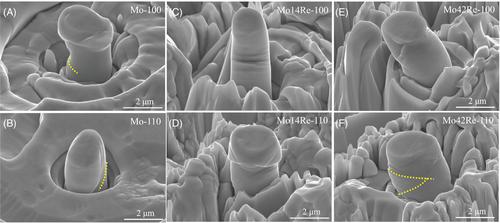
钼-铼(Mo-Re)合金的纹理在热加工过程中不可避免。[110]和[100]是 Mo-Re 合金中常见的取向,会影响机械响应。然而,Mo-Re 合金中机械响应的取向依赖性尚不十分明确。为了澄清这一问题,我们分别对取向为 [100] 和 [110] 的晶粒进行了微柱压缩试验。在 Mo-14Re 和 Mo-42Re(重量百分比)中发现了与取向相关的压缩特性,但在 Mo 和 Mo-5Re 中却没有发现,这可能是由于 Re 增加时激活了多滑移平面。Re 的固溶效应不仅取决于取向,还取决于 Re 的含量。[100]和[110]Mo-5Re中都出现了软化效应,而[110]Mo-14Re和Mo-42Re中则出现了强烈的强化效应。我们的研究表明,要获得良好的强化效果,应优先选择具有[110]取向/质地的 Mo-Re 合金。
Orientation-dependent mechanical responses in molybdenum-rhenium alloys evaluated via micro-pillars
Textures in molybdenum-rhenium (Mo-Re) alloys are inevitable during thermal fabrication. [110] and [100] are common orientations in Mo-Re alloys and effect mechanical responses. However, orientation dependence of mechanical responses in Mo-Re alloys is not quite clear yet. To clarity this problem, micro-pillar compression tests are conducted in grains with orientation [100] and [110] separately. Orientation-dependent compressive properties are found in Mo-14Re and Mo-42Re (wt.%), but are not found in Mo and Mo-5Re, which may be attributed to activated multi-slip planes as increased Re. Solid solution effect of Re not only relies on orientations, but also on Re contents. Softening effect occurs in both [100] and [110] Mo-5Re. while, strong strengthening effect happens in [110] Mo-14Re and Mo-42Re. Our research clarifies that Mo-Re alloys with [110] orientation/texture could be preferred to obtain good strengthening effect.




 京公网安备 11010802042870号
京ICP备2023020795号-1
京公网安备 11010802042870号
京ICP备2023020795号-1

 分享
分享

 求助内容:
求助内容: 应助结果提醒方式:
 扫码关注我们
