Uwe Wessels, Florian Neff, Julia Fakhiri, Klaus Mayer, Ulrich Brinkmann, Kay Stubenrauch
{"title":"用于检测总抗腺病毒抗体的新型检测方法,具有较低的囊壳消耗和内置特异性控制。","authors":"Uwe Wessels, Florian Neff, Julia Fakhiri, Klaus Mayer, Ulrich Brinkmann, Kay Stubenrauch","doi":"10.4155/bio-2023-0254","DOIUrl":null,"url":null,"abstract":"<p><p><b>Aim:</b> To develop an assay format for detection of total anti-adeno-associated virus 2 (AAV2) antibodies with low capsid material consumption. <b>Methods:</b> An immune complex (IC) assay format was developed. The format is based on the formation of ICs in solution and their subsequent detection using an anti-AAV2 antibody for capture and an antibody against the study species IgG for detection. <b>Results:</b> The feasibility of the IC assay for detection of preexisting and treatment-emergent anti-AAV2 antibodies was demonstrated in cynomolgus monkey and human serum samples, including samples from a preclinical study with AAV2-based therapies. <b>Conclusion:</b> The presented IC assay is an easy-to-perform total anti-AAV2 antibody assay that requires a small amount of unlabeled capsid material and provides an intrinsic specificity control.</p>","PeriodicalId":8797,"journal":{"name":"Bioanalysis","volume":" ","pages":"431-442"},"PeriodicalIF":1.8000,"publicationDate":"2024-01-01","publicationTypes":"Journal Article","fieldsOfStudy":null,"isOpenAccess":false,"openAccessPdf":"https://www.ncbi.nlm.nih.gov/pmc/articles/PMC11216498/pdf/","citationCount":"0","resultStr":"{\"title\":\"Novel assay format for total anti-adeno-associated virus antibody detection with low capsid consumption and built-in specificity control.\",\"authors\":\"Uwe Wessels, Florian Neff, Julia Fakhiri, Klaus Mayer, Ulrich Brinkmann, Kay Stubenrauch\",\"doi\":\"10.4155/bio-2023-0254\",\"DOIUrl\":null,\"url\":null,\"abstract\":\"<p><p><b>Aim:</b> To develop an assay format for detection of total anti-adeno-associated virus 2 (AAV2) antibodies with low capsid material consumption. <b>Methods:</b> An immune complex (IC) assay format was developed. The format is based on the formation of ICs in solution and their subsequent detection using an anti-AAV2 antibody for capture and an antibody against the study species IgG for detection. <b>Results:</b> The feasibility of the IC assay for detection of preexisting and treatment-emergent anti-AAV2 antibodies was demonstrated in cynomolgus monkey and human serum samples, including samples from a preclinical study with AAV2-based therapies. <b>Conclusion:</b> The presented IC assay is an easy-to-perform total anti-AAV2 antibody assay that requires a small amount of unlabeled capsid material and provides an intrinsic specificity control.</p>\",\"PeriodicalId\":8797,\"journal\":{\"name\":\"Bioanalysis\",\"volume\":\" \",\"pages\":\"431-442\"},\"PeriodicalIF\":1.8000,\"publicationDate\":\"2024-01-01\",\"publicationTypes\":\"Journal Article\",\"fieldsOfStudy\":null,\"isOpenAccess\":false,\"openAccessPdf\":\"https://www.ncbi.nlm.nih.gov/pmc/articles/PMC11216498/pdf/\",\"citationCount\":\"0\",\"resultStr\":null,\"platform\":\"Semanticscholar\",\"paperid\":null,\"PeriodicalName\":\"Bioanalysis\",\"FirstCategoryId\":\"3\",\"ListUrlMain\":\"https://doi.org/10.4155/bio-2023-0254\",\"RegionNum\":4,\"RegionCategory\":\"医学\",\"ArticlePicture\":[],\"TitleCN\":null,\"AbstractTextCN\":null,\"PMCID\":null,\"EPubDate\":\"2024/3/18 0:00:00\",\"PubModel\":\"Epub\",\"JCR\":\"Q3\",\"JCRName\":\"BIOCHEMICAL RESEARCH METHODS\",\"Score\":null,\"Total\":0}","platform":"Semanticscholar","paperid":null,"PeriodicalName":"Bioanalysis","FirstCategoryId":"3","ListUrlMain":"https://doi.org/10.4155/bio-2023-0254","RegionNum":4,"RegionCategory":"医学","ArticlePicture":[],"TitleCN":null,"AbstractTextCN":null,"PMCID":null,"EPubDate":"2024/3/18 0:00:00","PubModel":"Epub","JCR":"Q3","JCRName":"BIOCHEMICAL RESEARCH METHODS","Score":null,"Total":0}
引用次数: 0
摘要
目的:开发一种检测抗腺体相关病毒 2 (AAV2) 总抗体的检测方法,且囊壳材料消耗量低。方法:开发一种免疫复合物(IC)检测方法。该方法基于在溶液中形成 IC,然后使用抗 AAV2 抗体进行捕获和使用抗研究物种 IgG 的抗体进行检测。结果:在猕猴和人类血清样本(包括基于 AAV2 疗法的临床前研究样本)中证明了 IC 检测法检测已有的和治疗后出现的抗 AAV2 抗体的可行性。结论所介绍的 IC 检测法是一种易于操作的全抗 AAV2 抗体检测法,只需少量未标记的囊壳材料,并提供内在特异性控制。
Novel assay format for total anti-adeno-associated virus antibody detection with low capsid consumption and built-in specificity control.
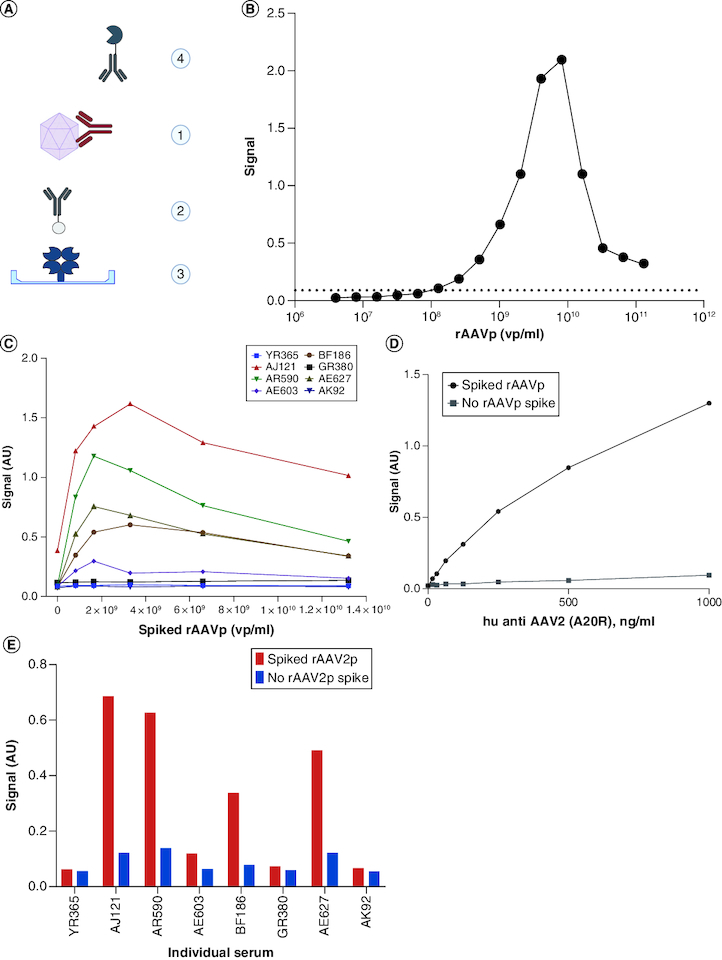
Aim: To develop an assay format for detection of total anti-adeno-associated virus 2 (AAV2) antibodies with low capsid material consumption. Methods: An immune complex (IC) assay format was developed. The format is based on the formation of ICs in solution and their subsequent detection using an anti-AAV2 antibody for capture and an antibody against the study species IgG for detection. Results: The feasibility of the IC assay for detection of preexisting and treatment-emergent anti-AAV2 antibodies was demonstrated in cynomolgus monkey and human serum samples, including samples from a preclinical study with AAV2-based therapies. Conclusion: The presented IC assay is an easy-to-perform total anti-AAV2 antibody assay that requires a small amount of unlabeled capsid material and provides an intrinsic specificity control.
BioanalysisBIOCHEMICAL RESEARCH METHODS-CHEMISTRY, ANALYTICAL
CiteScore
3.30
自引率
16.70%
发文量
88
审稿时长
2 months
期刊介绍:
Reliable data obtained from selective, sensitive and reproducible analysis of xenobiotics and biotics in biological samples is a fundamental and crucial part of every successful drug development program. The same principles can also apply to many other areas of research such as forensic science, toxicology and sports doping testing.
The bioanalytical field incorporates sophisticated techniques linking sample preparation and advanced separations with MS and NMR detection systems, automation and robotics. Standards set by regulatory bodies regarding method development and validation increasingly define the boundaries between speed and quality.
Bioanalysis is a progressive discipline for which the future holds many exciting opportunities to further reduce sample volumes, analysis cost and environmental impact, as well as to improve sensitivity, specificity, accuracy, efficiency, assay throughput, data quality, data handling and processing.
The journal Bioanalysis focuses on the techniques and methods used for the detection or quantitative study of analytes in human or animal biological samples. Bioanalysis encourages the submission of articles describing forward-looking applications, including biosensors, microfluidics, miniaturized analytical devices, and new hyphenated and multi-dimensional techniques.
Bioanalysis delivers essential information in concise, at-a-glance article formats. Key advances in the field are reported and analyzed by international experts, providing an authoritative but accessible forum for the modern bioanalyst.






 京公网安备 11010802042870号
京ICP备2023020795号-1
京公网安备 11010802042870号
京ICP备2023020795号-1

 分享
分享
 求助内容:
求助内容: 应助结果提醒方式:
 扫码关注我们
