Jonathan Sgaglione, Andrew Muran, Matthew Rhode, Howard J Goodman, Morris C Edelman, Suhail Ahmed Shah, Andrew S Greenberg, Shachar Kenan
{"title":"老年慢性复发性多灶性骨髓炎(CRMO)模仿多灶性多发性骨髓瘤:八旬老人的首例病例。","authors":"Jonathan Sgaglione, Andrew Muran, Matthew Rhode, Howard J Goodman, Morris C Edelman, Suhail Ahmed Shah, Andrew S Greenberg, Shachar Kenan","doi":"10.1007/s00256-024-04653-z","DOIUrl":null,"url":null,"abstract":"<p><p>Chronic recurrent multifocal osteomyelitis (CRMO), an autoinflammatory bone disorder characterized by non-bacterial osteomyelitis causing recurrent multifocal bone lesions, is a well-known, yet uncommon pediatric condition that rarely affects adults; to date, it has never been diagnosed over the age of 75. The following report will discuss the first octogenarian diagnosed with CRMO and therefore represents an exceptionally rare presentation of a rare disease. An 83-year-old woman presented with progressive right shoulder, forearm, and hip pain, with associated weight loss and global weakness, requiring a wheelchair for mobility. Imaging revealed a pathologic right ulna fracture in addition to lytic lesions of the right proximal humerus and proximal femur. The clinical picture was thus that of a patient with probable multiple myeloma versus metastatic disease. After an extensive workup, however, the lesions were not malignant; histologic findings were instead suggestive of chronic osteomyelitis with negative cultures. Given the multifocal nature of this condition, combined with a lack of clinical symptoms of infection, a diagnosis of CRMO was rendered. The patient underwent intramedullary nailing of the right femur and splinting of the ulna, with a subsequent remarkable recovery to painless ambulation, complete union of the right ulna fracture, and resolution of the lytic lesions without receiving any targeted medical treatment. This case highlights the importance of maintaining CRMO on the differential for multifocal skeletal lesions, regardless of age. Performing a thorough workup with necessary imaging, biopsy, and culture are critical to establishing this diagnosis, which can only made as a diagnosis of exclusion.</p>","PeriodicalId":21783,"journal":{"name":"Skeletal Radiology","volume":" ","pages":"2703-2711"},"PeriodicalIF":2.2000,"publicationDate":"2024-12-01","publicationTypes":"Journal Article","fieldsOfStudy":null,"isOpenAccess":false,"openAccessPdf":"https://www.ncbi.nlm.nih.gov/pmc/articles/PMC11493802/pdf/","citationCount":"0","resultStr":"{\"title\":\"Geriatric chronic recurrent multifocal osteomyelitis (CRMO) mimicking multifocal multiple myeloma: a first in an octogenarian.\",\"authors\":\"Jonathan Sgaglione, Andrew Muran, Matthew Rhode, Howard J Goodman, Morris C Edelman, Suhail Ahmed Shah, Andrew S Greenberg, Shachar Kenan\",\"doi\":\"10.1007/s00256-024-04653-z\",\"DOIUrl\":null,\"url\":null,\"abstract\":\"<p><p>Chronic recurrent multifocal osteomyelitis (CRMO), an autoinflammatory bone disorder characterized by non-bacterial osteomyelitis causing recurrent multifocal bone lesions, is a well-known, yet uncommon pediatric condition that rarely affects adults; to date, it has never been diagnosed over the age of 75. The following report will discuss the first octogenarian diagnosed with CRMO and therefore represents an exceptionally rare presentation of a rare disease. An 83-year-old woman presented with progressive right shoulder, forearm, and hip pain, with associated weight loss and global weakness, requiring a wheelchair for mobility. Imaging revealed a pathologic right ulna fracture in addition to lytic lesions of the right proximal humerus and proximal femur. The clinical picture was thus that of a patient with probable multiple myeloma versus metastatic disease. After an extensive workup, however, the lesions were not malignant; histologic findings were instead suggestive of chronic osteomyelitis with negative cultures. Given the multifocal nature of this condition, combined with a lack of clinical symptoms of infection, a diagnosis of CRMO was rendered. The patient underwent intramedullary nailing of the right femur and splinting of the ulna, with a subsequent remarkable recovery to painless ambulation, complete union of the right ulna fracture, and resolution of the lytic lesions without receiving any targeted medical treatment. This case highlights the importance of maintaining CRMO on the differential for multifocal skeletal lesions, regardless of age. Performing a thorough workup with necessary imaging, biopsy, and culture are critical to establishing this diagnosis, which can only made as a diagnosis of exclusion.</p>\",\"PeriodicalId\":21783,\"journal\":{\"name\":\"Skeletal Radiology\",\"volume\":\" \",\"pages\":\"2703-2711\"},\"PeriodicalIF\":2.2000,\"publicationDate\":\"2024-12-01\",\"publicationTypes\":\"Journal Article\",\"fieldsOfStudy\":null,\"isOpenAccess\":false,\"openAccessPdf\":\"https://www.ncbi.nlm.nih.gov/pmc/articles/PMC11493802/pdf/\",\"citationCount\":\"0\",\"resultStr\":null,\"platform\":\"Semanticscholar\",\"paperid\":null,\"PeriodicalName\":\"Skeletal Radiology\",\"FirstCategoryId\":\"3\",\"ListUrlMain\":\"https://doi.org/10.1007/s00256-024-04653-z\",\"RegionNum\":3,\"RegionCategory\":\"医学\",\"ArticlePicture\":[],\"TitleCN\":null,\"AbstractTextCN\":null,\"PMCID\":null,\"EPubDate\":\"2024/3/19 0:00:00\",\"PubModel\":\"Epub\",\"JCR\":\"Q2\",\"JCRName\":\"ORTHOPEDICS\",\"Score\":null,\"Total\":0}","platform":"Semanticscholar","paperid":null,"PeriodicalName":"Skeletal Radiology","FirstCategoryId":"3","ListUrlMain":"https://doi.org/10.1007/s00256-024-04653-z","RegionNum":3,"RegionCategory":"医学","ArticlePicture":[],"TitleCN":null,"AbstractTextCN":null,"PMCID":null,"EPubDate":"2024/3/19 0:00:00","PubModel":"Epub","JCR":"Q2","JCRName":"ORTHOPEDICS","Score":null,"Total":0}
Geriatric chronic recurrent multifocal osteomyelitis (CRMO) mimicking multifocal multiple myeloma: a first in an octogenarian.
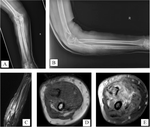
Chronic recurrent multifocal osteomyelitis (CRMO), an autoinflammatory bone disorder characterized by non-bacterial osteomyelitis causing recurrent multifocal bone lesions, is a well-known, yet uncommon pediatric condition that rarely affects adults; to date, it has never been diagnosed over the age of 75. The following report will discuss the first octogenarian diagnosed with CRMO and therefore represents an exceptionally rare presentation of a rare disease. An 83-year-old woman presented with progressive right shoulder, forearm, and hip pain, with associated weight loss and global weakness, requiring a wheelchair for mobility. Imaging revealed a pathologic right ulna fracture in addition to lytic lesions of the right proximal humerus and proximal femur. The clinical picture was thus that of a patient with probable multiple myeloma versus metastatic disease. After an extensive workup, however, the lesions were not malignant; histologic findings were instead suggestive of chronic osteomyelitis with negative cultures. Given the multifocal nature of this condition, combined with a lack of clinical symptoms of infection, a diagnosis of CRMO was rendered. The patient underwent intramedullary nailing of the right femur and splinting of the ulna, with a subsequent remarkable recovery to painless ambulation, complete union of the right ulna fracture, and resolution of the lytic lesions without receiving any targeted medical treatment. This case highlights the importance of maintaining CRMO on the differential for multifocal skeletal lesions, regardless of age. Performing a thorough workup with necessary imaging, biopsy, and culture are critical to establishing this diagnosis, which can only made as a diagnosis of exclusion.
期刊介绍:
Skeletal Radiology provides a forum for the dissemination of current knowledge and information dealing with disorders of the musculoskeletal system including the spine. While emphasizing the radiological aspects of the many varied skeletal abnormalities, the journal also adopts an interdisciplinary approach, reflecting the membership of the International Skeletal Society. Thus, the anatomical, pathological, physiological, clinical, metabolic and epidemiological aspects of the many entities affecting the skeleton receive appropriate consideration.
This is the Journal of the International Skeletal Society and the Official Journal of the Society of Skeletal Radiology and the Australasian Musculoskelelal Imaging Group.




 京公网安备 11010802042870号
京ICP备2023020795号-1
京公网安备 11010802042870号
京ICP备2023020795号-1

 分享
分享
 求助内容:
求助内容: 应助结果提醒方式:
 扫码关注我们
