{"title":"用于高效热能储存的聚乙二醇浸润生物质多孔碳相变复合材料","authors":"Yang Hu, Mengyang Zhang, Bingqing Quan, Xiaolong Li, Xinpeng Hu, Hao Wu, Xianrong Huang, Xiang Lu, Jinping Qu","doi":"10.1007/s42114-024-00880-z","DOIUrl":null,"url":null,"abstract":"<div><p>With the sharp increase in modern energy consumption, phase change composites with the characteristics of rapid preparation are employed for thermal energy storage to meet the challenge of energy crisis. In this study, a NaCl-assisted carbonization process was used to construct porous <i>Pleurotus eryngii</i> carbon with ultra-low volume shrinkage rate of 2%, which provides enormous space for encapsulation of PEG-4000. Such composite possesses exceptional thermal stability, with an absorption rate of 88.24%, a melting enthalpy of 174.87 J/g, and a relative enthalpy efficiency of 97.78%. Consequently, the resultant composites exhibit outstanding performances in storing and releasing thermal energy for photo-thermal, electric-thermal, and magnetic-thermal conversion. This study presents a highly valuable strategy into the quick fabrication of phase change composites, facilitating their practical applications in thermal energy storage.</p><h3>Graphical Abstract</h3>\n<div><figure><div><div><picture><source><img></source></picture></div></div></figure></div></div>","PeriodicalId":7220,"journal":{"name":"Advanced Composites and Hybrid Materials","volume":"7 2","pages":""},"PeriodicalIF":21.8000,"publicationDate":"2024-04-03","publicationTypes":"Journal Article","fieldsOfStudy":null,"isOpenAccess":false,"openAccessPdf":"","citationCount":"0","resultStr":"{\"title\":\"Polyethylene glycol infiltrated biomass-derived porous carbon phase change composites for efficient thermal energy storage\",\"authors\":\"Yang Hu, Mengyang Zhang, Bingqing Quan, Xiaolong Li, Xinpeng Hu, Hao Wu, Xianrong Huang, Xiang Lu, Jinping Qu\",\"doi\":\"10.1007/s42114-024-00880-z\",\"DOIUrl\":null,\"url\":null,\"abstract\":\"<div><p>With the sharp increase in modern energy consumption, phase change composites with the characteristics of rapid preparation are employed for thermal energy storage to meet the challenge of energy crisis. In this study, a NaCl-assisted carbonization process was used to construct porous <i>Pleurotus eryngii</i> carbon with ultra-low volume shrinkage rate of 2%, which provides enormous space for encapsulation of PEG-4000. Such composite possesses exceptional thermal stability, with an absorption rate of 88.24%, a melting enthalpy of 174.87 J/g, and a relative enthalpy efficiency of 97.78%. Consequently, the resultant composites exhibit outstanding performances in storing and releasing thermal energy for photo-thermal, electric-thermal, and magnetic-thermal conversion. This study presents a highly valuable strategy into the quick fabrication of phase change composites, facilitating their practical applications in thermal energy storage.</p><h3>Graphical Abstract</h3>\\n<div><figure><div><div><picture><source><img></source></picture></div></div></figure></div></div>\",\"PeriodicalId\":7220,\"journal\":{\"name\":\"Advanced Composites and Hybrid Materials\",\"volume\":\"7 2\",\"pages\":\"\"},\"PeriodicalIF\":21.8000,\"publicationDate\":\"2024-04-03\",\"publicationTypes\":\"Journal Article\",\"fieldsOfStudy\":null,\"isOpenAccess\":false,\"openAccessPdf\":\"\",\"citationCount\":\"0\",\"resultStr\":null,\"platform\":\"Semanticscholar\",\"paperid\":null,\"PeriodicalName\":\"Advanced Composites and Hybrid Materials\",\"FirstCategoryId\":\"88\",\"ListUrlMain\":\"https://link.springer.com/article/10.1007/s42114-024-00880-z\",\"RegionNum\":2,\"RegionCategory\":\"材料科学\",\"ArticlePicture\":[],\"TitleCN\":null,\"AbstractTextCN\":null,\"PMCID\":null,\"EPubDate\":\"\",\"PubModel\":\"\",\"JCR\":\"Q1\",\"JCRName\":\"MATERIALS SCIENCE, COMPOSITES\",\"Score\":null,\"Total\":0}","platform":"Semanticscholar","paperid":null,"PeriodicalName":"Advanced Composites and Hybrid Materials","FirstCategoryId":"88","ListUrlMain":"https://link.springer.com/article/10.1007/s42114-024-00880-z","RegionNum":2,"RegionCategory":"材料科学","ArticlePicture":[],"TitleCN":null,"AbstractTextCN":null,"PMCID":null,"EPubDate":"","PubModel":"","JCR":"Q1","JCRName":"MATERIALS SCIENCE, COMPOSITES","Score":null,"Total":0}
Polyethylene glycol infiltrated biomass-derived porous carbon phase change composites for efficient thermal energy storage
With the sharp increase in modern energy consumption, phase change composites with the characteristics of rapid preparation are employed for thermal energy storage to meet the challenge of energy crisis. In this study, a NaCl-assisted carbonization process was used to construct porous Pleurotus eryngii carbon with ultra-low volume shrinkage rate of 2%, which provides enormous space for encapsulation of PEG-4000. Such composite possesses exceptional thermal stability, with an absorption rate of 88.24%, a melting enthalpy of 174.87 J/g, and a relative enthalpy efficiency of 97.78%. Consequently, the resultant composites exhibit outstanding performances in storing and releasing thermal energy for photo-thermal, electric-thermal, and magnetic-thermal conversion. This study presents a highly valuable strategy into the quick fabrication of phase change composites, facilitating their practical applications in thermal energy storage.
期刊介绍:
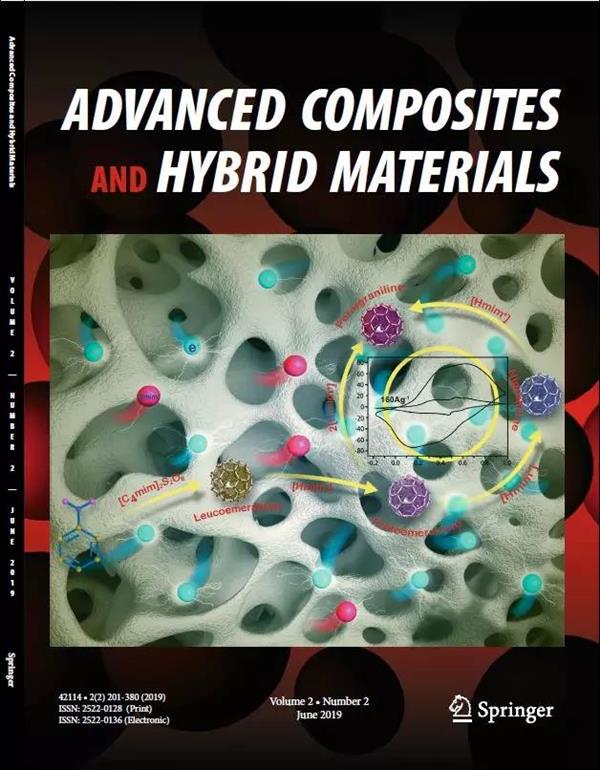
Advanced Composites and Hybrid Materials is a leading international journal that promotes interdisciplinary collaboration among materials scientists, engineers, chemists, biologists, and physicists working on composites, including nanocomposites. Our aim is to facilitate rapid scientific communication in this field.
The journal publishes high-quality research on various aspects of composite materials, including materials design, surface and interface science/engineering, manufacturing, structure control, property design, device fabrication, and other applications. We also welcome simulation and modeling studies that are relevant to composites. Additionally, papers focusing on the relationship between fillers and the matrix are of particular interest.
Our scope includes polymer, metal, and ceramic matrices, with a special emphasis on reviews and meta-analyses related to materials selection. We cover a wide range of topics, including transport properties, strategies for controlling interfaces and composition distribution, bottom-up assembly of nanocomposites, highly porous and high-density composites, electronic structure design, materials synergisms, and thermoelectric materials.
Advanced Composites and Hybrid Materials follows a rigorous single-blind peer-review process to ensure the quality and integrity of the published work.




 京公网安备 11010802042870号
京ICP备2023020795号-1
京公网安备 11010802042870号
京ICP备2023020795号-1

 分享
分享
 求助内容:
求助内容: 应助结果提醒方式:
 扫码关注我们
