Shihao Min , Zhuoyue Wang , Xiao Xu , Jiaxin He , Miao Sun , Wenlie Lin , Longtian Kang
{"title":"掺杂过渡金属(铁、钴、镍)的氧化亚铜纳米线阵列作为电催化二氧化碳还原乙烯反应的自支撑催化剂","authors":"Shihao Min , Zhuoyue Wang , Xiao Xu , Jiaxin He , Miao Sun , Wenlie Lin , Longtian Kang","doi":"10.1016/j.apsusc.2024.160150","DOIUrl":null,"url":null,"abstract":"<div><p>The transition metal (Fe, Co, Ni)-doped cuprous oxide (Cu<sub>2</sub>O) nanowire arrays on Cu mesh (CM) (M-Cu<sub>2</sub>O@CM, M = Fe, Co, Ni) are successfully synthesized for the electrocatalytic CO<sub>2</sub> reduction reaction (CO<sub>2</sub>RR) to ethylene (C<sub>2</sub>H<sub>4</sub>) through the simple calcination and impregnation-exchange methods. Systematic characterizations have demonstrated that the Ni/Co doping in Cu<sub>2</sub>O@CM is conducive to stabilizing the Cu<sup>+</sup> sites due to the electron transfer from Cu<sub>2</sub>O to Ni/Co, while the Fe doping has the opposite effect. Consequently, they show the different electrocatalytic performances of Ni-Cu<sub>2</sub>O@CM > Co-Cu<sub>2</sub>O@CM > Cu<sub>2</sub>O@CM > Fe-Cu<sub>2</sub>O@CM for CO<sub>2</sub>RR to C<sub>2</sub>H<sub>4</sub> in an H-cell. Among them, Ni-Cu<sub>2</sub>O@CM exhibits the ∼2.0-fold faradaic efficiency for C<sub>2</sub>H<sub>4</sub> (58.2 % <em>vs.</em> 28.7 %) and the ∼2.5-fold current density (−37.6 <em>vs.</em> −15.0 mA·cm<sup>−2</sup>) at −1.1 V <em>vs.</em> RHE, as compared with Cu<sub>2</sub>O@CM. Further experiments reveal that during the electrocatalytic CO<sub>2</sub>RR, the Ni-Cu<sub>2</sub>O@CM can generate more *CO, which promotes the C–C coupling reaction. The activity of Co-Cu<sub>2</sub>O@CM is lower than Ni-Cu<sub>2</sub>O@CM because of the strong adsorption of *COOH, while the Fe-Cu<sub>2</sub>O@CM even exhibits a lower activity than Cu<sub>2</sub>O@CM. This work provides an insight into the effect of transition metal-doped Cu<sub>2</sub>O array on the electrocatalytic CO<sub>2</sub>RR to C<sub>2</sub>H<sub>4</sub> products.</p></div>","PeriodicalId":247,"journal":{"name":"Applied Surface Science","volume":"663 ","pages":"Article 160150"},"PeriodicalIF":6.9000,"publicationDate":"2024-08-01","publicationTypes":"Journal Article","fieldsOfStudy":null,"isOpenAccess":false,"openAccessPdf":"","citationCount":"0","resultStr":"{\"title\":\"Transition metal (Fe, Co, Ni)-doped cuprous oxide nanowire arrays as self-supporting catalysts for electrocatalytic CO2 reduction reaction to ethylene\",\"authors\":\"Shihao Min , Zhuoyue Wang , Xiao Xu , Jiaxin He , Miao Sun , Wenlie Lin , Longtian Kang\",\"doi\":\"10.1016/j.apsusc.2024.160150\",\"DOIUrl\":null,\"url\":null,\"abstract\":\"<div><p>The transition metal (Fe, Co, Ni)-doped cuprous oxide (Cu<sub>2</sub>O) nanowire arrays on Cu mesh (CM) (M-Cu<sub>2</sub>O@CM, M = Fe, Co, Ni) are successfully synthesized for the electrocatalytic CO<sub>2</sub> reduction reaction (CO<sub>2</sub>RR) to ethylene (C<sub>2</sub>H<sub>4</sub>) through the simple calcination and impregnation-exchange methods. Systematic characterizations have demonstrated that the Ni/Co doping in Cu<sub>2</sub>O@CM is conducive to stabilizing the Cu<sup>+</sup> sites due to the electron transfer from Cu<sub>2</sub>O to Ni/Co, while the Fe doping has the opposite effect. Consequently, they show the different electrocatalytic performances of Ni-Cu<sub>2</sub>O@CM > Co-Cu<sub>2</sub>O@CM > Cu<sub>2</sub>O@CM > Fe-Cu<sub>2</sub>O@CM for CO<sub>2</sub>RR to C<sub>2</sub>H<sub>4</sub> in an H-cell. Among them, Ni-Cu<sub>2</sub>O@CM exhibits the ∼2.0-fold faradaic efficiency for C<sub>2</sub>H<sub>4</sub> (58.2 % <em>vs.</em> 28.7 %) and the ∼2.5-fold current density (−37.6 <em>vs.</em> −15.0 mA·cm<sup>−2</sup>) at −1.1 V <em>vs.</em> RHE, as compared with Cu<sub>2</sub>O@CM. Further experiments reveal that during the electrocatalytic CO<sub>2</sub>RR, the Ni-Cu<sub>2</sub>O@CM can generate more *CO, which promotes the C–C coupling reaction. The activity of Co-Cu<sub>2</sub>O@CM is lower than Ni-Cu<sub>2</sub>O@CM because of the strong adsorption of *COOH, while the Fe-Cu<sub>2</sub>O@CM even exhibits a lower activity than Cu<sub>2</sub>O@CM. This work provides an insight into the effect of transition metal-doped Cu<sub>2</sub>O array on the electrocatalytic CO<sub>2</sub>RR to C<sub>2</sub>H<sub>4</sub> products.</p></div>\",\"PeriodicalId\":247,\"journal\":{\"name\":\"Applied Surface Science\",\"volume\":\"663 \",\"pages\":\"Article 160150\"},\"PeriodicalIF\":6.9000,\"publicationDate\":\"2024-08-01\",\"publicationTypes\":\"Journal Article\",\"fieldsOfStudy\":null,\"isOpenAccess\":false,\"openAccessPdf\":\"\",\"citationCount\":\"0\",\"resultStr\":null,\"platform\":\"Semanticscholar\",\"paperid\":null,\"PeriodicalName\":\"Applied Surface Science\",\"FirstCategoryId\":\"88\",\"ListUrlMain\":\"https://www.sciencedirect.com/science/article/pii/S0169433224008638\",\"RegionNum\":2,\"RegionCategory\":\"材料科学\",\"ArticlePicture\":[],\"TitleCN\":null,\"AbstractTextCN\":null,\"PMCID\":null,\"EPubDate\":\"2024/4/23 0:00:00\",\"PubModel\":\"Epub\",\"JCR\":\"Q2\",\"JCRName\":\"CHEMISTRY, PHYSICAL\",\"Score\":null,\"Total\":0}","platform":"Semanticscholar","paperid":null,"PeriodicalName":"Applied Surface Science","FirstCategoryId":"88","ListUrlMain":"https://www.sciencedirect.com/science/article/pii/S0169433224008638","RegionNum":2,"RegionCategory":"材料科学","ArticlePicture":[],"TitleCN":null,"AbstractTextCN":null,"PMCID":null,"EPubDate":"2024/4/23 0:00:00","PubModel":"Epub","JCR":"Q2","JCRName":"CHEMISTRY, PHYSICAL","Score":null,"Total":0}
Transition metal (Fe, Co, Ni)-doped cuprous oxide nanowire arrays as self-supporting catalysts for electrocatalytic CO2 reduction reaction to ethylene
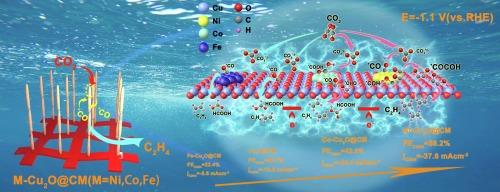
The transition metal (Fe, Co, Ni)-doped cuprous oxide (Cu2O) nanowire arrays on Cu mesh (CM) (M-Cu2O@CM, M = Fe, Co, Ni) are successfully synthesized for the electrocatalytic CO2 reduction reaction (CO2RR) to ethylene (C2H4) through the simple calcination and impregnation-exchange methods. Systematic characterizations have demonstrated that the Ni/Co doping in Cu2O@CM is conducive to stabilizing the Cu+ sites due to the electron transfer from Cu2O to Ni/Co, while the Fe doping has the opposite effect. Consequently, they show the different electrocatalytic performances of Ni-Cu2O@CM > Co-Cu2O@CM > Cu2O@CM > Fe-Cu2O@CM for CO2RR to C2H4 in an H-cell. Among them, Ni-Cu2O@CM exhibits the ∼2.0-fold faradaic efficiency for C2H4 (58.2 % vs. 28.7 %) and the ∼2.5-fold current density (−37.6 vs. −15.0 mA·cm−2) at −1.1 V vs. RHE, as compared with Cu2O@CM. Further experiments reveal that during the electrocatalytic CO2RR, the Ni-Cu2O@CM can generate more *CO, which promotes the C–C coupling reaction. The activity of Co-Cu2O@CM is lower than Ni-Cu2O@CM because of the strong adsorption of *COOH, while the Fe-Cu2O@CM even exhibits a lower activity than Cu2O@CM. This work provides an insight into the effect of transition metal-doped Cu2O array on the electrocatalytic CO2RR to C2H4 products.
期刊介绍:
Applied Surface Science covers topics contributing to a better understanding of surfaces, interfaces, nanostructures and their applications. The journal is concerned with scientific research on the atomic and molecular level of material properties determined with specific surface analytical techniques and/or computational methods, as well as the processing of such structures.




 京公网安备 11010802042870号
京ICP备2023020795号-1
京公网安备 11010802042870号
京ICP备2023020795号-1

 分享
分享
 求助内容:
求助内容: 应助结果提醒方式:
 扫码关注我们
