{"title":"基于深度学习的每小时气温预报后处理技术","authors":"Li Zhou, He Chen, Lin Xu, Rong-Hui Cai, Dong Chen","doi":"10.1002/met.2194","DOIUrl":null,"url":null,"abstract":"<p>In this article, a prediction model based on spatiotemporal stacked ResNet (Res-STS) for hourly temperature prediction is designed. On the timescale, the Res-STS removes the gate structure of the long short-term memory (LSTM) model, and the data of multiple consecutive time nodes are stacked together to preserve all temporal characteristics of the data. A point-to-point data mapping relationship is developed on the spatial scale to maximize the impact of large-scale environmental background field characteristics on a single grid point. Based on the historical gridded data from the China Meteorological Administration land data assimilation system (CLDAS) and the optimal factor dataset of the European Centre for Medium-Range Weather Forecasts Integrated Forecasting System (ECMWF-IFS) from 2017 to 2020, hourly temperature prediction models based on convolutional long short-term memory (ConvLSTM) and Res-STS model are developed, respectively. Furthermore, the prediction results of the two models in 2021 are compared with the ECMWF-IFS. The results show that the root mean square error (RMSE) of the prediction results by ConvLSTM and Res-STS models are both smaller than that of ECMWF-IFS. Specially, the Res-STS model performs best: it reduces the RMSE by 20.8% (24.5%) compared with the ConvLSTM (ECMWF-IFS). Specifically, the RMSE peaks in the afternoon when the daily maximum temperature occurs, while it is relatively smaller at night. Res-STS demonstrates a significant improvement in forecast performance compared with ECMWF-IFS, while ConvLSTM's correction during the period of maximum temperature occurrence has been enhanced. Moreover, the forecast performance of the Res-STS model is least affected by terrain compared with those of the ConvLSTM and ECMWF-IFS. For the regions with terrain height greater than 1 km, the model Res-STS evidently improves the RMSE.</p>","PeriodicalId":49825,"journal":{"name":"Meteorological Applications","volume":"31 2","pages":""},"PeriodicalIF":2.5000,"publicationDate":"2024-04-25","publicationTypes":"Journal Article","fieldsOfStudy":null,"isOpenAccess":false,"openAccessPdf":"https://onlinelibrary.wiley.com/doi/epdf/10.1002/met.2194","citationCount":"0","resultStr":"{\"title\":\"Deep learning-based postprocessing for hourly temperature forecasting\",\"authors\":\"Li Zhou, He Chen, Lin Xu, Rong-Hui Cai, Dong Chen\",\"doi\":\"10.1002/met.2194\",\"DOIUrl\":null,\"url\":null,\"abstract\":\"<p>In this article, a prediction model based on spatiotemporal stacked ResNet (Res-STS) for hourly temperature prediction is designed. On the timescale, the Res-STS removes the gate structure of the long short-term memory (LSTM) model, and the data of multiple consecutive time nodes are stacked together to preserve all temporal characteristics of the data. A point-to-point data mapping relationship is developed on the spatial scale to maximize the impact of large-scale environmental background field characteristics on a single grid point. Based on the historical gridded data from the China Meteorological Administration land data assimilation system (CLDAS) and the optimal factor dataset of the European Centre for Medium-Range Weather Forecasts Integrated Forecasting System (ECMWF-IFS) from 2017 to 2020, hourly temperature prediction models based on convolutional long short-term memory (ConvLSTM) and Res-STS model are developed, respectively. Furthermore, the prediction results of the two models in 2021 are compared with the ECMWF-IFS. The results show that the root mean square error (RMSE) of the prediction results by ConvLSTM and Res-STS models are both smaller than that of ECMWF-IFS. Specially, the Res-STS model performs best: it reduces the RMSE by 20.8% (24.5%) compared with the ConvLSTM (ECMWF-IFS). Specifically, the RMSE peaks in the afternoon when the daily maximum temperature occurs, while it is relatively smaller at night. Res-STS demonstrates a significant improvement in forecast performance compared with ECMWF-IFS, while ConvLSTM's correction during the period of maximum temperature occurrence has been enhanced. Moreover, the forecast performance of the Res-STS model is least affected by terrain compared with those of the ConvLSTM and ECMWF-IFS. For the regions with terrain height greater than 1 km, the model Res-STS evidently improves the RMSE.</p>\",\"PeriodicalId\":49825,\"journal\":{\"name\":\"Meteorological Applications\",\"volume\":\"31 2\",\"pages\":\"\"},\"PeriodicalIF\":2.5000,\"publicationDate\":\"2024-04-25\",\"publicationTypes\":\"Journal Article\",\"fieldsOfStudy\":null,\"isOpenAccess\":false,\"openAccessPdf\":\"https://onlinelibrary.wiley.com/doi/epdf/10.1002/met.2194\",\"citationCount\":\"0\",\"resultStr\":null,\"platform\":\"Semanticscholar\",\"paperid\":null,\"PeriodicalName\":\"Meteorological Applications\",\"FirstCategoryId\":\"89\",\"ListUrlMain\":\"https://rmets.onlinelibrary.wiley.com/doi/10.1002/met.2194\",\"RegionNum\":4,\"RegionCategory\":\"地球科学\",\"ArticlePicture\":[],\"TitleCN\":null,\"AbstractTextCN\":null,\"PMCID\":null,\"EPubDate\":\"\",\"PubModel\":\"\",\"JCR\":\"Q3\",\"JCRName\":\"METEOROLOGY & ATMOSPHERIC SCIENCES\",\"Score\":null,\"Total\":0}","platform":"Semanticscholar","paperid":null,"PeriodicalName":"Meteorological Applications","FirstCategoryId":"89","ListUrlMain":"https://rmets.onlinelibrary.wiley.com/doi/10.1002/met.2194","RegionNum":4,"RegionCategory":"地球科学","ArticlePicture":[],"TitleCN":null,"AbstractTextCN":null,"PMCID":null,"EPubDate":"","PubModel":"","JCR":"Q3","JCRName":"METEOROLOGY & ATMOSPHERIC SCIENCES","Score":null,"Total":0}
Deep learning-based postprocessing for hourly temperature forecasting
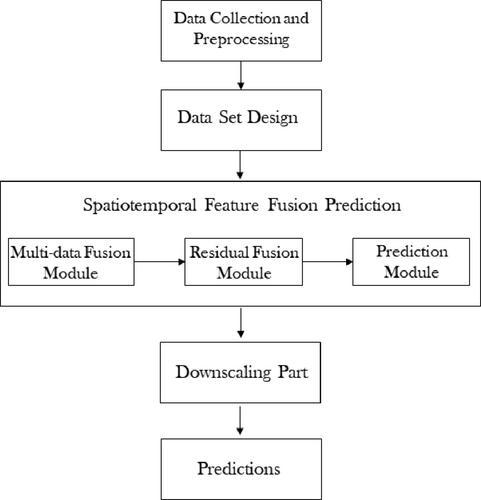
In this article, a prediction model based on spatiotemporal stacked ResNet (Res-STS) for hourly temperature prediction is designed. On the timescale, the Res-STS removes the gate structure of the long short-term memory (LSTM) model, and the data of multiple consecutive time nodes are stacked together to preserve all temporal characteristics of the data. A point-to-point data mapping relationship is developed on the spatial scale to maximize the impact of large-scale environmental background field characteristics on a single grid point. Based on the historical gridded data from the China Meteorological Administration land data assimilation system (CLDAS) and the optimal factor dataset of the European Centre for Medium-Range Weather Forecasts Integrated Forecasting System (ECMWF-IFS) from 2017 to 2020, hourly temperature prediction models based on convolutional long short-term memory (ConvLSTM) and Res-STS model are developed, respectively. Furthermore, the prediction results of the two models in 2021 are compared with the ECMWF-IFS. The results show that the root mean square error (RMSE) of the prediction results by ConvLSTM and Res-STS models are both smaller than that of ECMWF-IFS. Specially, the Res-STS model performs best: it reduces the RMSE by 20.8% (24.5%) compared with the ConvLSTM (ECMWF-IFS). Specifically, the RMSE peaks in the afternoon when the daily maximum temperature occurs, while it is relatively smaller at night. Res-STS demonstrates a significant improvement in forecast performance compared with ECMWF-IFS, while ConvLSTM's correction during the period of maximum temperature occurrence has been enhanced. Moreover, the forecast performance of the Res-STS model is least affected by terrain compared with those of the ConvLSTM and ECMWF-IFS. For the regions with terrain height greater than 1 km, the model Res-STS evidently improves the RMSE.
期刊介绍:
The aim of Meteorological Applications is to serve the needs of applied meteorologists, forecasters and users of meteorological services by publishing papers on all aspects of meteorological science, including:
applications of meteorological, climatological, analytical and forecasting data, and their socio-economic benefits;
forecasting, warning and service delivery techniques and methods;
weather hazards, their analysis and prediction;
performance, verification and value of numerical models and forecasting services;
practical applications of ocean and climate models;
education and training.





 京公网安备 11010802042870号
京ICP备2023020795号-1
京公网安备 11010802042870号
京ICP备2023020795号-1

 分享
分享
 求助内容:
求助内容: 应助结果提醒方式:
 扫码关注我们
