Thomas Lévi-Strauss, Jocelyn Gal, Eve Gelsi, Régine Truchi, Dann J. Ouizeman, Charlotte Hinault, Giulia Chinetti, Albert Tran, Philippe Gual, Rodolphe Anty
{"title":"大量饮酒患者戒酒后,肝纤维化评分的增强趋于稳定:一项试点研究","authors":"Thomas Lévi-Strauss, Jocelyn Gal, Eve Gelsi, Régine Truchi, Dann J. Ouizeman, Charlotte Hinault, Giulia Chinetti, Albert Tran, Philippe Gual, Rodolphe Anty","doi":"10.1111/acer.15311","DOIUrl":null,"url":null,"abstract":"<div>\n \n \n <section>\n \n <h3> Background</h3>\n \n <p>Enhanced liver fibrosis (ELF) score is an accurate, noninvasive test for assessing the severity of liver fibrosis in chronic liver disease, including alcohol-related liver disease. However, whether the ELF score changes during alcohol withdrawal is unknown. This pilot study assessed changes in the ELF score during withdrawal in patients with a history of excessive alcohol intake.</p>\n </section>\n \n <section>\n \n <h3> Methods</h3>\n \n <p>In this prospective study, ELF was performed on day 0 (D0, at the beginning of hospitalization), at day 7 (D7, on discharge from hospital), and at follow-up visits on days 30 (D30) and 90 (D90). Transient elastography (TE) was also assessed on days 4 (D4) and D30.</p>\n </section>\n \n <section>\n \n <h3> Results</h3>\n \n <p>The study included 35 patients (71% male) with a mean alcohol intake of 139 g/day. On D30 and D90, 8 and 13 patients had resumed alcohol consumption (mean intake of 90 and 80 g/day, respectively). In patients who remained abstinent, the mean ELF score was 8.93 on D0, 9.14 on D30 (<i>p</i> = 0.32), and 9.27 on D90 (<i>p</i> = 0.14). In patients who resumed alcohol, mean ELF score was 9.7 on D0, 10.05 on D30 (<i>p</i> = 0.09), and 9.71 on D90 (<i>p</i> = 0.12). ELF score was comparable over the first months after withdrawal, although there was a slight increase in the first week (mean ELF score increased from 9.24 on D0 to 9.74 on D7, <i>p</i> < 0.001). Mean TE value was 7.9 kPa on D4 and 8.1 kPa on D30 (<i>p</i> = 0.84) in patients who resumed alcohol consumption, and 8.3 and 7.5 kPa (<i>p</i> = 0.03) on D4 and D30, respectively, in abstinent patients.</p>\n </section>\n \n <section>\n \n <h3> Conclusion</h3>\n \n <p>The ELF score is stable during the first months after withdrawal and thus appears to be a useful tool to assess liver fibrosis or cirrhosis in this setting. Nevertheless, because in the first week there is a transient increase in ELF score, caution in interpretation is warranted.</p>\n </section>\n </div>","PeriodicalId":72145,"journal":{"name":"Alcohol (Hanover, York County, Pa.)","volume":"48 6","pages":"1088-1095"},"PeriodicalIF":2.7000,"publicationDate":"2024-04-15","publicationTypes":"Journal Article","fieldsOfStudy":null,"isOpenAccess":false,"openAccessPdf":"https://onlinelibrary.wiley.com/doi/epdf/10.1111/acer.15311","citationCount":"0","resultStr":"{\"title\":\"Enhanced liver fibrosis score is stable after withdrawal in patients with heavy alcohol consumption: A pilot study\",\"authors\":\"Thomas Lévi-Strauss, Jocelyn Gal, Eve Gelsi, Régine Truchi, Dann J. Ouizeman, Charlotte Hinault, Giulia Chinetti, Albert Tran, Philippe Gual, Rodolphe Anty\",\"doi\":\"10.1111/acer.15311\",\"DOIUrl\":null,\"url\":null,\"abstract\":\"<div>\\n \\n \\n <section>\\n \\n <h3> Background</h3>\\n \\n <p>Enhanced liver fibrosis (ELF) score is an accurate, noninvasive test for assessing the severity of liver fibrosis in chronic liver disease, including alcohol-related liver disease. However, whether the ELF score changes during alcohol withdrawal is unknown. This pilot study assessed changes in the ELF score during withdrawal in patients with a history of excessive alcohol intake.</p>\\n </section>\\n \\n <section>\\n \\n <h3> Methods</h3>\\n \\n <p>In this prospective study, ELF was performed on day 0 (D0, at the beginning of hospitalization), at day 7 (D7, on discharge from hospital), and at follow-up visits on days 30 (D30) and 90 (D90). Transient elastography (TE) was also assessed on days 4 (D4) and D30.</p>\\n </section>\\n \\n <section>\\n \\n <h3> Results</h3>\\n \\n <p>The study included 35 patients (71% male) with a mean alcohol intake of 139 g/day. On D30 and D90, 8 and 13 patients had resumed alcohol consumption (mean intake of 90 and 80 g/day, respectively). In patients who remained abstinent, the mean ELF score was 8.93 on D0, 9.14 on D30 (<i>p</i> = 0.32), and 9.27 on D90 (<i>p</i> = 0.14). In patients who resumed alcohol, mean ELF score was 9.7 on D0, 10.05 on D30 (<i>p</i> = 0.09), and 9.71 on D90 (<i>p</i> = 0.12). ELF score was comparable over the first months after withdrawal, although there was a slight increase in the first week (mean ELF score increased from 9.24 on D0 to 9.74 on D7, <i>p</i> < 0.001). Mean TE value was 7.9 kPa on D4 and 8.1 kPa on D30 (<i>p</i> = 0.84) in patients who resumed alcohol consumption, and 8.3 and 7.5 kPa (<i>p</i> = 0.03) on D4 and D30, respectively, in abstinent patients.</p>\\n </section>\\n \\n <section>\\n \\n <h3> Conclusion</h3>\\n \\n <p>The ELF score is stable during the first months after withdrawal and thus appears to be a useful tool to assess liver fibrosis or cirrhosis in this setting. Nevertheless, because in the first week there is a transient increase in ELF score, caution in interpretation is warranted.</p>\\n </section>\\n </div>\",\"PeriodicalId\":72145,\"journal\":{\"name\":\"Alcohol (Hanover, York County, Pa.)\",\"volume\":\"48 6\",\"pages\":\"1088-1095\"},\"PeriodicalIF\":2.7000,\"publicationDate\":\"2024-04-15\",\"publicationTypes\":\"Journal Article\",\"fieldsOfStudy\":null,\"isOpenAccess\":false,\"openAccessPdf\":\"https://onlinelibrary.wiley.com/doi/epdf/10.1111/acer.15311\",\"citationCount\":\"0\",\"resultStr\":null,\"platform\":\"Semanticscholar\",\"paperid\":null,\"PeriodicalName\":\"Alcohol (Hanover, York County, Pa.)\",\"FirstCategoryId\":\"1085\",\"ListUrlMain\":\"https://onlinelibrary.wiley.com/doi/10.1111/acer.15311\",\"RegionNum\":0,\"RegionCategory\":null,\"ArticlePicture\":[],\"TitleCN\":null,\"AbstractTextCN\":null,\"PMCID\":null,\"EPubDate\":\"\",\"PubModel\":\"\",\"JCR\":\"Q2\",\"JCRName\":\"SUBSTANCE ABUSE\",\"Score\":null,\"Total\":0}","platform":"Semanticscholar","paperid":null,"PeriodicalName":"Alcohol (Hanover, York County, Pa.)","FirstCategoryId":"1085","ListUrlMain":"https://onlinelibrary.wiley.com/doi/10.1111/acer.15311","RegionNum":0,"RegionCategory":null,"ArticlePicture":[],"TitleCN":null,"AbstractTextCN":null,"PMCID":null,"EPubDate":"","PubModel":"","JCR":"Q2","JCRName":"SUBSTANCE ABUSE","Score":null,"Total":0}
Enhanced liver fibrosis score is stable after withdrawal in patients with heavy alcohol consumption: A pilot study
Background
Enhanced liver fibrosis (ELF) score is an accurate, noninvasive test for assessing the severity of liver fibrosis in chronic liver disease, including alcohol-related liver disease. However, whether the ELF score changes during alcohol withdrawal is unknown. This pilot study assessed changes in the ELF score during withdrawal in patients with a history of excessive alcohol intake.
Methods
In this prospective study, ELF was performed on day 0 (D0, at the beginning of hospitalization), at day 7 (D7, on discharge from hospital), and at follow-up visits on days 30 (D30) and 90 (D90). Transient elastography (TE) was also assessed on days 4 (D4) and D30.
Results
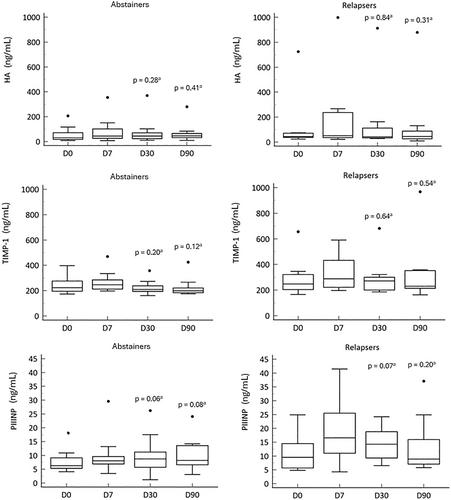
The study included 35 patients (71% male) with a mean alcohol intake of 139 g/day. On D30 and D90, 8 and 13 patients had resumed alcohol consumption (mean intake of 90 and 80 g/day, respectively). In patients who remained abstinent, the mean ELF score was 8.93 on D0, 9.14 on D30 (p = 0.32), and 9.27 on D90 (p = 0.14). In patients who resumed alcohol, mean ELF score was 9.7 on D0, 10.05 on D30 (p = 0.09), and 9.71 on D90 (p = 0.12). ELF score was comparable over the first months after withdrawal, although there was a slight increase in the first week (mean ELF score increased from 9.24 on D0 to 9.74 on D7, p < 0.001). Mean TE value was 7.9 kPa on D4 and 8.1 kPa on D30 (p = 0.84) in patients who resumed alcohol consumption, and 8.3 and 7.5 kPa (p = 0.03) on D4 and D30, respectively, in abstinent patients.
Conclusion
The ELF score is stable during the first months after withdrawal and thus appears to be a useful tool to assess liver fibrosis or cirrhosis in this setting. Nevertheless, because in the first week there is a transient increase in ELF score, caution in interpretation is warranted.




 京公网安备 11010802042870号
京ICP备2023020795号-1
京公网安备 11010802042870号
京ICP备2023020795号-1

 分享
分享

 求助内容:
求助内容: 应助结果提醒方式:
 扫码关注我们
