Rakesh Saroha, Dong Yun Shin, Jae Seob Lee, Sung Woo Cho, Dong-Hee Lim, Jung Sang Cho
{"title":"在具有大空腔的三维还原氧化石墨烯空心微球中接枝的理论耐受缺陷工程化硒化锑纳米晶体作为多硫化物阻挡层,实现强劲的硫动力学性能","authors":"Rakesh Saroha, Dong Yun Shin, Jae Seob Lee, Sung Woo Cho, Dong-Hee Lim, Jung Sang Cho","doi":"10.1007/s42114-024-00892-9","DOIUrl":null,"url":null,"abstract":"<div><p>Defect engineering techniques have gained significant attention worldwide as a promising strategy to amend the electronic and atomic arrangements of nanomaterials. By introducing defects such as dislocations or vacancies in polar materials, it is possible to create electrophilic adsorption sites that can effectively trap polysulfide species by lowering the energy transfer barrier for electrons. In this study, non-stoichiometric antimony selenide (Sb<sub>2</sub>Se<sub>2.2</sub>) nanocrystals embedded in a three-dimensional hollow microsphere composed of a reduced graphene oxide (rGO) matrix (H-Sb<sub>2</sub>Se<sub>2.2</sub>@rGO‒600) were synthesized by precisely controlling the heating conditions. Density functional theory (DFT) calculations revealed that thermally induced anionic Se-defects caused atomic disorder in the crystal structure, altering the electronic structure and in turn enhancing the adsorption strength of polysulfide through improved electrophilic coupling interactions between <span>\\(\\mathrm{Sb}^{\\delta+}-\\mathrm S_x^{2-}\\)</span> and <span>\\(\\mathrm{Li}^+-\\mathrm{Se}^{\\delta-}\\)</span>. Lithium–sulfur (Li–S) batteries incorporating H-Sb<sub>2</sub>Se<sub>2.2</sub>@rGO‒600-coated separator and a typical sulfur electrode (≈2.0 mg cm<sup>–2</sup>) exhibited excellent high-rate capability, with a discharge rate of up to 4.0 C, and exceptional cycling stability. After 1300 continuous charge‒discharge cycles at 4.0 C, the cell showed a capacity retention of 90.4%, with an average capacity decay rate of only 0.007% per cycle. The impressive performance was maintained under more demanding cell conditions, such as high effective S content (66%), high S loading (6.0 mg cm<sup>–2</sup>), and a low electrolyte-to-sulfur ratio (4.3 µL mg<sup>–1</sup>). The Li–S cell demonstrates excellent cycling stability (120 cycles at 0.1 C) and maintains feasible rate performance up to 0.3 C.</p></div>","PeriodicalId":7220,"journal":{"name":"Advanced Composites and Hybrid Materials","volume":"7 3","pages":""},"PeriodicalIF":21.8000,"publicationDate":"2024-05-17","publicationTypes":"Journal Article","fieldsOfStudy":null,"isOpenAccess":false,"openAccessPdf":"","citationCount":"0","resultStr":"{\"title\":\"Theoretically endured defect-engineered antimony selenide nanocrystals grafted within three-dimensional reduced graphene oxide hollow microspheres with large open cavities as polysulfide barrier for robust sulfur kinetics\",\"authors\":\"Rakesh Saroha, Dong Yun Shin, Jae Seob Lee, Sung Woo Cho, Dong-Hee Lim, Jung Sang Cho\",\"doi\":\"10.1007/s42114-024-00892-9\",\"DOIUrl\":null,\"url\":null,\"abstract\":\"<div><p>Defect engineering techniques have gained significant attention worldwide as a promising strategy to amend the electronic and atomic arrangements of nanomaterials. By introducing defects such as dislocations or vacancies in polar materials, it is possible to create electrophilic adsorption sites that can effectively trap polysulfide species by lowering the energy transfer barrier for electrons. In this study, non-stoichiometric antimony selenide (Sb<sub>2</sub>Se<sub>2.2</sub>) nanocrystals embedded in a three-dimensional hollow microsphere composed of a reduced graphene oxide (rGO) matrix (H-Sb<sub>2</sub>Se<sub>2.2</sub>@rGO‒600) were synthesized by precisely controlling the heating conditions. Density functional theory (DFT) calculations revealed that thermally induced anionic Se-defects caused atomic disorder in the crystal structure, altering the electronic structure and in turn enhancing the adsorption strength of polysulfide through improved electrophilic coupling interactions between <span>\\\\(\\\\mathrm{Sb}^{\\\\delta+}-\\\\mathrm S_x^{2-}\\\\)</span> and <span>\\\\(\\\\mathrm{Li}^+-\\\\mathrm{Se}^{\\\\delta-}\\\\)</span>. Lithium–sulfur (Li–S) batteries incorporating H-Sb<sub>2</sub>Se<sub>2.2</sub>@rGO‒600-coated separator and a typical sulfur electrode (≈2.0 mg cm<sup>–2</sup>) exhibited excellent high-rate capability, with a discharge rate of up to 4.0 C, and exceptional cycling stability. After 1300 continuous charge‒discharge cycles at 4.0 C, the cell showed a capacity retention of 90.4%, with an average capacity decay rate of only 0.007% per cycle. The impressive performance was maintained under more demanding cell conditions, such as high effective S content (66%), high S loading (6.0 mg cm<sup>–2</sup>), and a low electrolyte-to-sulfur ratio (4.3 µL mg<sup>–1</sup>). The Li–S cell demonstrates excellent cycling stability (120 cycles at 0.1 C) and maintains feasible rate performance up to 0.3 C.</p></div>\",\"PeriodicalId\":7220,\"journal\":{\"name\":\"Advanced Composites and Hybrid Materials\",\"volume\":\"7 3\",\"pages\":\"\"},\"PeriodicalIF\":21.8000,\"publicationDate\":\"2024-05-17\",\"publicationTypes\":\"Journal Article\",\"fieldsOfStudy\":null,\"isOpenAccess\":false,\"openAccessPdf\":\"\",\"citationCount\":\"0\",\"resultStr\":null,\"platform\":\"Semanticscholar\",\"paperid\":null,\"PeriodicalName\":\"Advanced Composites and Hybrid Materials\",\"FirstCategoryId\":\"88\",\"ListUrlMain\":\"https://link.springer.com/article/10.1007/s42114-024-00892-9\",\"RegionNum\":2,\"RegionCategory\":\"材料科学\",\"ArticlePicture\":[],\"TitleCN\":null,\"AbstractTextCN\":null,\"PMCID\":null,\"EPubDate\":\"\",\"PubModel\":\"\",\"JCR\":\"Q1\",\"JCRName\":\"MATERIALS SCIENCE, COMPOSITES\",\"Score\":null,\"Total\":0}","platform":"Semanticscholar","paperid":null,"PeriodicalName":"Advanced Composites and Hybrid Materials","FirstCategoryId":"88","ListUrlMain":"https://link.springer.com/article/10.1007/s42114-024-00892-9","RegionNum":2,"RegionCategory":"材料科学","ArticlePicture":[],"TitleCN":null,"AbstractTextCN":null,"PMCID":null,"EPubDate":"","PubModel":"","JCR":"Q1","JCRName":"MATERIALS SCIENCE, COMPOSITES","Score":null,"Total":0}
引用次数: 0
摘要
缺陷工程技术作为一种修正纳米材料电子和原子排列的有前途的策略,已在全球范围内受到广泛关注。通过在极性材料中引入位错或空位等缺陷,可以创建亲电吸附位点,通过降低电子的能量传递障碍来有效捕获多硫化物。本研究通过精确控制加热条件,合成了嵌入由还原氧化石墨烯(rGO)基质构成的三维中空微球(H-Sb2Se2.2@rGO-600)中的非全等硒化锑(Sb2Se2.2)纳米晶体。密度泛函理论(DFT)计算显示,热诱导的阴离子硒缺陷导致晶体结构中的原子紊乱,改变了电子结构,进而通过改善\(\mathrm{Sb}^{\delta+}-\mathrm S_x^{2-}\)和\(\mathrm{Li}^^+-\mathrm{Se}^{\delta-}\)之间的亲电耦合作用增强了多硫化物的吸附强度。采用 H-Sb2Se2.2@rGO-600 涂层隔膜和典型硫电极(≈2.0 mg cm-2)的锂硫(Li-S)电池表现出卓越的高倍率能力,放电速率高达 4.0 C,而且循环稳定性极佳。在 4.0 C 下连续充放电 1300 次后,电池的容量保持率达到 90.4%,平均容量衰减率仅为 0.007%。在更苛刻的电池条件下,如高有效 S 含量(66%)、高 S 负载(6.0 mg cm-2)和低电解质硫比(4.3 µL mg-1),仍能保持令人印象深刻的性能。这种锂-S 电池具有出色的循环稳定性(在 0.1 摄氏度条件下循环 120 次),在 0.3 摄氏度条件下仍能保持可行的速率性能。
Theoretically endured defect-engineered antimony selenide nanocrystals grafted within three-dimensional reduced graphene oxide hollow microspheres with large open cavities as polysulfide barrier for robust sulfur kinetics
Defect engineering techniques have gained significant attention worldwide as a promising strategy to amend the electronic and atomic arrangements of nanomaterials. By introducing defects such as dislocations or vacancies in polar materials, it is possible to create electrophilic adsorption sites that can effectively trap polysulfide species by lowering the energy transfer barrier for electrons. In this study, non-stoichiometric antimony selenide (Sb2Se2.2) nanocrystals embedded in a three-dimensional hollow microsphere composed of a reduced graphene oxide (rGO) matrix (H-Sb2Se2.2@rGO‒600) were synthesized by precisely controlling the heating conditions. Density functional theory (DFT) calculations revealed that thermally induced anionic Se-defects caused atomic disorder in the crystal structure, altering the electronic structure and in turn enhancing the adsorption strength of polysulfide through improved electrophilic coupling interactions between \(\mathrm{Sb}^{\delta+}-\mathrm S_x^{2-}\) and \(\mathrm{Li}^+-\mathrm{Se}^{\delta-}\). Lithium–sulfur (Li–S) batteries incorporating H-Sb2Se2.2@rGO‒600-coated separator and a typical sulfur electrode (≈2.0 mg cm–2) exhibited excellent high-rate capability, with a discharge rate of up to 4.0 C, and exceptional cycling stability. After 1300 continuous charge‒discharge cycles at 4.0 C, the cell showed a capacity retention of 90.4%, with an average capacity decay rate of only 0.007% per cycle. The impressive performance was maintained under more demanding cell conditions, such as high effective S content (66%), high S loading (6.0 mg cm–2), and a low electrolyte-to-sulfur ratio (4.3 µL mg–1). The Li–S cell demonstrates excellent cycling stability (120 cycles at 0.1 C) and maintains feasible rate performance up to 0.3 C.
期刊介绍:
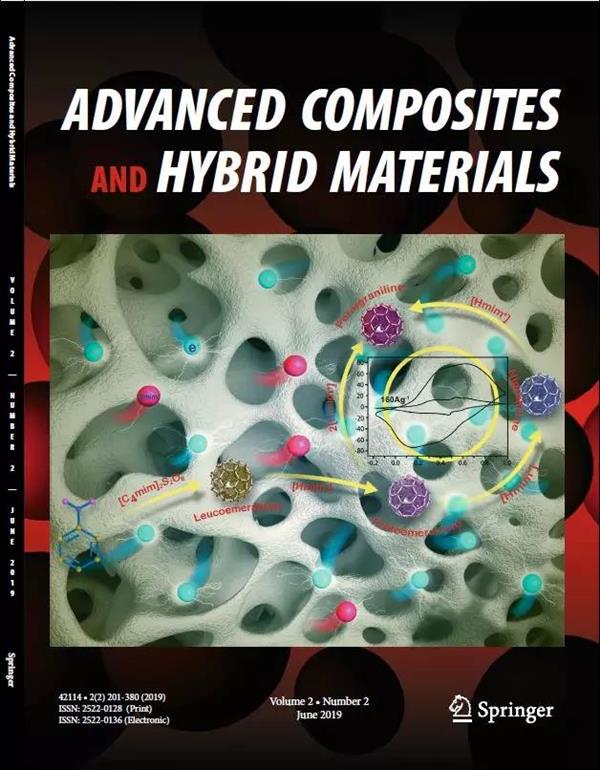
Advanced Composites and Hybrid Materials is a leading international journal that promotes interdisciplinary collaboration among materials scientists, engineers, chemists, biologists, and physicists working on composites, including nanocomposites. Our aim is to facilitate rapid scientific communication in this field.
The journal publishes high-quality research on various aspects of composite materials, including materials design, surface and interface science/engineering, manufacturing, structure control, property design, device fabrication, and other applications. We also welcome simulation and modeling studies that are relevant to composites. Additionally, papers focusing on the relationship between fillers and the matrix are of particular interest.
Our scope includes polymer, metal, and ceramic matrices, with a special emphasis on reviews and meta-analyses related to materials selection. We cover a wide range of topics, including transport properties, strategies for controlling interfaces and composition distribution, bottom-up assembly of nanocomposites, highly porous and high-density composites, electronic structure design, materials synergisms, and thermoelectric materials.
Advanced Composites and Hybrid Materials follows a rigorous single-blind peer-review process to ensure the quality and integrity of the published work.





 京公网安备 11010802042870号
京ICP备2023020795号-1
京公网安备 11010802042870号
京ICP备2023020795号-1

 分享
分享
 求助内容:
求助内容: 应助结果提醒方式:
 扫码关注我们
