Dr. Marie Peng, Dr. Henri Doucet, Prof. Dr. Jean-François Soulé
{"title":"铑催化 C-H 键环化合成 5 和 6 元 N-杂环构件","authors":"Dr. Marie Peng, Dr. Henri Doucet, Prof. Dr. Jean-François Soulé","doi":"10.1002/cctc.202400279","DOIUrl":null,"url":null,"abstract":"<p>The sustainable preparation of <i>N</i>-heterocycles is one of the most active research areas owing to their predominance as synthetics building blocks with extensive applications in organic, pharmaceutical, and material chemistry fields. Among the various catalytic protocols, the C−H bond functionalization with the concomitant C−N bond formation, so-called C−H bond annulation, has become one of the most sustainable routes to access <i>N</i>-heterocycles because it starts from low-functionalized materials and generates a limited amount of waste, all respecting the concept of atom economy. Rhodium complexes often catalyze these reactions. This review focuses on the synthesis of 5- and 6-membered ring <i>N</i>-containing heterocycles such as indoles, pyrroles, indolines, (iso)quinolinones, dihydroquinolines, and pyrrolidones from readily available starting materials, with an emphasis on the novel C−H bond cascade synthetic methodologies <i>via</i> C−N/C−C bond formation, as well as on the mechanisms of these reactions, especially the oxidation steps. We hope this review will help researchers looking to prepare <i>N</i>-heterocycles in a minimum of steps and those who want to develop new methodologies based on C−H bond activation/functionalizations.</p>","PeriodicalId":141,"journal":{"name":"ChemCatChem","volume":"16 24","pages":""},"PeriodicalIF":3.9000,"publicationDate":"2024-05-17","publicationTypes":"Journal Article","fieldsOfStudy":null,"isOpenAccess":false,"openAccessPdf":"https://onlinelibrary.wiley.com/doi/epdf/10.1002/cctc.202400279","citationCount":"0","resultStr":"{\"title\":\"Rhodium-Catalyzed C−H Bond Annulation for the Synthesis of 5- and 6-Membered N-Heterocyclic Building Blocks\",\"authors\":\"Dr. Marie Peng, Dr. Henri Doucet, Prof. Dr. Jean-François Soulé\",\"doi\":\"10.1002/cctc.202400279\",\"DOIUrl\":null,\"url\":null,\"abstract\":\"<p>The sustainable preparation of <i>N</i>-heterocycles is one of the most active research areas owing to their predominance as synthetics building blocks with extensive applications in organic, pharmaceutical, and material chemistry fields. Among the various catalytic protocols, the C−H bond functionalization with the concomitant C−N bond formation, so-called C−H bond annulation, has become one of the most sustainable routes to access <i>N</i>-heterocycles because it starts from low-functionalized materials and generates a limited amount of waste, all respecting the concept of atom economy. Rhodium complexes often catalyze these reactions. This review focuses on the synthesis of 5- and 6-membered ring <i>N</i>-containing heterocycles such as indoles, pyrroles, indolines, (iso)quinolinones, dihydroquinolines, and pyrrolidones from readily available starting materials, with an emphasis on the novel C−H bond cascade synthetic methodologies <i>via</i> C−N/C−C bond formation, as well as on the mechanisms of these reactions, especially the oxidation steps. We hope this review will help researchers looking to prepare <i>N</i>-heterocycles in a minimum of steps and those who want to develop new methodologies based on C−H bond activation/functionalizations.</p>\",\"PeriodicalId\":141,\"journal\":{\"name\":\"ChemCatChem\",\"volume\":\"16 24\",\"pages\":\"\"},\"PeriodicalIF\":3.9000,\"publicationDate\":\"2024-05-17\",\"publicationTypes\":\"Journal Article\",\"fieldsOfStudy\":null,\"isOpenAccess\":false,\"openAccessPdf\":\"https://onlinelibrary.wiley.com/doi/epdf/10.1002/cctc.202400279\",\"citationCount\":\"0\",\"resultStr\":null,\"platform\":\"Semanticscholar\",\"paperid\":null,\"PeriodicalName\":\"ChemCatChem\",\"FirstCategoryId\":\"92\",\"ListUrlMain\":\"https://chemistry-europe.onlinelibrary.wiley.com/doi/10.1002/cctc.202400279\",\"RegionNum\":3,\"RegionCategory\":\"化学\",\"ArticlePicture\":[],\"TitleCN\":null,\"AbstractTextCN\":null,\"PMCID\":null,\"EPubDate\":\"\",\"PubModel\":\"\",\"JCR\":\"Q2\",\"JCRName\":\"CHEMISTRY, PHYSICAL\",\"Score\":null,\"Total\":0}","platform":"Semanticscholar","paperid":null,"PeriodicalName":"ChemCatChem","FirstCategoryId":"92","ListUrlMain":"https://chemistry-europe.onlinelibrary.wiley.com/doi/10.1002/cctc.202400279","RegionNum":3,"RegionCategory":"化学","ArticlePicture":[],"TitleCN":null,"AbstractTextCN":null,"PMCID":null,"EPubDate":"","PubModel":"","JCR":"Q2","JCRName":"CHEMISTRY, PHYSICAL","Score":null,"Total":0}
Rhodium-Catalyzed C−H Bond Annulation for the Synthesis of 5- and 6-Membered N-Heterocyclic Building Blocks
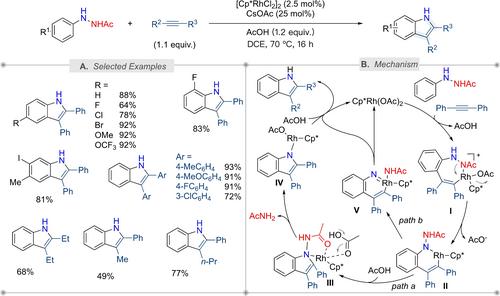
The sustainable preparation of N-heterocycles is one of the most active research areas owing to their predominance as synthetics building blocks with extensive applications in organic, pharmaceutical, and material chemistry fields. Among the various catalytic protocols, the C−H bond functionalization with the concomitant C−N bond formation, so-called C−H bond annulation, has become one of the most sustainable routes to access N-heterocycles because it starts from low-functionalized materials and generates a limited amount of waste, all respecting the concept of atom economy. Rhodium complexes often catalyze these reactions. This review focuses on the synthesis of 5- and 6-membered ring N-containing heterocycles such as indoles, pyrroles, indolines, (iso)quinolinones, dihydroquinolines, and pyrrolidones from readily available starting materials, with an emphasis on the novel C−H bond cascade synthetic methodologies via C−N/C−C bond formation, as well as on the mechanisms of these reactions, especially the oxidation steps. We hope this review will help researchers looking to prepare N-heterocycles in a minimum of steps and those who want to develop new methodologies based on C−H bond activation/functionalizations.
期刊介绍:
With an impact factor of 4.495 (2018), ChemCatChem is one of the premier journals in the field of catalysis. The journal provides primary research papers and critical secondary information on heterogeneous, homogeneous and bio- and nanocatalysis. The journal is well placed to strengthen cross-communication within between these communities. Its authors and readers come from academia, the chemical industry, and government laboratories across the world. It is published on behalf of Chemistry Europe, an association of 16 European chemical societies, and is supported by the German Catalysis Society.





 京公网安备 11010802042870号
京ICP备2023020795号-1
京公网安备 11010802042870号
京ICP备2023020795号-1

 分享
分享
 求助内容:
求助内容: 应助结果提醒方式:
 扫码关注我们
