{"title":"移动床生物膜反应器(MBBR)处理酚类废水的最新进展 - 综述","authors":"Zishan Aslam , Pervez Alam , Raisul Islam , Afzal Husain Khan , Hasara Samaraweera , Athar Hussain , Tasneem Imtiyaz Zargar","doi":"10.1016/j.jtice.2024.105517","DOIUrl":null,"url":null,"abstract":"<div><h3>Background</h3><div>Phenol, a toxic and carcinogenic compound found in industrial effluent, poses a severe threat to the environment and aquatic life. Conventional methods such as physio-chemical techniques have limitations in efficiency, cost, and sustainability, leading to the development of advanced hybrid approaches like the Moving Bed Biofilm Reactor (MBBR) to treat phenols.</div></div><div><h3>Review method</h3><div>In this study, we aimed at an in-depth review of MBBR for the remediation of phenolic wastewater at an industrial scale. The review uses a methodology that involves a comparative analysis of various conventional methods, including activated sludge process (ASP), sequencing batch biofilm reactor (SBBR), Fluidized Bed Biofilm Rector (FBBR), and trickling filter (TF) with MBBR, to determine their efficacy in phenol degradation. In this context, a thorough bibliometric assay of MBBR is carried out to understand the recent publication trends. The study also examines the impact of different types and shapes of bio-carriers and their filling ratios on phenol biodegradation.</div></div><div><h3>Significant finding</h3><div>The present work demonstrates the feasibility of using an aerobic MBBR along with a Fenton-like system (advanced oxidation processes) to treat phenolic effluent LCCA is discussed for selected treatment methods for assessing the sustainability aspects. In light of recent advancements, future research endeavors should prioritize the refinement and optimization of MBBR systems to strengthen their efficiency and sustainability, thus paving the way for a greener and cleaner future.</div></div>","PeriodicalId":381,"journal":{"name":"Journal of the Taiwan Institute of Chemical Engineers","volume":"166 ","pages":"Article 105517"},"PeriodicalIF":6.3000,"publicationDate":"2025-01-01","publicationTypes":"Journal Article","fieldsOfStudy":null,"isOpenAccess":false,"openAccessPdf":"","citationCount":"0","resultStr":"{\"title\":\"Recent developments in moving bed biofilm reactor (MBBR) for the treatment of phenolic wastewater -A review\",\"authors\":\"Zishan Aslam , Pervez Alam , Raisul Islam , Afzal Husain Khan , Hasara Samaraweera , Athar Hussain , Tasneem Imtiyaz Zargar\",\"doi\":\"10.1016/j.jtice.2024.105517\",\"DOIUrl\":null,\"url\":null,\"abstract\":\"<div><h3>Background</h3><div>Phenol, a toxic and carcinogenic compound found in industrial effluent, poses a severe threat to the environment and aquatic life. Conventional methods such as physio-chemical techniques have limitations in efficiency, cost, and sustainability, leading to the development of advanced hybrid approaches like the Moving Bed Biofilm Reactor (MBBR) to treat phenols.</div></div><div><h3>Review method</h3><div>In this study, we aimed at an in-depth review of MBBR for the remediation of phenolic wastewater at an industrial scale. The review uses a methodology that involves a comparative analysis of various conventional methods, including activated sludge process (ASP), sequencing batch biofilm reactor (SBBR), Fluidized Bed Biofilm Rector (FBBR), and trickling filter (TF) with MBBR, to determine their efficacy in phenol degradation. In this context, a thorough bibliometric assay of MBBR is carried out to understand the recent publication trends. The study also examines the impact of different types and shapes of bio-carriers and their filling ratios on phenol biodegradation.</div></div><div><h3>Significant finding</h3><div>The present work demonstrates the feasibility of using an aerobic MBBR along with a Fenton-like system (advanced oxidation processes) to treat phenolic effluent LCCA is discussed for selected treatment methods for assessing the sustainability aspects. In light of recent advancements, future research endeavors should prioritize the refinement and optimization of MBBR systems to strengthen their efficiency and sustainability, thus paving the way for a greener and cleaner future.</div></div>\",\"PeriodicalId\":381,\"journal\":{\"name\":\"Journal of the Taiwan Institute of Chemical Engineers\",\"volume\":\"166 \",\"pages\":\"Article 105517\"},\"PeriodicalIF\":6.3000,\"publicationDate\":\"2025-01-01\",\"publicationTypes\":\"Journal Article\",\"fieldsOfStudy\":null,\"isOpenAccess\":false,\"openAccessPdf\":\"\",\"citationCount\":\"0\",\"resultStr\":null,\"platform\":\"Semanticscholar\",\"paperid\":null,\"PeriodicalName\":\"Journal of the Taiwan Institute of Chemical Engineers\",\"FirstCategoryId\":\"5\",\"ListUrlMain\":\"https://www.sciencedirect.com/science/article/pii/S1876107024001755\",\"RegionNum\":3,\"RegionCategory\":\"工程技术\",\"ArticlePicture\":[],\"TitleCN\":null,\"AbstractTextCN\":null,\"PMCID\":null,\"EPubDate\":\"2024/5/3 0:00:00\",\"PubModel\":\"Epub\",\"JCR\":\"Q1\",\"JCRName\":\"ENGINEERING, CHEMICAL\",\"Score\":null,\"Total\":0}","platform":"Semanticscholar","paperid":null,"PeriodicalName":"Journal of the Taiwan Institute of Chemical Engineers","FirstCategoryId":"5","ListUrlMain":"https://www.sciencedirect.com/science/article/pii/S1876107024001755","RegionNum":3,"RegionCategory":"工程技术","ArticlePicture":[],"TitleCN":null,"AbstractTextCN":null,"PMCID":null,"EPubDate":"2024/5/3 0:00:00","PubModel":"Epub","JCR":"Q1","JCRName":"ENGINEERING, CHEMICAL","Score":null,"Total":0}
Recent developments in moving bed biofilm reactor (MBBR) for the treatment of phenolic wastewater -A review
Background
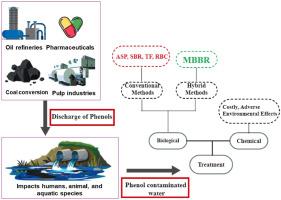
Phenol, a toxic and carcinogenic compound found in industrial effluent, poses a severe threat to the environment and aquatic life. Conventional methods such as physio-chemical techniques have limitations in efficiency, cost, and sustainability, leading to the development of advanced hybrid approaches like the Moving Bed Biofilm Reactor (MBBR) to treat phenols.
Review method
In this study, we aimed at an in-depth review of MBBR for the remediation of phenolic wastewater at an industrial scale. The review uses a methodology that involves a comparative analysis of various conventional methods, including activated sludge process (ASP), sequencing batch biofilm reactor (SBBR), Fluidized Bed Biofilm Rector (FBBR), and trickling filter (TF) with MBBR, to determine their efficacy in phenol degradation. In this context, a thorough bibliometric assay of MBBR is carried out to understand the recent publication trends. The study also examines the impact of different types and shapes of bio-carriers and their filling ratios on phenol biodegradation.
Significant finding
The present work demonstrates the feasibility of using an aerobic MBBR along with a Fenton-like system (advanced oxidation processes) to treat phenolic effluent LCCA is discussed for selected treatment methods for assessing the sustainability aspects. In light of recent advancements, future research endeavors should prioritize the refinement and optimization of MBBR systems to strengthen their efficiency and sustainability, thus paving the way for a greener and cleaner future.
期刊介绍:
Journal of the Taiwan Institute of Chemical Engineers (formerly known as Journal of the Chinese Institute of Chemical Engineers) publishes original works, from fundamental principles to practical applications, in the broad field of chemical engineering with special focus on three aspects: Chemical and Biomolecular Science and Technology, Energy and Environmental Science and Technology, and Materials Science and Technology. Authors should choose for their manuscript an appropriate aspect section and a few related classifications when submitting to the journal online.




 京公网安备 11010802042870号
京ICP备2023020795号-1
京公网安备 11010802042870号
京ICP备2023020795号-1

 分享
分享
 求助内容:
求助内容: 应助结果提醒方式:
 扫码关注我们
