{"title":"N′-(吡啶-2-基亚甲基)烟酰肼锌(II)配位化合物:合成、晶体结构、计算和细胞毒性研究","authors":"Suman Adhikari , Sourav Nath , Sevgi Kansız , Nabajyoti Balidya , Anirban Kumar Paul , Necmi Dege , Onur Sahin , Ghodrat Mahmoudi , Akalesh Kumar Verma , Damir A. Safin","doi":"10.1016/j.jinorgbio.2024.112598","DOIUrl":null,"url":null,"abstract":"<div><p>In this work, we report on the synthesis of a novel zinc(II) coordination compound [ZnL<sub>2</sub>] (<strong>1</strong>), which was readily obtained from the reaction of Zn(OAc)·2H<sub>2</sub>O and <em>N′</em>-(pyridin-2-ylmethylene)nicotinohydrazide (<strong>HL</strong>) in methanol. Recrystallization of <strong>1</strong> from dimethylformamide under ambient conditions allowed to produce yellow block-like crystals of <strong>1</strong>·H<sub>2</sub>O. Complex <strong>1</strong>·H<sub>2</sub>O was characterized by FT-IR and <sup>1</sup>H NMR spectroscopy, while its optical properties were studied by UV–vis and spectrofluorimetry in methanol. The crystal structure of the title complex was revealed by single crystal X-ray diffraction and further explored in detail by the Hirshfeld surface analysis. Theoretical investigations based on the DFT calculations have also been applied to show the electronic properties of complex <strong>1</strong>. The antitumor activities of the parent ligand <strong>HL</strong> and complex <strong>1</strong> were studied using Dalton's lymphoma malignant cancer model. Both compounds were found to induce concentration-dependent cytotoxicity and apoptotic cell death, leading to a decrease in cell viability, body weight, and tumor volume in mice with the superior activity of complex <strong>1</strong> over <strong>HL</strong>. Mice treated with complex <strong>1</strong> demonstrated an increase in life span with a survival period of 23 days. Finally, using a molecular docking approach, we have probed complex <strong>1</strong> to inhibit the recombinant mouse tumor-necrosis factor alpha (mTNF).</p></div>","PeriodicalId":364,"journal":{"name":"Journal of Inorganic Biochemistry","volume":"257 ","pages":"Article 112598"},"PeriodicalIF":3.2000,"publicationDate":"2024-08-01","publicationTypes":"Journal Article","fieldsOfStudy":null,"isOpenAccess":false,"openAccessPdf":"","citationCount":"0","resultStr":"{\"title\":\"Zinc(II) coordination compound with N′-(pyridin-2-ylmethylene)nicotinohydrazide: Synthesis, crystal structure, computational and cytotoxicity studies\",\"authors\":\"Suman Adhikari , Sourav Nath , Sevgi Kansız , Nabajyoti Balidya , Anirban Kumar Paul , Necmi Dege , Onur Sahin , Ghodrat Mahmoudi , Akalesh Kumar Verma , Damir A. Safin\",\"doi\":\"10.1016/j.jinorgbio.2024.112598\",\"DOIUrl\":null,\"url\":null,\"abstract\":\"<div><p>In this work, we report on the synthesis of a novel zinc(II) coordination compound [ZnL<sub>2</sub>] (<strong>1</strong>), which was readily obtained from the reaction of Zn(OAc)·2H<sub>2</sub>O and <em>N′</em>-(pyridin-2-ylmethylene)nicotinohydrazide (<strong>HL</strong>) in methanol. Recrystallization of <strong>1</strong> from dimethylformamide under ambient conditions allowed to produce yellow block-like crystals of <strong>1</strong>·H<sub>2</sub>O. Complex <strong>1</strong>·H<sub>2</sub>O was characterized by FT-IR and <sup>1</sup>H NMR spectroscopy, while its optical properties were studied by UV–vis and spectrofluorimetry in methanol. The crystal structure of the title complex was revealed by single crystal X-ray diffraction and further explored in detail by the Hirshfeld surface analysis. Theoretical investigations based on the DFT calculations have also been applied to show the electronic properties of complex <strong>1</strong>. The antitumor activities of the parent ligand <strong>HL</strong> and complex <strong>1</strong> were studied using Dalton's lymphoma malignant cancer model. Both compounds were found to induce concentration-dependent cytotoxicity and apoptotic cell death, leading to a decrease in cell viability, body weight, and tumor volume in mice with the superior activity of complex <strong>1</strong> over <strong>HL</strong>. Mice treated with complex <strong>1</strong> demonstrated an increase in life span with a survival period of 23 days. Finally, using a molecular docking approach, we have probed complex <strong>1</strong> to inhibit the recombinant mouse tumor-necrosis factor alpha (mTNF).</p></div>\",\"PeriodicalId\":364,\"journal\":{\"name\":\"Journal of Inorganic Biochemistry\",\"volume\":\"257 \",\"pages\":\"Article 112598\"},\"PeriodicalIF\":3.2000,\"publicationDate\":\"2024-08-01\",\"publicationTypes\":\"Journal Article\",\"fieldsOfStudy\":null,\"isOpenAccess\":false,\"openAccessPdf\":\"\",\"citationCount\":\"0\",\"resultStr\":null,\"platform\":\"Semanticscholar\",\"paperid\":null,\"PeriodicalName\":\"Journal of Inorganic Biochemistry\",\"FirstCategoryId\":\"99\",\"ListUrlMain\":\"https://www.sciencedirect.com/science/article/pii/S0162013424001211\",\"RegionNum\":2,\"RegionCategory\":\"化学\",\"ArticlePicture\":[],\"TitleCN\":null,\"AbstractTextCN\":null,\"PMCID\":null,\"EPubDate\":\"2024/5/8 0:00:00\",\"PubModel\":\"Epub\",\"JCR\":\"Q2\",\"JCRName\":\"BIOCHEMISTRY & MOLECULAR BIOLOGY\",\"Score\":null,\"Total\":0}","platform":"Semanticscholar","paperid":null,"PeriodicalName":"Journal of Inorganic Biochemistry","FirstCategoryId":"99","ListUrlMain":"https://www.sciencedirect.com/science/article/pii/S0162013424001211","RegionNum":2,"RegionCategory":"化学","ArticlePicture":[],"TitleCN":null,"AbstractTextCN":null,"PMCID":null,"EPubDate":"2024/5/8 0:00:00","PubModel":"Epub","JCR":"Q2","JCRName":"BIOCHEMISTRY & MOLECULAR BIOLOGY","Score":null,"Total":0}
Zinc(II) coordination compound with N′-(pyridin-2-ylmethylene)nicotinohydrazide: Synthesis, crystal structure, computational and cytotoxicity studies
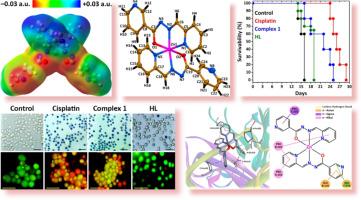
In this work, we report on the synthesis of a novel zinc(II) coordination compound [ZnL2] (1), which was readily obtained from the reaction of Zn(OAc)·2H2O and N′-(pyridin-2-ylmethylene)nicotinohydrazide (HL) in methanol. Recrystallization of 1 from dimethylformamide under ambient conditions allowed to produce yellow block-like crystals of 1·H2O. Complex 1·H2O was characterized by FT-IR and 1H NMR spectroscopy, while its optical properties were studied by UV–vis and spectrofluorimetry in methanol. The crystal structure of the title complex was revealed by single crystal X-ray diffraction and further explored in detail by the Hirshfeld surface analysis. Theoretical investigations based on the DFT calculations have also been applied to show the electronic properties of complex 1. The antitumor activities of the parent ligand HL and complex 1 were studied using Dalton's lymphoma malignant cancer model. Both compounds were found to induce concentration-dependent cytotoxicity and apoptotic cell death, leading to a decrease in cell viability, body weight, and tumor volume in mice with the superior activity of complex 1 over HL. Mice treated with complex 1 demonstrated an increase in life span with a survival period of 23 days. Finally, using a molecular docking approach, we have probed complex 1 to inhibit the recombinant mouse tumor-necrosis factor alpha (mTNF).
期刊介绍:
The Journal of Inorganic Biochemistry is an established international forum for research in all aspects of Biological Inorganic Chemistry. Original papers of a high scientific level are published in the form of Articles (full length papers), Short Communications, Focused Reviews and Bioinorganic Methods. Topics include: the chemistry, structure and function of metalloenzymes; the interaction of inorganic ions and molecules with proteins and nucleic acids; the synthesis and properties of coordination complexes of biological interest including both structural and functional model systems; the function of metal- containing systems in the regulation of gene expression; the role of metals in medicine; the application of spectroscopic methods to determine the structure of metallobiomolecules; the preparation and characterization of metal-based biomaterials; and related systems. The emphasis of the Journal is on the structure and mechanism of action of metallobiomolecules.




 京公网安备 11010802042870号
京ICP备2023020795号-1
京公网安备 11010802042870号
京ICP备2023020795号-1

 分享
分享
 求助内容:
求助内容: 应助结果提醒方式:
 扫码关注我们
