{"title":"揭开小麦减数分裂的神秘面纱。","authors":"Dylan W. Phillips, Andrew Lloyd","doi":"10.1111/nph.19853","DOIUrl":null,"url":null,"abstract":"<p>The gene targeted by Osman <i>et al</i>. was FIDGETIN-like protein one (FIGL1/FIGNL1). This gene encodes a member of the AAA-ATPase (ATPases Associated with diverse cellular Activities) family and, like many AAA-ATPases, forms a hexameric ring structure (Vale, <span>2000</span>; Peng <i>et al</i>., <span>2013</span>). There are two other members of the FIDGETIN sub-family of AAA-ATPases; however, these proteins, FIDGETIN and FIGL2, are only found in vertebrates (Girard <i>et al</i>., <span>2015</span>), so it is likely that FIGL1 plays the ancestral role. FIGL1 is involved in the maintenance of genomic stability through regulation of recombinases RAD51 and DMC1 at sites of both somatic and meiotic DNA repair (Yuan & Chen, <span>2013</span>; Girard <i>et al</i>., <span>2015</span>; Fernandes <i>et al</i>., <span>2018</span>). RAD51 and DMC1 bind to single-stranded overhangs generated by DNA repair enzymes at sites of DNA damage, forming extended nucleoprotein filaments. These filaments are involved in the homology search required to find a template molecule for repair, either the sister-chromatid or homologous chromosome, and once found, mediate strand-exchange.</p><p>FIGL1 is also recruited to sites of DNA repair independently of RAD51 (Yuan & Chen, <span>2013</span>), and promotes the subsequent dissociation of RAD51 and DMC1 (Girard <i>et al</i>., <span>2015</span>; Matsuzaki <i>et al</i>., <span>2019</span>; Yang <i>et al</i>., <span>2022</span>). FIGL1 likely directly promotes the de-oligomerisation of RAD51/DMC1 nucleoprotein filaments as FIGL1 binds both RAD51 and DMC1 (Yuan & Chen, <span>2013</span>; Fernandes <i>et al</i>., <span>2018</span>), is sufficient to promote RAD51 disassembly from ssDNA and dsDNA <i>in vitro</i> (Matsuzaki <i>et al</i>., <span>2019</span>; Ito <i>et al</i>., <span>2023</span>), and AAA-ATPases have a well-characterised role in disassembly of protein complexes (Vale, <span>2000</span>). The unloading of RAD51/DMC1 enables DNA repair enzymes, for example polymerase theta, to access the 3′-OH DNA end, and efficiently repair the break (Li & Heyer, <span>2009</span>). In the absence of FIGL1 in Arabidopsis, rice, and mice, RAD51 and DMC1 foci accumulate at higher levels, with large numbers of DMC1 foci persisting into pachytene in meiosis I (Girard <i>et al</i>., <span>2015</span>; Yang <i>et al</i>., <span>2022</span>; Ito <i>et al</i>., <span>2023</span>), indicating the persistence of potentially highly toxic unresolved double-stranded breaks (DSBs).</p><p>The fate of the persistent RAD51/DMC1-bound DNA ends and/or recombination intermediates in <i>figl1</i> mutants appears to differ between species (Fig. 1). In Arabidopsis, all meiotic DSBs in <i>figl1</i> mutants are faithfully repaired and meiosis progresses as normal through the first meiotic division, though with an overall increase in the number of crossovers (Girard <i>et al</i>., <span>2015</span>). However, rice and wheat, fragmentation and aberrant chromosome associations are observed indicating that some DSBs are not accurately repaired resulting in a significant reduction in, or complete loss of, fertility. Further complicating the picture, maize <i>figl1</i> mutants are fertile but have decreased rather than increased RAD51 and DMC1 foci as well as reduced crossovers (Zhang <i>et al</i>., <span>2023</span>). Clearly, there is a wide phenotypic range associated with the loss of FIGL1 across the plant kingdom, though some of this may be explained by differing effects of the various alleles investigated.</p><p>The overarching goal of Osman <i>et al</i>. was to establish whether the loss of FIGL1 could positively modulate the crossover landscape in wheat, replicating the findings observed in Arabidopsis (Girard <i>et al</i>., <span>2015</span>). Crossovers are unevenly distributed in wheat, a phenomenon observed in many other members of the Poaceae, a large family of grasses that includes the key cereals, with the chromosome ends receiving the bulk of the crossover events. This provides a challenge to breeders interested in bringing into elite lines novel beneficial alleles found in the interstitial regions – a task that is often unfeasible. Several anti-crossover genes have been identified in Arabidopsis, which elevate the rate of crossovers, and if replicated in a cereal crop, would serve to unleash the trapped allelic variation found in these cold regions of the genome.</p><p>The deletion of one such anti-crossover factor, <i>fancm</i>, in wheat (both 4× and 6×), did show elevated levels of crossovers but only in localised regions (Desjardins <i>et al</i>., <span>2022</span>). Unlike the Arabidopsis mutant, the wheat mutants showed a decrease in crossover rate within the interstitial regions, and an increase in the distal. Additionally, barley carrying a mutated copy of <i>recq4</i>, another potent anti-crossover gene in Arabidopsis, doubled the rate of recombination, but their distribution was the same as wild-type plants (preferentially located to the distal regions) (Arrieta <i>et al</i>., <span>2021</span>). The work by Osman <i>et al</i>. yet again highlights the subtle divergence in meiotic processes between wheat and Arabidopsis.</p><p>Taken together, these studies provide a body of evidence that meiosis in the Poaceae is distinctly different from that of Arabidopsis. The same orthologous proteins are conserved across broad family groups, but there are important phenotypic differences between Arabidopsis and crops when these genes are disrupted. This may be due to differences in their precise function, other meiotic differences (e.g. telomere-driven synapsis) or differences in genomic architecture and genome size. Frustratingly, when crossover numbers are elevated in crops, their distribution remains constrained to the distal regions. While studies in Arabidopsis have proven very important for understanding much of the underlying biology of meiosis, Arabidopsis is not a faithful model for more genomically complex crops. Indeed, the inherent variation between related members of the Poaceae, as shown in Fig. 1, highlights the need to carry out relevant research on the crop species of interest. The idea of having a convenient proxy to accelerate our understanding of crops has been weakened by the important findings presented by Osman <i>et al</i>. and other similar studies.</p><p>The selection of Arabidopsis as a model for crop research was pragmatic, but advances in a plethora of areas now make detailed research in the meiotic pathway of bread wheat, and other crops, a viable alternative. The existence of large mutant collections, as exploited by Osman <i>et al</i>., now make it possible to explore the nuanced behaviour of specific genes in complex polyploid genomes. The exploitation of more rapid methods, such as virus-induced gene silencing, offers an alternate route to explore gene function in meiosis. Gene editing techniques have been successfully deployed in the study of meiosis in wheat through the targeting of the <i>TaZIP4-B2</i> gene located in the <i>Ph1</i> locus (Rey <i>et al</i>., <span>2018</span>), a key region on chromosome 5B of wheat that promotes homologous pairing. Further innovation in the gene editing pipeline will only make the generation of specific mutants more achievable.</p><p>Polyploidy is abundant, particularly within our agricultural crops. Every extant angiosperm has passed through a period of polyploidy, implying their formation is readily achievable, but the modifications of the meiotic process that must have occurred are still largely unknown. The study of FIGL1 in two closely related wheat species has uncovered distinctly different phenotypes in the mutant lines, showing how challenging it will be to untangle meiosis in these crops, and emphasises the need to work in the specific crop species. The phenotypic divergence within the Poaceae also highlights that there is much still to be learnt about the biochemical pathways that drive meiosis, and a fuller understanding will be required to resolve these differences. Understanding the subtleties of meiosis and its variation within crops will ultimately enable the creation of novel neopolyploid species that could play a role in safeguarding future food security and be better equipped to survive an ever-changing environment.</p>","PeriodicalId":214,"journal":{"name":"New Phytologist","volume":"244 2","pages":"341-343"},"PeriodicalIF":8.7000,"publicationDate":"2024-05-20","publicationTypes":"Journal Article","fieldsOfStudy":null,"isOpenAccess":false,"openAccessPdf":"https://onlinelibrary.wiley.com/doi/epdf/10.1111/nph.19853","citationCount":"0","resultStr":"{\"title\":\"Unravelling meiosis in wheat\",\"authors\":\"Dylan W. Phillips, Andrew Lloyd\",\"doi\":\"10.1111/nph.19853\",\"DOIUrl\":null,\"url\":null,\"abstract\":\"<p>The gene targeted by Osman <i>et al</i>. was FIDGETIN-like protein one (FIGL1/FIGNL1). This gene encodes a member of the AAA-ATPase (ATPases Associated with diverse cellular Activities) family and, like many AAA-ATPases, forms a hexameric ring structure (Vale, <span>2000</span>; Peng <i>et al</i>., <span>2013</span>). There are two other members of the FIDGETIN sub-family of AAA-ATPases; however, these proteins, FIDGETIN and FIGL2, are only found in vertebrates (Girard <i>et al</i>., <span>2015</span>), so it is likely that FIGL1 plays the ancestral role. FIGL1 is involved in the maintenance of genomic stability through regulation of recombinases RAD51 and DMC1 at sites of both somatic and meiotic DNA repair (Yuan & Chen, <span>2013</span>; Girard <i>et al</i>., <span>2015</span>; Fernandes <i>et al</i>., <span>2018</span>). RAD51 and DMC1 bind to single-stranded overhangs generated by DNA repair enzymes at sites of DNA damage, forming extended nucleoprotein filaments. These filaments are involved in the homology search required to find a template molecule for repair, either the sister-chromatid or homologous chromosome, and once found, mediate strand-exchange.</p><p>FIGL1 is also recruited to sites of DNA repair independently of RAD51 (Yuan & Chen, <span>2013</span>), and promotes the subsequent dissociation of RAD51 and DMC1 (Girard <i>et al</i>., <span>2015</span>; Matsuzaki <i>et al</i>., <span>2019</span>; Yang <i>et al</i>., <span>2022</span>). FIGL1 likely directly promotes the de-oligomerisation of RAD51/DMC1 nucleoprotein filaments as FIGL1 binds both RAD51 and DMC1 (Yuan & Chen, <span>2013</span>; Fernandes <i>et al</i>., <span>2018</span>), is sufficient to promote RAD51 disassembly from ssDNA and dsDNA <i>in vitro</i> (Matsuzaki <i>et al</i>., <span>2019</span>; Ito <i>et al</i>., <span>2023</span>), and AAA-ATPases have a well-characterised role in disassembly of protein complexes (Vale, <span>2000</span>). The unloading of RAD51/DMC1 enables DNA repair enzymes, for example polymerase theta, to access the 3′-OH DNA end, and efficiently repair the break (Li & Heyer, <span>2009</span>). In the absence of FIGL1 in Arabidopsis, rice, and mice, RAD51 and DMC1 foci accumulate at higher levels, with large numbers of DMC1 foci persisting into pachytene in meiosis I (Girard <i>et al</i>., <span>2015</span>; Yang <i>et al</i>., <span>2022</span>; Ito <i>et al</i>., <span>2023</span>), indicating the persistence of potentially highly toxic unresolved double-stranded breaks (DSBs).</p><p>The fate of the persistent RAD51/DMC1-bound DNA ends and/or recombination intermediates in <i>figl1</i> mutants appears to differ between species (Fig. 1). In Arabidopsis, all meiotic DSBs in <i>figl1</i> mutants are faithfully repaired and meiosis progresses as normal through the first meiotic division, though with an overall increase in the number of crossovers (Girard <i>et al</i>., <span>2015</span>). However, rice and wheat, fragmentation and aberrant chromosome associations are observed indicating that some DSBs are not accurately repaired resulting in a significant reduction in, or complete loss of, fertility. Further complicating the picture, maize <i>figl1</i> mutants are fertile but have decreased rather than increased RAD51 and DMC1 foci as well as reduced crossovers (Zhang <i>et al</i>., <span>2023</span>). Clearly, there is a wide phenotypic range associated with the loss of FIGL1 across the plant kingdom, though some of this may be explained by differing effects of the various alleles investigated.</p><p>The overarching goal of Osman <i>et al</i>. was to establish whether the loss of FIGL1 could positively modulate the crossover landscape in wheat, replicating the findings observed in Arabidopsis (Girard <i>et al</i>., <span>2015</span>). Crossovers are unevenly distributed in wheat, a phenomenon observed in many other members of the Poaceae, a large family of grasses that includes the key cereals, with the chromosome ends receiving the bulk of the crossover events. This provides a challenge to breeders interested in bringing into elite lines novel beneficial alleles found in the interstitial regions – a task that is often unfeasible. Several anti-crossover genes have been identified in Arabidopsis, which elevate the rate of crossovers, and if replicated in a cereal crop, would serve to unleash the trapped allelic variation found in these cold regions of the genome.</p><p>The deletion of one such anti-crossover factor, <i>fancm</i>, in wheat (both 4× and 6×), did show elevated levels of crossovers but only in localised regions (Desjardins <i>et al</i>., <span>2022</span>). Unlike the Arabidopsis mutant, the wheat mutants showed a decrease in crossover rate within the interstitial regions, and an increase in the distal. Additionally, barley carrying a mutated copy of <i>recq4</i>, another potent anti-crossover gene in Arabidopsis, doubled the rate of recombination, but their distribution was the same as wild-type plants (preferentially located to the distal regions) (Arrieta <i>et al</i>., <span>2021</span>). The work by Osman <i>et al</i>. yet again highlights the subtle divergence in meiotic processes between wheat and Arabidopsis.</p><p>Taken together, these studies provide a body of evidence that meiosis in the Poaceae is distinctly different from that of Arabidopsis. The same orthologous proteins are conserved across broad family groups, but there are important phenotypic differences between Arabidopsis and crops when these genes are disrupted. This may be due to differences in their precise function, other meiotic differences (e.g. telomere-driven synapsis) or differences in genomic architecture and genome size. Frustratingly, when crossover numbers are elevated in crops, their distribution remains constrained to the distal regions. While studies in Arabidopsis have proven very important for understanding much of the underlying biology of meiosis, Arabidopsis is not a faithful model for more genomically complex crops. Indeed, the inherent variation between related members of the Poaceae, as shown in Fig. 1, highlights the need to carry out relevant research on the crop species of interest. The idea of having a convenient proxy to accelerate our understanding of crops has been weakened by the important findings presented by Osman <i>et al</i>. and other similar studies.</p><p>The selection of Arabidopsis as a model for crop research was pragmatic, but advances in a plethora of areas now make detailed research in the meiotic pathway of bread wheat, and other crops, a viable alternative. The existence of large mutant collections, as exploited by Osman <i>et al</i>., now make it possible to explore the nuanced behaviour of specific genes in complex polyploid genomes. The exploitation of more rapid methods, such as virus-induced gene silencing, offers an alternate route to explore gene function in meiosis. Gene editing techniques have been successfully deployed in the study of meiosis in wheat through the targeting of the <i>TaZIP4-B2</i> gene located in the <i>Ph1</i> locus (Rey <i>et al</i>., <span>2018</span>), a key region on chromosome 5B of wheat that promotes homologous pairing. Further innovation in the gene editing pipeline will only make the generation of specific mutants more achievable.</p><p>Polyploidy is abundant, particularly within our agricultural crops. Every extant angiosperm has passed through a period of polyploidy, implying their formation is readily achievable, but the modifications of the meiotic process that must have occurred are still largely unknown. The study of FIGL1 in two closely related wheat species has uncovered distinctly different phenotypes in the mutant lines, showing how challenging it will be to untangle meiosis in these crops, and emphasises the need to work in the specific crop species. The phenotypic divergence within the Poaceae also highlights that there is much still to be learnt about the biochemical pathways that drive meiosis, and a fuller understanding will be required to resolve these differences. Understanding the subtleties of meiosis and its variation within crops will ultimately enable the creation of novel neopolyploid species that could play a role in safeguarding future food security and be better equipped to survive an ever-changing environment.</p>\",\"PeriodicalId\":214,\"journal\":{\"name\":\"New Phytologist\",\"volume\":\"244 2\",\"pages\":\"341-343\"},\"PeriodicalIF\":8.7000,\"publicationDate\":\"2024-05-20\",\"publicationTypes\":\"Journal Article\",\"fieldsOfStudy\":null,\"isOpenAccess\":false,\"openAccessPdf\":\"https://onlinelibrary.wiley.com/doi/epdf/10.1111/nph.19853\",\"citationCount\":\"0\",\"resultStr\":null,\"platform\":\"Semanticscholar\",\"paperid\":null,\"PeriodicalName\":\"New Phytologist\",\"FirstCategoryId\":\"99\",\"ListUrlMain\":\"https://nph.onlinelibrary.wiley.com/doi/10.1111/nph.19853\",\"RegionNum\":1,\"RegionCategory\":\"生物学\",\"ArticlePicture\":[],\"TitleCN\":null,\"AbstractTextCN\":null,\"PMCID\":null,\"EPubDate\":\"\",\"PubModel\":\"\",\"JCR\":\"Q1\",\"JCRName\":\"PLANT SCIENCES\",\"Score\":null,\"Total\":0}","platform":"Semanticscholar","paperid":null,"PeriodicalName":"New Phytologist","FirstCategoryId":"99","ListUrlMain":"https://nph.onlinelibrary.wiley.com/doi/10.1111/nph.19853","RegionNum":1,"RegionCategory":"生物学","ArticlePicture":[],"TitleCN":null,"AbstractTextCN":null,"PMCID":null,"EPubDate":"","PubModel":"","JCR":"Q1","JCRName":"PLANT SCIENCES","Score":null,"Total":0}
The gene targeted by Osman et al. was FIDGETIN-like protein one (FIGL1/FIGNL1). This gene encodes a member of the AAA-ATPase (ATPases Associated with diverse cellular Activities) family and, like many AAA-ATPases, forms a hexameric ring structure (Vale, 2000; Peng et al., 2013). There are two other members of the FIDGETIN sub-family of AAA-ATPases; however, these proteins, FIDGETIN and FIGL2, are only found in vertebrates (Girard et al., 2015), so it is likely that FIGL1 plays the ancestral role. FIGL1 is involved in the maintenance of genomic stability through regulation of recombinases RAD51 and DMC1 at sites of both somatic and meiotic DNA repair (Yuan & Chen, 2013; Girard et al., 2015; Fernandes et al., 2018). RAD51 and DMC1 bind to single-stranded overhangs generated by DNA repair enzymes at sites of DNA damage, forming extended nucleoprotein filaments. These filaments are involved in the homology search required to find a template molecule for repair, either the sister-chromatid or homologous chromosome, and once found, mediate strand-exchange.
FIGL1 is also recruited to sites of DNA repair independently of RAD51 (Yuan & Chen, 2013), and promotes the subsequent dissociation of RAD51 and DMC1 (Girard et al., 2015; Matsuzaki et al., 2019; Yang et al., 2022). FIGL1 likely directly promotes the de-oligomerisation of RAD51/DMC1 nucleoprotein filaments as FIGL1 binds both RAD51 and DMC1 (Yuan & Chen, 2013; Fernandes et al., 2018), is sufficient to promote RAD51 disassembly from ssDNA and dsDNA in vitro (Matsuzaki et al., 2019; Ito et al., 2023), and AAA-ATPases have a well-characterised role in disassembly of protein complexes (Vale, 2000). The unloading of RAD51/DMC1 enables DNA repair enzymes, for example polymerase theta, to access the 3′-OH DNA end, and efficiently repair the break (Li & Heyer, 2009). In the absence of FIGL1 in Arabidopsis, rice, and mice, RAD51 and DMC1 foci accumulate at higher levels, with large numbers of DMC1 foci persisting into pachytene in meiosis I (Girard et al., 2015; Yang et al., 2022; Ito et al., 2023), indicating the persistence of potentially highly toxic unresolved double-stranded breaks (DSBs).
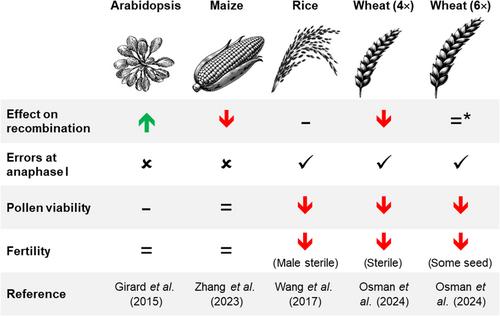
The fate of the persistent RAD51/DMC1-bound DNA ends and/or recombination intermediates in figl1 mutants appears to differ between species (Fig. 1). In Arabidopsis, all meiotic DSBs in figl1 mutants are faithfully repaired and meiosis progresses as normal through the first meiotic division, though with an overall increase in the number of crossovers (Girard et al., 2015). However, rice and wheat, fragmentation and aberrant chromosome associations are observed indicating that some DSBs are not accurately repaired resulting in a significant reduction in, or complete loss of, fertility. Further complicating the picture, maize figl1 mutants are fertile but have decreased rather than increased RAD51 and DMC1 foci as well as reduced crossovers (Zhang et al., 2023). Clearly, there is a wide phenotypic range associated with the loss of FIGL1 across the plant kingdom, though some of this may be explained by differing effects of the various alleles investigated.
The overarching goal of Osman et al. was to establish whether the loss of FIGL1 could positively modulate the crossover landscape in wheat, replicating the findings observed in Arabidopsis (Girard et al., 2015). Crossovers are unevenly distributed in wheat, a phenomenon observed in many other members of the Poaceae, a large family of grasses that includes the key cereals, with the chromosome ends receiving the bulk of the crossover events. This provides a challenge to breeders interested in bringing into elite lines novel beneficial alleles found in the interstitial regions – a task that is often unfeasible. Several anti-crossover genes have been identified in Arabidopsis, which elevate the rate of crossovers, and if replicated in a cereal crop, would serve to unleash the trapped allelic variation found in these cold regions of the genome.
The deletion of one such anti-crossover factor, fancm, in wheat (both 4× and 6×), did show elevated levels of crossovers but only in localised regions (Desjardins et al., 2022). Unlike the Arabidopsis mutant, the wheat mutants showed a decrease in crossover rate within the interstitial regions, and an increase in the distal. Additionally, barley carrying a mutated copy of recq4, another potent anti-crossover gene in Arabidopsis, doubled the rate of recombination, but their distribution was the same as wild-type plants (preferentially located to the distal regions) (Arrieta et al., 2021). The work by Osman et al. yet again highlights the subtle divergence in meiotic processes between wheat and Arabidopsis.
Taken together, these studies provide a body of evidence that meiosis in the Poaceae is distinctly different from that of Arabidopsis. The same orthologous proteins are conserved across broad family groups, but there are important phenotypic differences between Arabidopsis and crops when these genes are disrupted. This may be due to differences in their precise function, other meiotic differences (e.g. telomere-driven synapsis) or differences in genomic architecture and genome size. Frustratingly, when crossover numbers are elevated in crops, their distribution remains constrained to the distal regions. While studies in Arabidopsis have proven very important for understanding much of the underlying biology of meiosis, Arabidopsis is not a faithful model for more genomically complex crops. Indeed, the inherent variation between related members of the Poaceae, as shown in Fig. 1, highlights the need to carry out relevant research on the crop species of interest. The idea of having a convenient proxy to accelerate our understanding of crops has been weakened by the important findings presented by Osman et al. and other similar studies.
The selection of Arabidopsis as a model for crop research was pragmatic, but advances in a plethora of areas now make detailed research in the meiotic pathway of bread wheat, and other crops, a viable alternative. The existence of large mutant collections, as exploited by Osman et al., now make it possible to explore the nuanced behaviour of specific genes in complex polyploid genomes. The exploitation of more rapid methods, such as virus-induced gene silencing, offers an alternate route to explore gene function in meiosis. Gene editing techniques have been successfully deployed in the study of meiosis in wheat through the targeting of the TaZIP4-B2 gene located in the Ph1 locus (Rey et al., 2018), a key region on chromosome 5B of wheat that promotes homologous pairing. Further innovation in the gene editing pipeline will only make the generation of specific mutants more achievable.
Polyploidy is abundant, particularly within our agricultural crops. Every extant angiosperm has passed through a period of polyploidy, implying their formation is readily achievable, but the modifications of the meiotic process that must have occurred are still largely unknown. The study of FIGL1 in two closely related wheat species has uncovered distinctly different phenotypes in the mutant lines, showing how challenging it will be to untangle meiosis in these crops, and emphasises the need to work in the specific crop species. The phenotypic divergence within the Poaceae also highlights that there is much still to be learnt about the biochemical pathways that drive meiosis, and a fuller understanding will be required to resolve these differences. Understanding the subtleties of meiosis and its variation within crops will ultimately enable the creation of novel neopolyploid species that could play a role in safeguarding future food security and be better equipped to survive an ever-changing environment.
期刊介绍:
New Phytologist is an international electronic journal published 24 times a year. It is owned by the New Phytologist Foundation, a non-profit-making charitable organization dedicated to promoting plant science. The journal publishes excellent, novel, rigorous, and timely research and scholarship in plant science and its applications. The articles cover topics in five sections: Physiology & Development, Environment, Interaction, Evolution, and Transformative Plant Biotechnology. These sections encompass intracellular processes, global environmental change, and encourage cross-disciplinary approaches. The journal recognizes the use of techniques from molecular and cell biology, functional genomics, modeling, and system-based approaches in plant science. Abstracting and Indexing Information for New Phytologist includes Academic Search, AgBiotech News & Information, Agroforestry Abstracts, Biochemistry & Biophysics Citation Index, Botanical Pesticides, CAB Abstracts®, Environment Index, Global Health, and Plant Breeding Abstracts, and others.





 京公网安备 11010802042870号
京ICP备2023020795号-1
京公网安备 11010802042870号
京ICP备2023020795号-1

 分享
分享
 求助内容:
求助内容: 应助结果提醒方式:
 扫码关注我们
