{"title":"探索新型嗜热细菌菌株利用甘蔗渣水解物生产生物乳化剂的潜力","authors":"Uroosa Ejaz, Syed Muzammil Zaidi, Saleha Fatima, Musfira Faisal, Muhammad Sohail","doi":"10.1007/s13399-024-05689-w","DOIUrl":null,"url":null,"abstract":"<div><p>Microbial bioemulsifiers are biodegradable and non-toxic compounds that stabilize oil–water emulsions. However, their widespread application necessitates their cost-effective production. The use of agro-wastes in the production medium can substantially reduce costs. This study reports the production of bioemulsifier by thermophilic bacteria using an enzymatic hydrolysate of sugarcane bagasse. Crude cellulase from the bacterial strain was used to saccharify sugarcane bagasse, and the hydrolysate was used as a medium for bioemulsifier production. The results showed that crude cellulase preparation from <i>Brevibacillus borstelensis</i> UE10, <i>Neobacillus sedimentimangrovi</i> UE25, and <i>B. borstelensis</i> UE27 yielded 1.2, 1.5, and 1.6 g L<sup>−1</sup> of reducing sugars in the hydrolysate of sugarcane bagasse. Upon cultivation of these strains in the hydrolysates, 25–35% emulsification indices with bioemulsifier amounts that ranged between 107 and 113 mg mL<sup>−1</sup> were obtained. Based on the screening results and no prior reports on bioemulsifier production by any strain of <i>Neobacillus</i>, <i>N. sedimentimangrovi</i> UE25 was selected for statistical optimization of bioemulsifier production. Plackett–Burman design revealed significant effect of pH and incubation period which were optimized by central composite design. Under optimized conditions of temperature 60 °C, inoculum size 5%, NaCl and glucose concentration 0.5%, peptone concentration 1%, pH 7.6, and incubation period of 37.98 h, a 52% emulsification index was obtained. Moreover, structural analysis of the saccharified substrate by crude cellulase preparation using scanning electron microscopy and nuclear magnetic resonance revealed the removal of the cellulosic content. This bioemulsifier from a less-studied thermophilic bacterial strain makes it an interesting biotechnological product for various environmental and industrial applications.</p><h3>Graphical Abstract</h3>\n<div><figure><div><div><picture><source><img></source></picture></div></div></figure></div></div>","PeriodicalId":488,"journal":{"name":"Biomass Conversion and Biorefinery","volume":"15 :","pages":"8351 - 8363"},"PeriodicalIF":4.3000,"publicationDate":"2024-05-22","publicationTypes":"Journal Article","fieldsOfStudy":null,"isOpenAccess":false,"openAccessPdf":"","citationCount":"0","resultStr":"{\"title\":\"Exploring the potential of novel thermophilic bacterial strain for the production of bioemulsifiers using the hydrolysate of sugarcane bagasse\",\"authors\":\"Uroosa Ejaz, Syed Muzammil Zaidi, Saleha Fatima, Musfira Faisal, Muhammad Sohail\",\"doi\":\"10.1007/s13399-024-05689-w\",\"DOIUrl\":null,\"url\":null,\"abstract\":\"<div><p>Microbial bioemulsifiers are biodegradable and non-toxic compounds that stabilize oil–water emulsions. However, their widespread application necessitates their cost-effective production. The use of agro-wastes in the production medium can substantially reduce costs. This study reports the production of bioemulsifier by thermophilic bacteria using an enzymatic hydrolysate of sugarcane bagasse. Crude cellulase from the bacterial strain was used to saccharify sugarcane bagasse, and the hydrolysate was used as a medium for bioemulsifier production. The results showed that crude cellulase preparation from <i>Brevibacillus borstelensis</i> UE10, <i>Neobacillus sedimentimangrovi</i> UE25, and <i>B. borstelensis</i> UE27 yielded 1.2, 1.5, and 1.6 g L<sup>−1</sup> of reducing sugars in the hydrolysate of sugarcane bagasse. Upon cultivation of these strains in the hydrolysates, 25–35% emulsification indices with bioemulsifier amounts that ranged between 107 and 113 mg mL<sup>−1</sup> were obtained. Based on the screening results and no prior reports on bioemulsifier production by any strain of <i>Neobacillus</i>, <i>N. sedimentimangrovi</i> UE25 was selected for statistical optimization of bioemulsifier production. Plackett–Burman design revealed significant effect of pH and incubation period which were optimized by central composite design. Under optimized conditions of temperature 60 °C, inoculum size 5%, NaCl and glucose concentration 0.5%, peptone concentration 1%, pH 7.6, and incubation period of 37.98 h, a 52% emulsification index was obtained. Moreover, structural analysis of the saccharified substrate by crude cellulase preparation using scanning electron microscopy and nuclear magnetic resonance revealed the removal of the cellulosic content. This bioemulsifier from a less-studied thermophilic bacterial strain makes it an interesting biotechnological product for various environmental and industrial applications.</p><h3>Graphical Abstract</h3>\\n<div><figure><div><div><picture><source><img></source></picture></div></div></figure></div></div>\",\"PeriodicalId\":488,\"journal\":{\"name\":\"Biomass Conversion and Biorefinery\",\"volume\":\"15 :\",\"pages\":\"8351 - 8363\"},\"PeriodicalIF\":4.3000,\"publicationDate\":\"2024-05-22\",\"publicationTypes\":\"Journal Article\",\"fieldsOfStudy\":null,\"isOpenAccess\":false,\"openAccessPdf\":\"\",\"citationCount\":\"0\",\"resultStr\":null,\"platform\":\"Semanticscholar\",\"paperid\":null,\"PeriodicalName\":\"Biomass Conversion and Biorefinery\",\"FirstCategoryId\":\"5\",\"ListUrlMain\":\"https://link.springer.com/article/10.1007/s13399-024-05689-w\",\"RegionNum\":4,\"RegionCategory\":\"工程技术\",\"ArticlePicture\":[],\"TitleCN\":null,\"AbstractTextCN\":null,\"PMCID\":null,\"EPubDate\":\"\",\"PubModel\":\"\",\"JCR\":\"Q3\",\"JCRName\":\"ENERGY & FUELS\",\"Score\":null,\"Total\":0}","platform":"Semanticscholar","paperid":null,"PeriodicalName":"Biomass Conversion and Biorefinery","FirstCategoryId":"5","ListUrlMain":"https://link.springer.com/article/10.1007/s13399-024-05689-w","RegionNum":4,"RegionCategory":"工程技术","ArticlePicture":[],"TitleCN":null,"AbstractTextCN":null,"PMCID":null,"EPubDate":"","PubModel":"","JCR":"Q3","JCRName":"ENERGY & FUELS","Score":null,"Total":0}
Exploring the potential of novel thermophilic bacterial strain for the production of bioemulsifiers using the hydrolysate of sugarcane bagasse
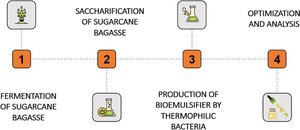
Microbial bioemulsifiers are biodegradable and non-toxic compounds that stabilize oil–water emulsions. However, their widespread application necessitates their cost-effective production. The use of agro-wastes in the production medium can substantially reduce costs. This study reports the production of bioemulsifier by thermophilic bacteria using an enzymatic hydrolysate of sugarcane bagasse. Crude cellulase from the bacterial strain was used to saccharify sugarcane bagasse, and the hydrolysate was used as a medium for bioemulsifier production. The results showed that crude cellulase preparation from Brevibacillus borstelensis UE10, Neobacillus sedimentimangrovi UE25, and B. borstelensis UE27 yielded 1.2, 1.5, and 1.6 g L−1 of reducing sugars in the hydrolysate of sugarcane bagasse. Upon cultivation of these strains in the hydrolysates, 25–35% emulsification indices with bioemulsifier amounts that ranged between 107 and 113 mg mL−1 were obtained. Based on the screening results and no prior reports on bioemulsifier production by any strain of Neobacillus, N. sedimentimangrovi UE25 was selected for statistical optimization of bioemulsifier production. Plackett–Burman design revealed significant effect of pH and incubation period which were optimized by central composite design. Under optimized conditions of temperature 60 °C, inoculum size 5%, NaCl and glucose concentration 0.5%, peptone concentration 1%, pH 7.6, and incubation period of 37.98 h, a 52% emulsification index was obtained. Moreover, structural analysis of the saccharified substrate by crude cellulase preparation using scanning electron microscopy and nuclear magnetic resonance revealed the removal of the cellulosic content. This bioemulsifier from a less-studied thermophilic bacterial strain makes it an interesting biotechnological product for various environmental and industrial applications.
期刊介绍:
Biomass Conversion and Biorefinery presents articles and information on research, development and applications in thermo-chemical conversion; physico-chemical conversion and bio-chemical conversion, including all necessary steps for the provision and preparation of the biomass as well as all possible downstream processing steps for the environmentally sound and economically viable provision of energy and chemical products.




 京公网安备 11010802042870号
京ICP备2023020795号-1
京公网安备 11010802042870号
京ICP备2023020795号-1

 分享
分享
 求助内容:
求助内容: 应助结果提醒方式:
 扫码关注我们
